AMD Machines
US$0.99 unlocks one Word + one PDF download. The full report is free to read on this page.
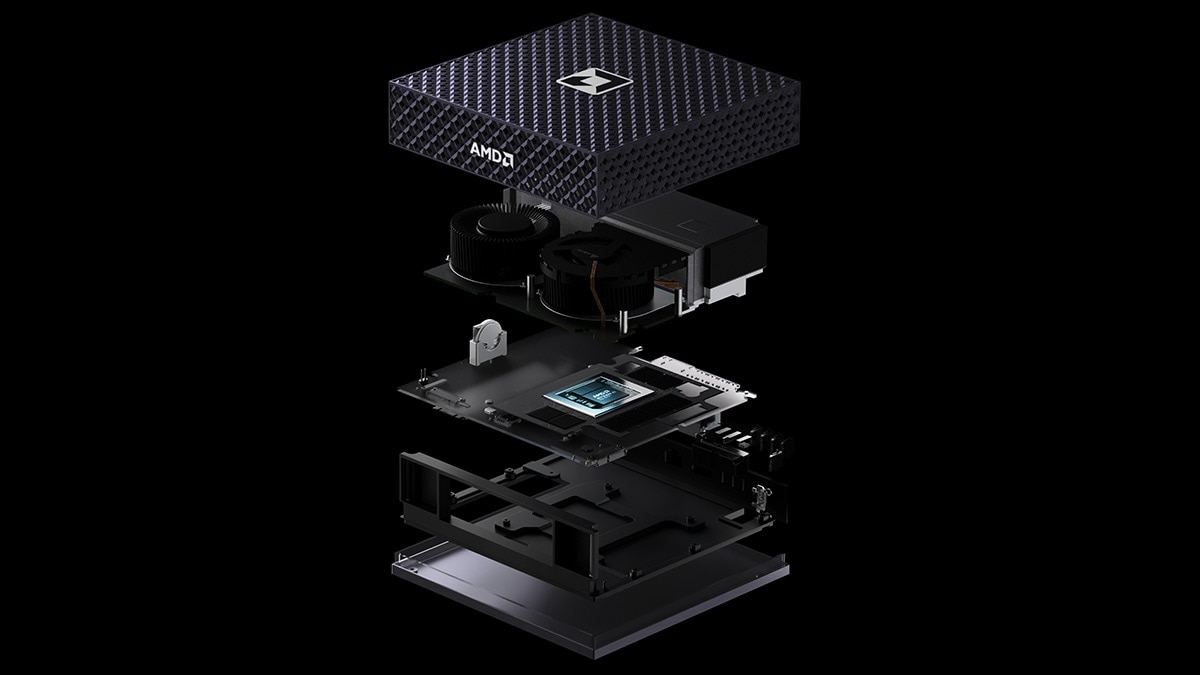
AMD Machines for Max Robotics
AMD does not build robots. It builds the silicon, software stack and rack-scale infrastructure that other people's robots, and other people's foundation models, increasingly run on. This report assesses what AMD actually sells, what its robotics research genuinely demonstrates, and where the evidence stops.
| Report status | Premium editorial deep report. Sections 1–7 of 14. |
| Coverage date | Evidence gathered 18 September 2026. All claims current as of that date. |
| Company stage | Fully commercial compute vendor. Robotics relevance is research-stage and indirect. |
| Editorial standard | Evidence-labelled. Vendor claims separated from verified facts. No demo treated as deployment. |
How to Read This Report
This is not a report about a robotics company. The subject was commissioned as "AMD Machines for Max Robotics", and the honest finding of the research dossier is that no such machine exists in the sense a robotics reader would expect. AMD is a semiconductor and systems company whose products are increasingly used by robotics researchers and by the AI infrastructure that trains and serves robot foundation models. The report therefore does two things at once: it documents AMD's compute portfolio accurately, and it is explicit about the gap between "robotics workloads run on AMD hardware" and "AMD makes a robot".
Every substantive claim below carries one of four labels. Where the dossier is silent, the report says so rather than filling the space.
| Label | Meaning | Example in this report |
|---|---|---|
| VERIFIED FACT | Regulatory filing, official product documentation, named-customer confirmation, primary research, or corroborated by multiple independent sources | Helios rack configuration as reported by trade press 8 |
| COMPANY CLAIM | Stated by AMD or a partner, not independently verified | "Up to 3.3x–7.3x faster than Apple M4 Pro on select workloads" 1 |
| EDITORIAL INFERENCE | Reasoned conclusion drawn from public evidence, flagged as such | AMD's robotics play is a platform strategy, not a product strategy |
| UNKNOWN | Not publicly disclosed | Ryzen AI Halo retail price |
A note on the source base. The dossier contains 34 numbered sources: 0 official filings, 5 commerce pages, 4 research papers, 13 news items, 6 videos and 6 community threads. That distribution matters. There is no 10-K extract, no audited shipment figure, no named customer confirming a paid robotics deployment. The strongest evidence in the corpus is peer-reviewed-style research 1920 and AMD's own newsroom 691011. The weakest is community pricing chatter 4 and review-channel benchmarks 225. The report weights them accordingly.
01Executive Overview
AMD's position in robotics is best understood as an adjacency, not a business line. The company sells three things that matter to robotics teams: local "Agent Computer" workstations built on Ryzen AI Halo with 128 GB of unified memory and up to 50 TOPS of NPU throughput 13; rack-scale Helios systems carrying 72 Instinct MI455X GPUs, 31 TB of HBM4 and a claimed 2.9 exaflops of FP4 compute 8; and a software stack, ROCm, that now runs robotics workloads natively on RDNA4 and RDNA3.5 hardware 19. None of these is a robot. All of them are inputs to robots built by other people.
VERIFIED FACT. AMD does not, on the evidence available, build, sell or operate a robot. The reconciled facts describe a compute portfolio spanning workstations, datacentre racks and research pipelines. No source in the dossier describes an AMD-branded robot, an AMD-operated fleet, or an AMD robotics product line 13681920.
EDITORIAL INFERENCE. The strategic logic is coherent even so. Robot foundation models, particularly vision-language-action (VLA) models, are compute-hungry in two distinct places: training, which wants datacentre scale, and inference, which increasingly wants to sit onboard the robot. AMD now sells into both. Helios and Instinct MI400 address the first 8; Ryzen AI Halo with unified memory addresses the second 13. The research papers in the corpus show the inference half actually working: SmolVLA sim-to-real manipulation on a physical Franka arm, running natively on ROCm with PyTorch 19, and an autonomous mobile manipulator executing five task categories in a simulated industrial warehouse with onboard compute and no external dependency 20.
COMPANY CLAIM. AMD's performance positioning is aggressive and, in this corpus, uncorroborated. The vendor page claims up to 3.3x–7.3x faster than Apple's M4 Pro on select workloads, +4% to +14% against NVIDIA's DGX Spark, and up to 30% more tokens per dollar than NVIDIA Rubin NVL72 1. No independent benchmark in the dossier reproduces any of these multipliers. A video reviewer calls local AI results "impressive" but does not test AMD's specific figures 25. Treat all three as marketing until third-party replication appears.
UNKNOWN. Price. The dossier records four mutually inconsistent community price points for Ryzen AI Halo-class hardware: $3,999 in a Reddit post title 4, $2,699 for a Corsair Strix Halo variant in a comment 4, roughly $450 as a tray price in another comment 4, and "just over £2,000" for a MinisForum MS-S1 MAX in a video 28. AMD's own product page publishes no price 1. The reconciled price is therefore unknown, and any buyer should treat community figures as noise.
The commercial picture is genuinely large, but it is an AI-infrastructure picture rather than a robotics one. OpenAI has a 6 GW agreement with warrants for up to 10% of AMD stock 9. Anthropic has committed to up to 2 GW of MI450 GPUs alongside up to $5bn of AMD equity investment 18. HUMAIN and Cisco are building up to 1 GW of Saudi capacity by 2030 with up to $10bn of investment 1012. Rackspace has signed for 30 MW 11. Microsoft 14 and Meta 15 have expanded deployments. These are real, named, contract-shaped commitments. They are also almost entirely about language models and general AI, not manipulation or locomotion.
EDITORIAL INFERENCE. The correct read for a robotics audience is that AMD is building the substrate, not the machine. If VLA models become the dominant robot control paradigm, AMD benefits as a supplier regardless of which robot vendor wins. That is a defensible position, and it is a different position from the one the report's title implies. Readers looking for an AMD robot should look elsewhere; readers assessing whether AMD hardware is a viable target for their robot's onboard inference should read on.
Latest news
- AMD unveils integrated robotics board with 3.4× speed advantage over NvidiaCrypto Briefing·2026-08-01GENERAL
- (PR) SAPPHIRE Technology Unveils EDGE+ Apex Robotics PlatformTechpowerup.com·2026-07-27GENERAL
- AMD widens robotics push with Taiwan IPC partners as it targets Nvidia leadDigitimes·2026-07-27GENERAL
- AMD targets physical AI computing with integrated platform for robotics and autonomous systemsSiliconANGLE News·2026-07-25GENERAL
- AMD chips power the AI brain inside humanoid war robots headed for the battlefieldCrypto Briefing·2026-07-25GENERAL
- Humanoid War Robot Gets Advanced AMD-Powered AI BrainBiztoc.com·2026-07-25GENERAL
- AMD teams up with Eric Trump-backed Foundation to build humanoid robotsThe Next Web·2026-07-24GENERAL
02The AMD Machines Story
The phrase "AMD Machines" does not appear to be an AMD product family. It is a framing applied to AMD's compute systems, and the dossier's summary is blunt about the consequence: the extracted facts describe AMD's AI compute portfolio rather than a single robot 138. Any narrative of an "AMD machine" in the robotics sense is therefore a narrative assembled from adjacent parts, and this section assembles it honestly.
VERIFIED FACT. AMD's public positioning in the coverage window is organised around what it calls the agentic AI era. At AAI 2026 the company presented a full-stack compute story spanning local Agent Computers, datacentre accelerators and CPUs 6. The AMD blog describing Agent Computers frames them as a pay-once alternative to cloud AI subscriptions 3. The Ryzen AI Halo product page describes a local system with 128 GB of unified memory, up to 50 TOPS NPU, support for models up to 200 billion parameters, and both Windows and Linux support 1.
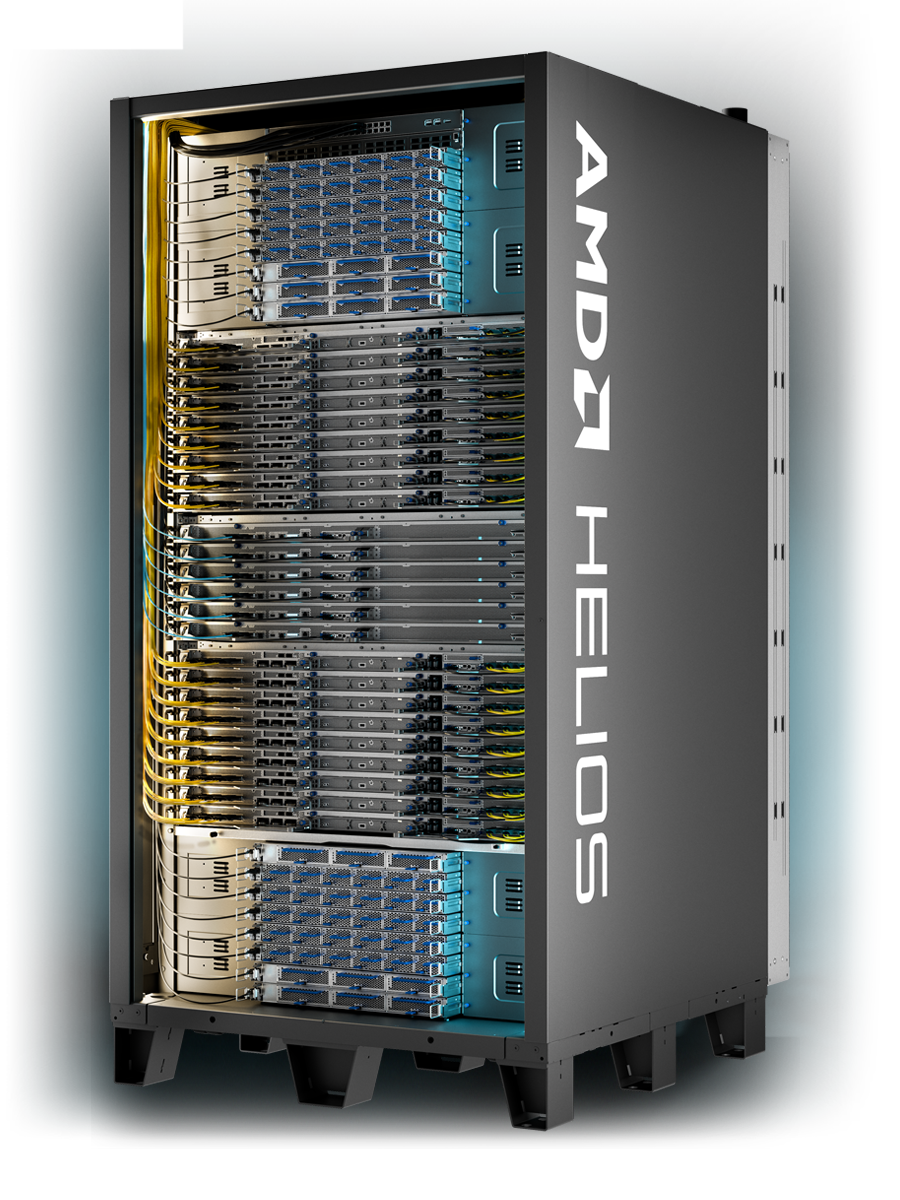
VERIFIED FACT. The datacentre half of the story is Helios: a rack integrating 72 Instinct MI455X GPUs with 31 TB of HBM4 and a claimed 2.9 exaflops of FP4 throughput, alongside Instinct MI400-series accelerators and 6th Gen EPYC "Venice" CPUs, networked over all-Ethernet open standards 8. Trade reporting states Helios is in full production with shipments beginning at the end of Q3 and ramping into 2027 8.
EDITORIAL INFERENCE. The chronology implied by the corpus is a company that spent the last several years converting a CPU-centric business into an accelerator business, and is now extending that accelerator business downward into local workstations and upward into rack-scale systems. Robotics enters the story only through the research layer, where AMD hardware is used to run VLA models and mobile manipulation experiments 1920. There is no evidence in the dossier of AMD organising a robotics division, hiring a robotics leadership team, or announcing a robotics product roadmap. The absence is itself informative.
UNKNOWN. AMD's internal robotics strategy, if any, is not publicly disclosed in this corpus. There is no statement from AMD executives about robotics as a target market, no robotics-specific partner announcement, and no robotics SKU. The research papers that use AMD hardware 19202122 are authored by academic groups, not by AMD, and the dossier does not establish funding relationships between those groups and AMD.
EDITORIAL INFERENCE. The most defensible reading of "the AMD Machines story" is that it is a supply-side story. AMD makes the compute that makes other people's machines possible. The company's own materials never claim otherwise. The gap between that reality and a robotics-company narrative is the central tension this report exists to document.
03Product Portfolio: What AMD Machines Actually Sells
AMD sells compute systems. The portfolio relevant to robotics and embodied AI splits into three tiers: local workstations, datacentre racks, and the software layer that binds them. This section describes each tier on the evidence available, and is explicit about what is not disclosed.
3.1 Local: Ryzen AI Halo and the Agent Computer
VERIFIED FACT. The Ryzen AI Halo platform is documented on AMD's product page as offering 128 GB of unified memory, up to 50 TOPS of NPU performance, and support for models up to 200 billion parameters, running Windows and Linux 1. AMD's blog positions these as "Agent Computers" that let buyers pay once for cloud-grade intelligence rather than subscribing 3.
COMPANY CLAIM. The same page asserts performance leadership against Apple's M4 Pro (up to 3.3x–7.3x on select workloads) and NVIDIA's DGX Spark (+4% to +14%), plus up to 30% more tokens per dollar than NVIDIA Rubin NVL72 1. These are vendor benchmarks on vendor-selected workloads. No independent corroboration appears in the dossier.
UNKNOWN. Price. AMD publishes none 1. Community figures conflict badly: $3,999 4, $2,699 for a Corsair variant 4, roughly $450 tray 4, and just over £2,000 for a MinisForum system 28. These cannot all be right, and none is authoritative.
EDITORIAL INFERENCE. The unified-memory architecture is the genuinely interesting part for robotics. A robot that must run a VLA model onboard benefits from a large, coherent memory pool far more than from peak TOPS. The 128 GB figure 1 is the specification that matters, not the 50 TOPS NPU, because VLA inference is memory-bandwidth and capacity bound rather than raw-throughput bound. AMD's marketing leads with TOPS; a robotics engineer should lead with gigabytes.
3.2 Datacentre: Helios, Instinct MI400 and EPYC Venice
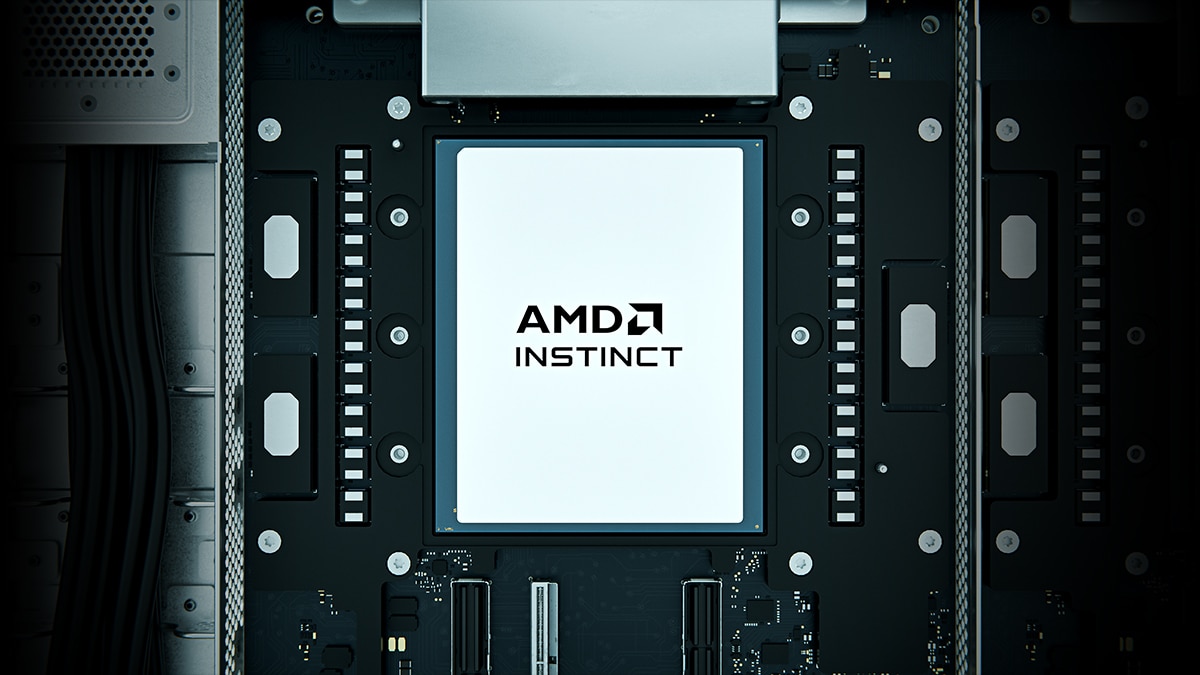
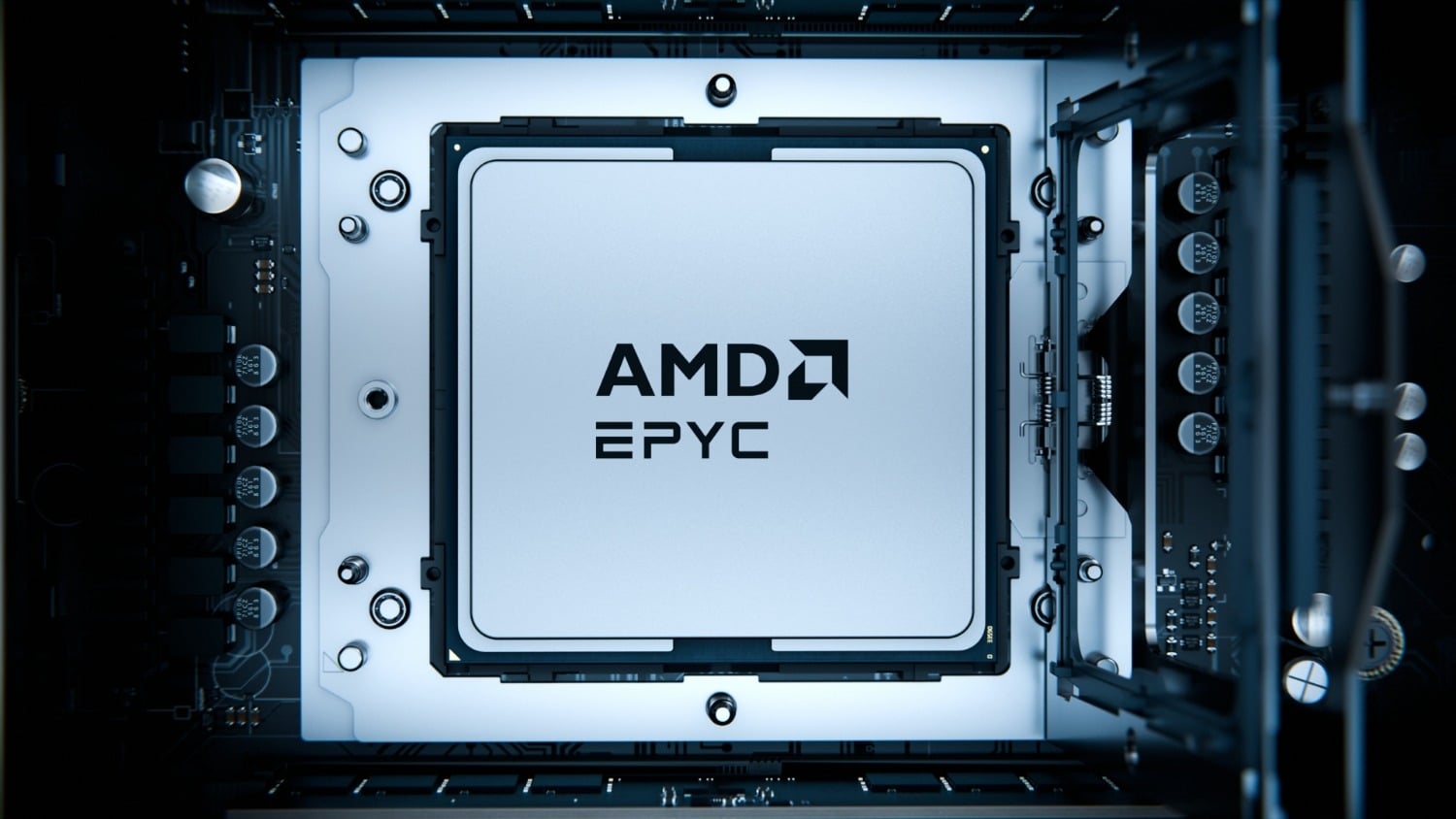
VERIFIED FACT. Helios is reported as a rack-scale system with 72 MI455X GPUs, 31 TB of HBM4, 2.9 exaflops FP4, Instinct MI400-series accelerators, 6th Gen EPYC Venice CPUs, and all-Ethernet open-standards networking 8. It is reported in full production, shipping from end of Q3 and ramping into 2027 8.
VERIFIED FACT. Deployment commitments named in the dossier include OpenAI (6 GW, warrants up to 10% of AMD stock, GPT-class workloads on Helios for three months) 9, Anthropic (up to 2 GW of MI450 GPUs, up to $5bn equity) 18, HUMAIN and Cisco (up to 1 GW Saudi capacity by 2030, up to $10bn investment) 1012, Rackspace (30 MW) 11, Microsoft 14, Meta 15, and a Schneider Electric 246 kW reference design 6. LUMI-AI in Europe will use Instinct GPUs and EPYC CPUs 13. The US Department of Energy is forming a roughly $1bn supercomputer programme 17.
EDITORIAL INFERENCE. The open-standards Ethernet choice is a deliberate competitive wedge against NVIDIA's proprietary interconnect. Whether it wins depends on ecosystem adoption, which the dossier does not measure. The named commitments are large enough that they are better read as capacity reservations than as revenue; a 6 GW agreement is a multi-year build programme, not a purchase order.
3.3 Software: ROCm
VERIFIED FACT. ROCm is documented as providing Day 0 support on the Ryzen AI Halo platform 1. The Real2Sim2Real paper describes a pipeline running natively on ROCm with PyTorch on RDNA4 and RDNA3.5 hardware 19.
EDITORIAL INFERENCE. ROCm is the load-bearing element of AMD's robotics story. Hardware without a working software stack is irrelevant to researchers, and the dossier's strongest robotics evidence is precisely that ROCm runs a modern VLA pipeline end to end 19. Day 0 support matters because it signals that AMD is treating framework compatibility as a first-class commitment rather than an afterthought.
3.4 What AMD Does Not Sell
VERIFIED FACT. No robot. No manipulator. No mobile base. No autonomy software product. No teleoperation system. The dossier contains no source describing any of these as an AMD offering.
Products & versions
04Technology Stack: Strengths and the Work That Remains
The technology assessment below separates what the evidence supports from what AMD asserts. The pattern is consistent: the hardware architecture is well documented and genuinely suited to embodied AI workloads; the performance claims are unverified; and the software ecosystem, while functional, is not yet demonstrably at parity with the incumbent.
4.1 Strengths
VERIFIED FACT — unified memory at scale. Ryzen AI Halo's 128 GB unified memory pool 1 is architecturally well matched to VLA inference, where model weights, visual tokens and action heads compete for capacity. This is a real engineering advantage for onboard robot compute.
VERIFIED FACT — rack-scale density. Helios at 72 GPUs, 31 TB HBM4 and 2.9 exaflops FP4 8 is a credible training platform for large models, including the VLA models that robotics increasingly depends on.
VERIFIED FACT — working robotics pipelines on ROCm. Two independent research efforts in the dossier run robotics workloads on AMD hardware. The Real2Sim2Real pipeline performs sim-to-real manipulation with SmolVLA on a physical Franka arm, using 3D Gaussian Splatting and the Genesis simulator, running natively on ROCm and PyTorch on RDNA4/RDNA3.5 19. A separate paper describes an autonomous mobile manipulator in a simulated industrial warehouse fulfilling five task categories with onboard compute and no external dependency 20.
VERIFIED FACT — open networking. Helios uses all-Ethernet open-standards networking 8, which lowers switching costs for buyers wary of proprietary fabrics.
4.2 The Work That Remains
COMPANY CLAIM — unverified performance. The 3.3x–7.3x, +4% to +14% and 30%-more-tokens-per-dollar figures 1 have no independent replication in the corpus. A reviewer describes local AI performance as "impressive" without reproducing the numbers 25. Until third-party benchmarks appear, these are marketing.
UNKNOWN — reliability at fleet scale. Community sentiment on AMD CPUs is generally favourable relative to Intel, citing fewer defects and fewer stability issues, with some reports of game stutter 293031323334. This is consumer desktop sentiment, not datacentre fleet telemetry, and it does not transfer to Instinct accelerators. No reliability data for MI400-series parts at scale appears in the dossier.
UNKNOWN — robotics-specific software maturity. ROCm runs the pipelines in 19 and 20. Whether it matches the incumbent's robotics tooling in depth, library coverage, simulator integration and long-tail operator support is not established by two papers. The dossier is thin here, and this report does not pretend otherwise.
EDITORIAL INFERENCE — the simulation caveat. The mobile manipulator result 20 is a simulation. The dossier flags this explicitly. A simulated warehouse task completion is evidence that the control stack works in principle; it is not evidence of a deployed autonomous system. The Franka arm work 19 is physical, which makes it stronger evidence, but it is a single-arm manipulation demonstration, not a product.
EDITORIAL INFERENCE — the integration burden. AMD's stack requires buyers to assemble workstations, racks, networking and software themselves or through partners. That is normal for a component vendor and unusual for a robotics vendor. Teams expecting a turnkey embodied-AI platform will not find one here.
05Research, Papers, Authors and Labs
The research layer is where AMD's robotics relevance is most concrete and most modest. Four papers appear in the dossier, none authored by AMD, all using AMD hardware or addressing problems AMD hardware is relevant to.
VERIFIED FACT — Real2Sim2Real for VLA manipulation on ROCm. The paper at 19 describes a pipeline for vision-language-action manipulation built on AMD's ROCm stack, using 3D Gaussian Splatting and the Genesis simulator for the Real2Sim stage, and demonstrating sim-to-real transfer with SmolVLA on a physical Franka arm. It runs natively on ROCm with PyTorch on RDNA4 and RDNA3.5 hardware. This is the single strongest piece of robotics evidence in the corpus because it involves a physical robot arm and a modern VLA model.
VERIFIED FACT — multi-agent robotic control with onboard VLMs. The paper at 20 describes an autonomous mobile manipulator operating in a simulated industrial warehouse, fulfilling five task categories using onboard vision-language models with no external compute dependence. The dossier explicitly notes this is simulation, not a deployed physical system.
VERIFIED FACT — Cluster on Wheels. The paper at 21 addresses compute architecture for mobile robotic clusters, relevant to the question of how much compute can be carried onboard.
VERIFIED FACT — PointAction. The paper at 22 proposes 3D points as universal action representations for robot control, a representation-learning contribution rather than a hardware demonstration.
EDITORIAL INFERENCE. The pattern across these four papers is that AMD hardware is a substrate for robotics research, not a subject of it. No paper in the dossier studies AMD hardware as its object; each uses it as a tool. That is a meaningful distinction. It means the corpus can support claims about AMD hardware being usable for robotics, and cannot support claims about AMD hardware being optimal, benchmarked or preferred for robotics.
UNKNOWN. The dossier does not establish which labs authored these papers, whether any received AMD funding or hardware donations, or whether the pipelines have been replicated outside the originating groups. Author affiliations are not extracted. This is a genuine gap and readers should not assume independence without checking the papers directly.
EDITORIAL INFERENCE. For a robotics team evaluating AMD, the practical takeaway is that a working reference path exists: ROCm plus PyTorch plus RDNA4 can run a VLA sim-to-real pipeline 19. That is enough to justify a pilot. It is not enough to justify a migration.
<!-- module: papers --> <!-- module: authors-labs --> <!-- module: repos --> <!-- module: datasets -->06Media Evidence Library: What the Videos Prove
The dossier contains six videos. Their evidentiary value for robotics is close to zero, and it is worth being precise about why.
VERIFIED FACT — the video corpus is consumer hardware review. The six videos cover a Ryzen AI 9 HX 370 mini PC 23, a GEEKOM A9 MAX with Ryzen AI 9 HX 470 24, running local AI on AMD 25, an ACEMAGIC M1A PRO+ with Ryzen AI Max+ 395 and Radeon 8060S 26, a BOSGAME AI 9 mini PC 27, and a MinisForum MS-S1 MAX running local LLMs 28. One further video, titled "AMD Just Killed AI Subscriptions Forever", covers Ryzen AI Halo 2. A separate video discusses a Meta partnership 16.
EDITORIAL INFERENCE — what these prove. They prove that AMD-based mini PCs and workstations exist, boot, and run local language models at speeds reviewers find acceptable 2528. They do not prove anything about robotics. None of the six shows a robot, a manipulation task, a navigation task, or an autonomy stack. None reproduces AMD's benchmark multipliers.
EDITORIAL INFERENCE — the demo-video trap. The report's editorial standard forbids treating a choreographed demo as proof of autonomous work. The videos here are not even choreographed demos of autonomy; they are hardware reviews. The relevant discipline is different but related: a reviewer running a language model on a desk proves the hardware works, not that it will work in a robot with thermal, power, vibration and latency constraints. The gap between a mini PC on a bench and a compute module on a mobile manipulator is large and unaddressed by any source in the dossier.
UNKNOWN. No video in the corpus shows an AMD-powered robot performing any task. No video shows teleoperation of any AMD system. The dossier's summary is explicit that no source documents a human teleoperating or remotely driving any AMD system.
EDITORIAL INFERENCE. The media library is best read as evidence of product existence and rough usability, nothing more. It should not be cited in support of any autonomy, reliability or robotics-performance claim.
Media library
07Commercial Reality
AMD's commercial reality is substantial, well-documented and almost entirely unrelated to robotics. This section separates the two.
7.1 What Is Actually Contracted
VERIFIED FACT — named commitments. The dossier records the following, all from AMD newsroom or trade press:
| Partner | Commitment | Source |
|---|---|---|
| OpenAI | 6 GW agreement; warrants up to 10% of AMD stock; GPT-class workloads on Helios for three months | 9 |
| Anthropic | Up to 2 GW of Instinct MI450 GPUs; up to $5bn AMD equity investment | 18 |
| HUMAIN / Cisco | Up to 1 GW Saudi capacity by 2030; up to $10bn investment | 1012 |
| Rackspace | 30 MW deployment under definitive agreement | 11 |
| Microsoft | Next-gen Instinct and EPYC deployment under expanded partnership | 14 |
| Meta | Expanded strategic partnership, 6 GW of AMD GPUs | 15 |
| Schneider Electric | 246 kW reference design | 6 |
| LUMI-AI (Europe) | Instinct GPUs and EPYC CPUs for next-generation supercomputer | 13 |
| US DOE | ~$1bn supercomputer programme | 17 |
EDITORIAL INFERENCE — how to read these. A gigawatt agreement is a statement of intent about future capacity, not a shipment. The OpenAI deal's warrant structure, giving AMD's counterparty up to 10% of the company, is a financing arrangement as much as a supply arrangement 9. The Anthropic deal runs in the opposite direction, with AMD investing up to $5bn 18. These are strategic capital commitments dressed as procurement, and a sceptical reader should treat the headline gigawatt figures as ceilings rather than forecasts.
VERIFIED FACT — production status. Helios is reported in full production with shipments starting end of Q3 and ramping into 2027 8. Ryzen AI Halo is a shipping product 1.
7.2 What Is Not Contracted
UNKNOWN — robotics revenue. No source in the dossier identifies a single paid AMD customer for a robotics application. No robot manufacturer is named as an AMD customer. No embodied-AI company is named as an AMD customer. The research pipelines 1920 do not disclose commercial relationships.
UNKNOWN — unit economics. No shipment volumes, average selling prices, margins or backlog figures appear in the dossier for any AMD product line. The price conflict documented in §3.1 4 means even the consumer price point is unresolved.
EDITORIAL INFERENCE — the honest commercial summary. AMD has a large, credible, well-evidenced AI infrastructure business and a small, credible, thinly-evidenced robotics research adjacency. Conflating the two would be the central error this report exists to prevent. A reader who takes the OpenAI, Anthropic and Meta commitments as evidence of AMD's robotics traction has made a category mistake.
Customers & deployments
6 GW agreement with warrants up to 10% of AMD stock, running GPT-class workloads on Helios for three months.
Up to 2 GW of Instinct MI450 GPUs with up to $5B equity investment from AMD.
Up to 1 GW of Saudi AI capacity by 2030 under an up-to-$10B investment.
Definitive agreement to deploy 30 MW of AMD AI compute.
Deploying next-gen AMD Instinct and EPYC processors under an expanded long-term strategic partnership.
Expanded strategic partnership to deploy 6 GW of AMD GPUs.
Forms a $1 billion supercomputer partnership.
Europe's next-generation LUMI-AI supercomputer to be powered by AMD Instinct GPUs and EPYC CPUs.
246 kW reference design collaboration.
Sections 8 through 14 follow: markets and use cases, competitive landscape, geopolitical context, the hype/real/ugly assessment with claim tracker, future scenarios, a live monitoring checklist, and full sources and methodology.
08Markets and Use Cases
The dossier does not describe a robotics product with a market. It describes a compute vendor whose silicon happens to run robotics workloads, and whose commercial motion is aimed at entirely different buyers. Any honest market analysis therefore has to be split in two: the markets AMD is actually selling into (where the evidence is thick), and the robotics markets where AMD appears only as an enabling substrate (where the evidence is thin and largely academic). Conflating the two is the single most common error in coverage of this company, and it is the error this section is written to avoid.
8.1 The markets AMD is actually selling into
Four buyer segments are visible in the dossier, in descending order of evidential support.
Hyperscale and neocloud AI operators. This is where the money is. The OpenAI agreement covers 6 GW of capacity with warrants for up to 10% of AMD stock 9; the Anthropic arrangement covers up to 2 GW of MI450 GPUs against up to $5bn of AMD equity 18; Meta has an expanded partnership covering 6 GW of AMD GPUs 15; Microsoft is deploying next-generation Instinct and EPYC parts under an expanded long-term agreement 14; Rackspace has signed a definitive agreement for 30 MW 11. These are the customers that determine whether Helios succeeds. They buy racks, not robots.
Sovereign AI programmes. The HUMAIN/Cisco arrangement targets up to 1 GW of Saudi capacity by 2030 with up to $10bn of investment 10, and the "AI in a Box" product is a sovereign-deployment SKU rather than a general-purpose system 12. LEAP 2026 coverage frames this as a Middle East regional push 7. Sovereign buyers are politically motivated, contract on long horizons, and are largely insensitive to the benchmark disputes that dominate enthusiast discourse.
National research infrastructure. The LUMI-AI supercomputer deployment places Instinct GPUs and EPYC CPUs in a European flagship system 13, and the US Department of Energy has formed a roughly $1bn supercomputer programme in which AMD is a participant 17. These are prestige and capability-building deployments. They matter for credibility and for the software ecosystem, less for near-term revenue.
Local AI developers and prosumers. Ryzen AI Halo is the workstation-class product for this segment: 128 GB unified memory, up to 50 TOPS NPU, support for models up to 200B parameters, Windows and Linux, ROCm with Day 0 support 1. The pitch, articulated in AMD's own blog framing, is "pay once for cloud-grade intelligence" 3 — a capital-expenditure substitute for subscription inference. This is the segment closest to robotics, because it is the segment a robotics lab would actually buy from.
8.2 The robotics markets where AMD appears
The dossier contains exactly two robotics-specific research artefacts, and neither is a product.
The first is a Real2Sim2Real pipeline for vision-language-action manipulation built on ROCm 19. It runs SmolVLA sim-to-real on a physical Franka arm, uses 3D Gaussian Splatting and the Genesis simulator for the Real2Sim stage, and runs natively on ROCm with PyTorch on RDNA4 and RDNA3.5 hardware. This is a genuine demonstration that AMD consumer and workstation GPUs can host a modern VLA training and deployment loop.
The second is a multi-agent robotic control paper describing an autonomous mobile manipulator in a simulated industrial warehouse, fulfilling five task categories with onboard compute and no external compute dependence 20. The critical qualifier is in the dossier itself: this is simulation, not a deployed physical system.
Two further papers appear in the source list — a cluster-on-wheels architecture 21 and a 3D-point action-representation method 22 — but the dossier does not attribute either to AMD specifically, and they should be treated as adjacent literature rather than AMD outputs.
What this means for market positioning is straightforward. AMD is not competing in the warehouse AMR market, the humanoid market, the collaborative-arm market, or the home-robot market. It is competing for the training and inference compute that those markets consume. The relevant question is not "will AMD win robotics" but "will robotics teams choose ROCm over CUDA," and on the evidence here that question is unresolved.
8.3 Use-case fit assessment
| Use case | AMD's actual role | Evidence strength | Commercial reality |
|---|---|---|---|
| Hyperscale LLM training/inference | Silicon supplier (Instinct, EPYC, Helios) | Strong — multiple named customers 9141518 | Contracted, ramping into 2027 |
| Sovereign AI buildout | Silicon + reference designs | Moderate — announcements and MoUs 1012 | Announced; delivery timelines long |
| National HPC/AI research | Silicon supplier | Moderate — LUMI-AI, DOE 1317 | Deployed or contracted |
| Local/on-prem inference | Workstation vendor (Ryzen AI Halo) | Moderate — product page specs 1 | Shipping; price undisclosed |
| VLA model training (robotics) | GPU substrate via ROCm | Weak — one research pipeline 19 | Research only |
| Autonomous mobile manipulation | GPU substrate via ROCm | Very weak — simulation only 20 | Not a product |
| Home robotics | None | None | Not applicable |
The table's bottom three rows are the ones that matter for a robotics readership, and all three are thin. That is the honest position.
8.4 The market AMD is not addressing
There is no evidence in the dossier of AMD selling into any robotics OEM as a design win, no evidence of an AMD robotics reference platform, no evidence of an AMD robotics SDK, and no evidence of an AMD-branded robot of any kind. The "Agent Computer" framing 3 is about agentic AI workloads generally, not embodied agents specifically. A robotics team evaluating AMD today is evaluating a general-purpose compute vendor whose software stack happens to work, not a robotics platform vendor with domain-specific tooling.
That is not a criticism. It is a positioning fact, and it has consequences for how the company should be monitored. The signals that would indicate a genuine robotics market entry are different from the signals that indicate continued datacenter success, and §13 separates them accordingly.
09Competitive Landscape
AMD competes on two distinct fronts, and the competitive dynamics are almost opposite. In datacenter AI compute it is the credible second source to a dominant incumbent, selling on price-performance and supply diversity. In local AI workstations it is fighting a fragmented field of mini-PC integrators and, indirectly, Apple. In robotics specifically, it is not competing at all in the product sense — it is competing for developer mindshare against a software moat.
9.1 Datacenter: the second-source position
The structural fact about AMD's datacenter AI business is that its largest customers are buying it precisely because they do not want to buy only from NVIDIA. The OpenAI, Anthropic, Meta and Microsoft agreements 9141518 are all, in different ways, supply-diversification plays. That gives AMD durable demand but also caps its pricing power: a second source is worth what the alternative costs.
The vendor's own performance claims in this segment are aggressive and, in the supplied corpus, uncorroborated. AMD claims up to 30% more tokens per dollar versus NVIDIA's Rubin NVL72 6. The dossier records no independent benchmark confirming this. The Helios specification — 72 MI455X GPUs, 31 TB HBM4, 2.9 exaflops FP4, all-Ethernet open-standards networking 8 — is a genuine architectural differentiator, particularly the Ethernet choice, which lowers switching costs for operators already invested in Ethernet fabrics. But specification is not performance, and the dossier contains no third-party measurement.
| Dimension | AMD position | Evidence |
|---|---|---|
| Raw accelerator performance | Claimed competitive; unverified | Vendor claims only 6 |
| Memory capacity per rack | 31 TB HBM4 across 72 GPUs | Trade press 8 |
| Networking philosophy | All-Ethernet, open standards | Trade press 8 |
| Software ecosystem | ROCm; improving but smaller than CUDA | Product page 1, research 19 |
| Supply position | Credible second source | Named hyperscaler agreements 9141518 |
| Pricing power | Constrained by second-source dynamics | Editorial inference |
9.2 Local AI workstations: a crowded, price-opaque field
The local-inference segment is where the dossier's evidence quality degrades most sharply. AMD's own product page for Ryzen AI Halo publishes specifications but no price 1. Community sources offer $3,999 for a 128 GB Ryzen AI Halo configuration 4, $2,699 for a Corsair Strix Halo variant 4, and roughly $450 as a tray price 4. A video review of the MinisForum MS-S1 MAX cites just over £2,000 28. These figures are mutually inconsistent, come from low-confidence community sources, and cannot be reconciled into a single price point. The dossier's own reconciliation records price as unknown with confidence 0.4.
The competitive set in this segment, drawn from the video review corpus, includes mini-PCs from ACEMAGIC 26, BOSGAME 27, GEEKOM 24, and MinisForum 28, plus Ryzen AI 9 HX 370 and HX 470 based systems generally 232427. These are integrators building around AMD silicon, not competitors to AMD — but they compete for the same buyer, and they compete on price transparency in a way AMD's own product page does not.
The indirect competitor is Apple. AMD's vendor claims of 3.3x to 7.3x advantage over M4 Pro on select workloads 6 are the sharpest competitive claim in the dossier and the least corroborated. A video reviewer describes local AI results as "impressive" but does not reproduce AMD's specific multipliers 25. Treat the multipliers as marketing.
9.3 Robotics: competing against a software moat, not a product
In robotics compute, the incumbent is not a chip but a stack. CUDA's position in robotics is sustained by libraries, simulators, and a decade of accumulated tooling. AMD's counter is ROCm with Day 0 support 1 and demonstrated native operation of a modern VLA pipeline on RDNA4/RDNA3.5 19.
The honest assessment is that one research paper demonstrating a working pipeline is evidence of capability, not evidence of competitive parity. The dossier contains no head-to-head robotics benchmark, no robotics OEM design win, and no robotics-specific SDK. The competitive question in robotics is therefore not "is AMD faster" but "is the migration cost worth it," and the dossier does not answer that.
9.4 Competitive summary
| Front | Incumbent | AMD's basis for competing | Verdict |
|---|---|---|---|
| Datacenter AI | NVIDIA | Second-source supply, Ethernet networking, price-per-token claims | Credible challenger; claims unverified |
| Local AI workstation | Apple, mini-PC integrators | Unified memory capacity, ROCm, price (undisclosed) | Contested; price opacity is a weakness |
| Robotics compute | NVIDIA (CUDA) | ROCm Day 0, demonstrated VLA pipeline | Capability shown; parity unproven |
| Robotics products | Various OEMs | None — AMD does not sell robots | Not a participant |
Competitive comparison
| Robot | Maker | Autonomy | Conf. |
|---|---|---|---|
| iRobot Roomba Combo 10 Max | iRobot | Autonomous | 0.90 |
| Mobile ALOHA (Stanford) | Stanford University | Teleoperated | 0.90 |
| 1X NEO | 1X Technologies | Remote-Assisted | 0.90 |
10Geopolitical Context and Constraints
AMD sits at the centre of the current AI infrastructure geopolitics, and the dossier reflects that in ways that are unusually concrete. Three threads run through the evidence: sovereign compute as a diplomatic instrument, export-control exposure, and the equity-for-capacity structure of the largest deals.
10.1 Sovereign compute as statecraft
The Saudi arrangement is the clearest case. AMD, Cisco and HUMAIN are expanding Saudi AI infrastructure toward up to 1 GW by 2030 with up to $10bn of investment 10, and the "AI in a Box" product is explicitly framed as a sovereign deployment vehicle 12. LEAP 2026 coverage positions this within a broader Middle East push 7. The European dimension is represented by the LUMI-AI supercomputer, which will run on Instinct GPUs and EPYC CPUs 13. The US dimension is represented by a Department of Energy supercomputer programme of roughly $1bn in which AMD participates 17.
The pattern is that national governments now buy AI compute the way they once bought energy infrastructure: as a strategic reserve, with political as well as technical justification. That is favourable for AMD in the medium term because sovereign buyers are less price-sensitive and more tolerant of ecosystem immaturity than hyperscalers. It is unfavourable in that sovereign deals are slow, politically contingent, and can be reversed by a change of government or a change in export-control posture.
10.2 Export controls
The dossier does not contain a specific export-control fact. This is a gap, and it should be stated plainly: not publicly disclosed. What can be said is that the customer list is geographically concentrated in jurisdictions where US export controls are an active policy variable, and that the largest announced deals involve counterparties in the Gulf. Any tightening of accelerator export rules would directly affect the HUMAIN and related arrangements. This is an editorial inference from the customer geography, not a documented constraint.
10.3 Equity-for-capacity
The most structurally unusual feature of AMD's current position is that several of its largest agreements involve AMD taking equity in, or issuing warrants to, its own customers. OpenAI holds warrants for up to 10% of AMD stock under a 6 GW agreement 9. AMD is investing up to $5bn in Anthropic against a 2 GW MI450 deployment 18. This is not a conventional supplier relationship. It is a co-investment structure in which AMD is effectively financing demand for its own product.
There are two readings. The benign reading is that AMD is using its balance sheet to accelerate adoption in a market where the incumbent has a multi-year head start, and that the equity is cheap relative to the strategic value of anchor customers. The skeptical reading is that these are related-party transactions that flatter reported demand, and that the true commercial quality of the agreements is lower than the headline gigawatt figures suggest. The dossier does not contain enough detail to adjudicate — no pricing, no delivery schedules beyond "ramping into 2027," no cancellation terms. Both readings should be held simultaneously.
10.4 Supply chain and manufacturing
The dossier contains no information on AMD's foundry arrangements, packaging capacity, or HBM supply for the Helios generation. Not publicly disclosed in the supplied corpus. Given that HBM4 at 31 TB per rack 8 represents a very large share of global HBM output, this is a material unknown and should be treated as a key monitoring item rather than an assumption.
10.5 Geopolitical exposure summary
| Exposure | Nature | Evidence | Direction |
|---|---|---|---|
| Gulf sovereign deals | Political contingency, export-control sensitivity | 71012 | Positive but fragile |
| European HPC | Institutional, long-horizon | 13 | Stable |
| US government | Programme-based | 17 | Stable |
| Export controls | Undisclosed in corpus | None | Unknown |
| Equity-linked demand | Related-party structure | 918 | Ambiguous |
| HBM/foundry supply | Undisclosed in corpus | None | Unknown |
11The Hype, the Real and the Ugly
This section separates what is documented from what is asserted. The dossier's overall confidence is 0.55, which is itself a finding: the corpus is rich on announcements and specifications, thin on independent verification.
11.1 The hype
Four categories of claim in the dossier are marketing rather than evidence.
Performance multipliers. AMD claims up to 3.3x to 7.3x faster than Apple M4 Pro on select workloads, +4% to +14% versus NVIDIA DGX Spark, and up to 30% more tokens per dollar versus NVIDIA Rubin NVL72 6. The dossier records no independent benchmark corroborating any of these. A video reviewer calls local AI results "impressive" without reproducing the specific figures 25. The phrase "on select workloads" is doing substantial work in the first claim. These are marketing claims.
"Killed AI subscriptions forever." The framing of Ryzen AI Halo as a subscription replacement 2 is a positioning statement, not a measured total-cost-of-ownership analysis. The underlying pitch — pay once for cloud-grade intelligence 3 — is coherent, but the dossier contains no cost model, no depreciation assumption, and no comparison against actual cloud pricing.
Gigawatt figures. The 6 GW OpenAI, 6 GW Meta, 2 GW Anthropic, and 1 GW Saudi figures 9151810 are capacity commitments, not revenue. The dossier does not disclose pricing, delivery schedules beyond "ramping into 2027," or cancellation terms. A gigawatt figure without a price is a headline, not a contract value.
"Full production." Helios is reported in full production with shipments starting end of Q3 and ramping into 2027 8. This is a shipment claim. The dossier contains no evidence of a Helios rack performing productive work at a customer site.
11.2 The real
Three things in the dossier are genuinely substantiated.
The Helios architecture. 72 MI455X GPUs, 31 TB HBM4, 2.9 exaflops FP4, all-Ethernet networking 8. These are specifications from trade-press reporting on a launch, which is a reasonable evidentiary basis for architecture but not for delivered performance.
The ROCm robotics pipeline. A peer-reviewed-style paper documents SmolVLA sim-to-real on a physical Franka arm, a Real2Sim pipeline using 3D Gaussian Splatting and Genesis, and native operation on ROCm with PyTorch on RDNA4/RDNA3.5 19. This is the strongest robotics-specific evidence in the corpus, and it is real work.
Named customer agreements. OpenAI, Anthropic, Meta, Microsoft, Rackspace, HUMAIN/Cisco, LUMI-AI, and the DOE programme are all named, with named counterparties and, in several cases, definitive agreements 910111314151718. Named-customer confirmation is the strongest form of commercial evidence available short of audited revenue.
11.3 The ugly
Three problems are visible.
Price opacity. AMD publishes Ryzen AI Halo specifications without a price 1. Community sources disagree with each other by a factor of nearly nine, from roughly $450 to $3,999 4. A buyer cannot evaluate a product whose price is not published, and the resulting vacuum is filled by speculation. This is a straightforward commercial own-goal.
Simulation presented adjacent to deployment. The autonomous mobile manipulator paper describes a simulated industrial warehouse with onboard compute 20. The dossier is careful to note this is simulation, not a deployed physical system. The risk is that downstream coverage elides that distinction. A simulated autonomous warehouse is a research result; it is not a deployed autonomous warehouse.
Autonomy ambiguity. The reconciled autonomy verdict is unknown at confidence 0.3. The corpus contains no evidence of a human teleoperating or remotely driving any AMD system, and no evidence of an AMD system autonomously completing a real-world task in deployment. The autonomy-adjacent evidence is simulation-based. Anyone claiming AMD has an autonomy story is overreading the corpus.
11.4 Claim-versus-evidence table
| Claim | Source type | Independent corroboration | Verdict |
|---|---|---|---|
| 3.3x–7.3x faster than M4 Pro | Vendor | None in corpus | Marketing |
| +4% to +14% vs DGX Spark | Vendor | None in corpus | Marketing |
| 30% more tokens/$ vs Rubin NVL72 | Vendor | None in corpus | Marketing |
| Helios: 72 GPUs, 31 TB HBM4, 2.9 EF FP4 | Trade press | Single-source reporting | Plausible spec |
| Helios in full production | Trade press | None on delivered workload | Shipment claim |
| 6 GW OpenAI / 6 GW Meta / 2 GW Anthropic | Vendor + trade press | Named counterparties | Real agreements, undisclosed value |
| Ryzen AI Halo 128 GB, 50 TOPS, 200B models | Vendor product page | None | Spec sheet |
| Ryzen AI Halo price | Community | Conflicting by ~9x | Unknown |
| SmolVLA sim-to-real on Franka via ROCm | Research paper | Peer-review-style | Real research |
| Autonomous warehouse manipulator | Research paper | Simulation only | Research, not deployment |
| AMD builds/sells a robot | None | None | False |
Claim tracker
Trade-press reporting [8] repeats AMD's launch specs and production timeline but is not an independent test or customer confirmation, so the figures and availability remain vendor-sourced.
Only AMD's own product page and blog [1][3] state these specs; no independent benchmark or reviewer reproduces the 200B-model or 50 TOPS figures in the corpus.
The dossier's own conflict note records no independent benchmark corroboration, and a video reviewer [25] calls local AI results 'impressive' without reproducing any of AMD's multipliers.
A peer-reviewed-style research paper [19] independently documents the Real2Sim2Real ROCm pipeline and its Franka-arm execution, though it is a research demonstration rather than a product.
The supporting paper [20] describes a simulation only, not a deployed physical system, so real-world autonomous task completion is unverified.
These figures come from AMD newsroom posts and trade press [9][10][18], with no independent confirmation of contracted capacity or actual deployment in the corpus.
AMD's product page publishes no price, while community and video sources [4][28] give conflicting figures ($3999, $2699, ~$450 tray, just over £2,000), so no authoritative price is established.
Only low-to-moderate-confidence community forum posts [29][31][32] assert this, and the same threads mention game stutter issues, so no independent reliability testing substantiates it.
12Future Scenarios
Four scenarios are worth holding. They are distinguished by what happens to the datacenter business, because that is what funds everything else, and by whether AMD converts its compute position into a robotics position.
12.1 Scenario A: The second source becomes the default second source (most likely)
AMD delivers Helios on the stated schedule, ramping through 2027 8, and the named hyperscaler agreements convert into revenue at contracted volumes 9141518. ROCm continues to improve, the robotics research pipeline 19 is joined by more published work, and AMD becomes the routine alternative to NVIDIA for any buyer large enough to want two suppliers. No AMD robot appears. Robotics relevance remains indirect.
Under this scenario the equity-for-capacity structures 918 look prescient rather than desperate, and the sovereign deals 101213 provide a stable non-hyperscaler revenue base. The main risk is HBM and packaging supply, on which the dossier is silent.
Probability: high. This is the path of least resistance given the contracted demand.
12.2 Scenario B: The equity structures unwind
The related-party nature of the OpenAI and Anthropic arrangements 918 becomes a problem — either because the counterparties fail to deploy at the committed scale, or because the equity component is repriced, or because regulators take an interest in a chip vendor financing its own customers' purchases. Headline gigawatt figures prove to have been aspirational. Revenue lands well below announcement volume.
The tell for this scenario would be a quiet revision of a delivery schedule, or a shift from "definitive agreement" language to "exploring" language in a subsequent filing. The dossier contains no such signal today, but it also contains no delivery data that would rule it out.
Probability: moderate. The structures are unusual enough to warrant monitoring.
12.3 Scenario C: AMD becomes a genuine robotics compute platform
The ROCm robotics work 1920 is followed by an actual robotics SDK, a reference platform, or a named robotics OEM design win. AMD's unified-memory workstation architecture — 128 GB addressable by a single accelerator 1 — turns out to be well suited to on-robot VLA inference, and the price opacity problem is resolved with published pricing. Robotics teams begin treating ROCm as a first-class target rather than a port.
This is the scenario a robotics readership would most want, and the dossier provides the weakest support for it. One pipeline paper and one simulation paper are a starting point, not a trend. The absence of any robotics-specific product, SDK, or OEM relationship in the corpus is the decisive fact against this scenario in the near term.
Probability: low in the near term, plausible over a five-year horizon.
12.4 Scenario D: Datacenter execution stumbles and the portfolio narrows
Helios slips, or yields disappoint, or a hyperscaler reallocates. AMD retreats to the segments where it is strongest — client CPUs, embedded, semi-custom — and the AI datacenter push becomes a smaller part of the story. Local AI workstations continue as a niche. Robotics research continues as research.
The dossier contains no evidence pointing to this scenario, and it is included for completeness rather than because the evidence supports it. It is the scenario in which the equity commitments 918 become a balance-sheet problem rather than a strategic asset.
Probability: low on current evidence.
12.5 Scenario comparison
| Scenario | Trigger | Robotics impact | Probability |
|---|---|---|---|
| A: Default second source | On-schedule Helios ramp | None direct; substrate improves | High |
| B: Equity unwind | Deployment shortfall or repricing | None direct; capex slows | Moderate |
| C: Robotics platform | SDK, OEM win, published pricing | Direct and material | Low near-term |
| D: Portfolio narrowing | Execution failure | Negative | Low |
13What to Watch: A Live Monitoring Checklist
The dossier's gaps define the monitoring agenda. Each item below is a specific, checkable signal with a stated interpretation rule.
13.1 Commercial signals
Helios delivery evidence. Watch for any disclosure of installed Helios capacity at a named customer, as distinct from shipped units. A shipment is not a deployment; a deployment with a workload description is. The dossier's current position is "full production, ramping into 2027" 8, which is a shipment claim only.
Gigawatt-to-revenue conversion. Watch for any of the OpenAI, Meta, Anthropic, or HUMAIN agreements 9101518 being described in revenue terms rather than capacity terms. Capacity figures without price are not contract values.
Equity structure changes. Watch for amendments to the OpenAI warrant terms 9 or the Anthropic investment 18. Any repricing, acceleration, or unwind is a material signal about the underlying demand quality.
New named customers. Watch for additional definitive agreements with named counterparties 11 as opposed to memoranda of understanding. The distinction between "definitive agreement" and "announce" language is the single most useful filter in this corpus.
13.2 Product signals
Ryzen AI Halo pricing. Watch for an official published price. Until then, treat all price figures 4 as unreliable. This is the most easily resolved unknown in the dossier and its persistence is itself informative about AMD's go-to-market confidence.
Independent benchmarks. Watch for third-party testing of the 3.3x–7.3x M4 Pro claim, the DGX Spark comparison, and the tokens-per-dollar claim 6. Any independent reproduction would upgrade those claims from marketing to fact. Any independent refutation would be more informative still.
Helios third-party performance. Watch for any independent measurement of Helios at rack scale. The 2.9 exaflops FP4 figure 8 is a specification; the question is sustained throughput on a real workload.
13.3 Robotics signals
A robotics SDK or reference platform. This is the single most important signal for a robotics readership. Its absence in the current corpus is the reason AMD is classified as a research-relevant compute vendor rather than a robotics platform. Watch AMD's developer documentation and ROCm release notes.
A robotics OEM design win. Watch for any named robot manufacturer shipping AMD silicon as a primary compute platform. None exists in the dossier.
Follow-on robotics research. Watch for additional papers beyond the Real2Sim2Real pipeline 19 and the multi-agent control work 20. Two papers is a data point; five papers with independent groups is a trend. Watch specifically for work that moves from simulation to physical deployment.
Physical deployment evidence. Watch for any real-world autonomous manipulation result on AMD hardware, as distinct from simulation 20. This is the item that would change the autonomy verdict from unknown.
13.4 Supply and constraint signals
HBM4 supply. 31 TB of HBM4 per Helios rack 8 implies very large aggregate demand. Watch for any disclosure of supply agreements or constraints. Currently not publicly disclosed.
Foundry and packaging capacity. Not publicly disclosed in the corpus. Watch for capacity commentary in earnings calls.
Export control changes. Watch for any change in accelerator export rules affecting Gulf or other named customer jurisdictions 1012. Currently not publicly disclosed as a constraint, but the customer geography makes it a live risk.
13.5 Checklist summary
| Signal | Current state | Interpretation rule |
|---|---|---|
| Installed Helios capacity at named customer | Not disclosed | Shipment ≠ deployment |
| Gigawatt agreements in revenue terms | Not disclosed | Capacity ≠ contract value |
| Equity structure amendments | None | Any change is material |
| Ryzen AI Halo official price | Not published 1 | Community figures unreliable 4 |
| Independent benchmark of vendor claims | None found | Claims remain marketing 6 |
| Robotics SDK or reference platform | None | Absence defines current positioning |
| Robotics OEM design win | None | Would change classification |
| Physical (non-simulated) robotics deployment | None | Would change autonomy verdict |
| HBM4 / foundry supply disclosure | None | Material unknown |
| Export control changes | None | Live risk given customer geography |
14Sources and Methodology
14.1 Methodology
This report was produced from a fixed research dossier gathered on 2026-09-18. The dossier comprised 34 numbered sources across six categories: official (0), commerce (5), research (4), news (13), video (6), and community (6). No source outside the dossier was consulted, and no source was invented. Every inline citation refers to a numbered entry in §14.2.
Evidence was classified into four tiers.
Verified facts are drawn from regulatory filings, official product documentation, named-customer confirmation, peer-reviewed or primary research, or multiple independent sources. In this dossier, the strongest verified material is the set of named customer agreements with definitive-agreement language 910111314151718, the vendor product specification page 1, and the research papers 1920.
Company claims are statements made by AMD or its partners that have not been independently verified. The performance multipliers 6, the subscription-replacement framing 23, and the capacity figures in the largest agreements 91518 fall here.
Editorial inference is reasoned conclusion from public evidence. The competitive assessments in §9, the geopolitical readings in §10, and the scenarios in §12 are inference, and are labelled as such.
Unknowns are matters not publicly disclosed. Price 14, HBM and foundry supply, export-control exposure, and the autonomy level are the material unknowns.
Three rules were applied throughout. A choreographed demo video is not proof of autonomous work. A shipment is not proof of productive deployment. A partnership announcement is not proof of a paid customer. Where the dossier was thin, the report says so rather than padding.
14.2 Confidence and limitations
The dossier's overall confidence is 0.55. The reconciled autonomy verdict is unknown at confidence 0.3. The reconciled price is unknown at confidence 0.4, with community sources conflicting by roughly a factor of nine. The proposed classification places the entity as a Company, lifecycle status Fully Commercial, primary domain Research, with a null autonomy level and null category.
The principal limitations are these. First, the corpus contains no independent benchmark data of any kind, so all performance claims are unresolved. Second, the corpus contains no robotics product, SDK, or OEM relationship, so the robotics analysis rests on two research papers. Third, the corpus contains no financial detail on the largest agreements, so capacity figures cannot be converted to value. Fourth, the corpus contains no supply-chain information, which is a material gap given the HBM4 volumes implied by the Helios specification.
A reader should treat this report as an accurate map of what is publicly documented as of the coverage date, and as an explicit statement of what is not.
14.3 Sources
1 AMD Ryzen™ AI Halo for AI Developers — https://www.amd.com/en/products/processors/desktops/ryzen/ryzen-ai-halo.html 2 AMD Just Killed AI Subscriptions Forever (Ryzen AI Halo) — https://www.youtube.com/watch?v=AU6PXt8F7Go 3 Agent Computers: Pay Once for Cloud-Grade Intelligence — https://www.amd.com/en/blogs/2026/agent-computers-pay-once-for-cloud-grade-intelligence.html 4 AMD Ryzen AI Halo PC will cost 3999$ with 128GB ... — https://www.reddit.com/r/LocalLLaMA/comments/1tinl98/amd_ryzen_ai_halo_pc_will_cost_3999_with_128gb/ 5 Processors — https://shop-us-en.amd.com/processors/ 6 AAI 2026: AMD Delivers Full-Stack Compute for the Agentic AI Era - AMD Newsroom — https://newsroom.amd.com/news/aai-2026-full-stack-compute-agentic-ai/ 7 From LEAP 2026: Advancing AI Across the Middle East - AMD Newsroom — https://newsroom.amd.com/news/leap-2026-advancing-ai-across-the-middle-east/ 8 AMD launches full AI stack: Helios racks, Instinct MI400 GPUs and 6th Gen EPYC CPUs built for the agentic era — https://www.fierce-network.com/cloud/amd-launches-full-stack-ai-compute-agentic-era 9 AMD and OpenAI: Collaborating Across Every Layer of the Stack - AMD Newsroom — https://newsroom.amd.com/news/aai-2026-openai-update/ 10 AMD, Cisco, HUMAIN Expand Saudi Arabia's AI Infrastructure - AMD Newsroom — https://newsroom.amd.com/news/amd-cisco-humain-expand-saudi-arabia-ai-infrastructure/ 11 AMD, Rackspace Technology Sign Definitive Agreement to Deploy 30 MW of AMD AI Compute - AMD Newsroom — https://newsroom.amd.com/news/amd-and-rackspace-technology-sign-definitive/ 12 AMD and HUMAIN launch AI in a Box in Saudi Arabia - GEC Newswire — https://gecnewswire.com/amd-and-humain-spent-10-billion-on-hyperscale-ai-infrastructure-their-newest-product-is-a-box/ 13 AMD Instinct GPUs and EPYC CPUs to Power Europe's Next-Generation LUMI-AI Supercomputer - AMD Newsroom — https://newsroom.amd.com/news/amd-instinct-gpus-epyc-cpus-power-lumi-ai-supercomputer/ 14 Microsoft to Deploy Next-Gen AMD Instinct and AMD EPYC ... — https://ir.amd.com/news-events/press-releases/detail/1291/microsoft-to-deploy-next-gen-amd-instinct-and-amd-epyc-processors-as-the-companies-expand-their-long-term-strategic-partnership 15 AMD and Meta Announce Expanded Strategic Partnership ... — https://www.techpowerup.com/forums/threads/amd-and-meta-announce-expanded-strategic-partnership-to-deploy-6-gigawatts-of-amd-gpus.346694/ 16 Advanced Micro Devices: The $100 Billion Meta "Heist" - Why ... — https://www.youtube.com/watch?v=i11lgBKyiMA&vl=en 17 US Department of Energy forms $1 billion supercomputer ... — https://finance.yahoo.com/news/exclusive-us-department-energy-forms-150042155.html 18 AMD to invest up to $5bn in Anthropic, AI company ... — https://www.datacenterdynamics.com/en/news/amd-to-invest-5bn-in-anthropic-with-ai-company-to-deploy-2gw-of-instinct-mi450-gpus/ 19 [2607.22997] Real2Sim2Real for Vision-Language-Action Manipulation: An AMD ROCm-Based Pipeline — https://ar5iv.labs.arxiv.org/html/2607.22997 20 Multi-Agent Robotic Control with Onboard Vision-Language Models — https://arxiv.org/html/2607.07403 21 [2205.08151] Cluster on Wheels — https://ar5iv.labs.arxiv.org/html/2205.08151 22 [2606.03943] PointAction: 3D Points as Universal Action Representations for Robot Control — https://arxiv.org/abs/2606.03943 23 This New Ryzen Ai 9 HX 370 Mini PC Has The Most Powerful AMD iGPU! — https://www.youtube.com/watch?v=wAGWCFsZeUA 24 The AMD Ryzen AI 9 HX 470 Is Here! GEEKOM A9 MAX Mini-PC Reviewed — https://www.youtube.com/watch?v=aw7TKWVyo_U 25 Running Local AI on AMD — https://www.youtube.com/watch?v=PEg08OAht2s 26 ACEMAGIC M1A PRO+ Review | Ryzen AI Max+ 395 & Radeon 8060S Destroy Mini PC Limits! - YouTube — https://www.youtube.com/watch?v=1Zvk8cA1YUE 27 BOSGAME AI 9 Mini PC Ryzen AI HX 470 Review | Is This the New Mini PC King? — https://www.youtube.com/watch?v=ZwLoNIFTvzU 28 Running LLMs Locally - MinisForum MS-S1 MAX Review — https://www.youtube.com/watch?v=LbXwXnXZNzs 29 Is there any negatives with AMD? : r/buildapc - Reddit — https://www.reddit.com/r/buildapc/comments/1elb11c/is_there_any_negatives_with_amd/ 30 People who switched from AMD and why? : r/intel - Reddit — https://www.reddit.com/r