AI2 Robotics
US$0.99 unlocks one Word + one PDF download. The full report is free to read on this page.
AI2 Robotics: Capital Velocity, Wheeled Humanoids and the Autonomy Gap
Shenzhen's fastest-funded embodied-AI challenger has raised at a pace that outruns its public evidence base; the AlphaBot is real, the deployment claims are not yet.
| Report status | Coverage date | Company stage | Editorial standard |
|---|---|---|---|
| Premium editorial deep report, first edition | Evidence gathered 18 September 2026 | Fully commercial (vendor-claimed), shipping hardware, autonomy unverified | Evidence-labelled; company claims separated from verified facts; no demo treated as proof |
How to Read This Report
This report is built on a deliberately narrow evidence base: a research dossier of 34 numbered sources gathered on 18 September 2026, comprising five commerce/funding records, four research items, thirteen news items, six video items and six community items. The dossier contains no official AI2 Robotics product documentation, no regulatory filings, no named-customer confirmation and no peer-reviewed primary research authored by the company. That absence shapes everything below. Where the dossier is thin, this report says so rather than filling the gap with inference dressed as fact.
Every substantive statement carries one of four labels:
| Label | Meaning | Example in this report |
|---|---|---|
| VERIFIED FACT | Confirmed by regulatory filing, official product documentation, named-customer confirmation, peer-reviewed/primary research, or multiple independent sources agreeing | Founding date, location, founder identity |
| COMPANY CLAIM | Stated by AI2 Robotics or its officers, reported by media, not independently verified | Deployment in retail, biotech and semiconductor manufacturing |
| EDITORIAL INFERENCE | Reasoned conclusion drawn from public evidence, explicitly flagged as such | The funding figures likely reflect different rounds rather than error |
| UNKNOWN | Not publicly disclosed, or disclosed only in a form that cannot be checked | Task autonomy level of deployed AlphaBot units |
Three disciplines govern the analysis. First, a choreographed demo video is not proof of autonomous work. The ice-cream-serving demonstration at the World Robot Conference 2026 is a public showing, not an audit; it establishes that a robot can be made to serve ice cream under controlled conditions, and nothing more. Second, a shipment is not proof of productive deployment. A unit delivered to a factory floor and a unit performing useful labour are different claims, and the dossier supports only the former. Third, a partnership announcement is not proof of a paid customer. Investor lists, memoranda of understanding and pilot programmes are routinely reported as deployments; none of the AI2 Robotics deployment claims in the dossier is accompanied by a named customer confirming payment for autonomous work.
A note on a persistent source hazard: several dossier items concern Ai2, the Allen Institute for AI in Seattle 1215, an entirely separate organisation with an embodied-AI research programme. Any analyst searching for "AI2 robotics" will collide with this entity. This report concerns AI² Robotics of Shenzhen, and citations to the Allen Institute are included only to mark the confusion, not as evidence about the Shenzhen company.
01Executive Overview
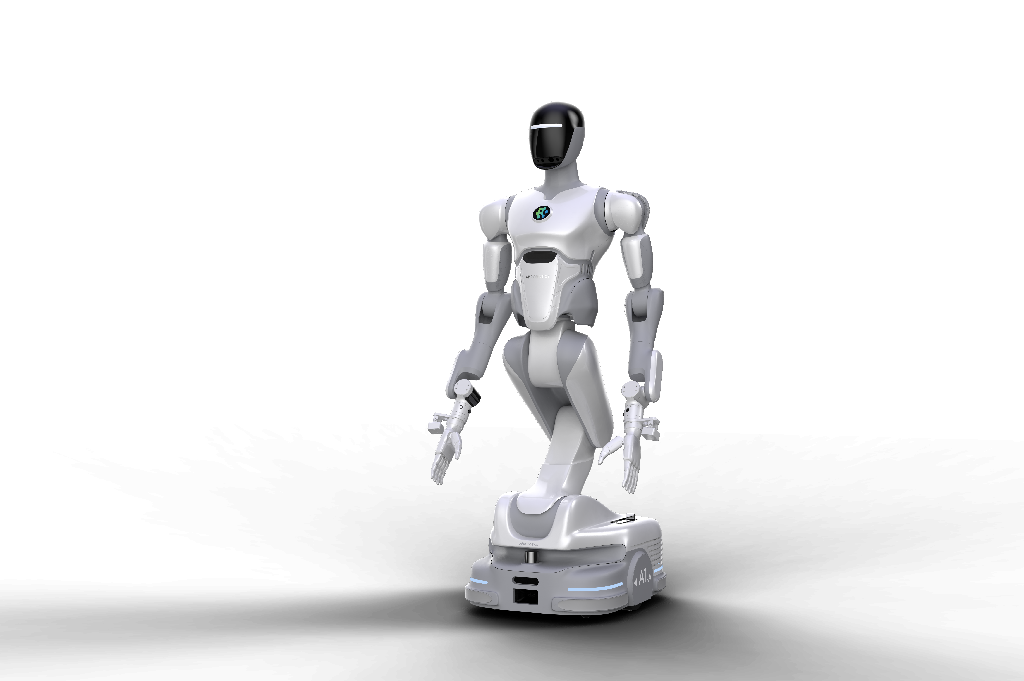
AI2 Robotics is a Shenzhen-based embodied-AI company founded in April 2023 by Dr. Yangdong Eric Guo, building wheeled humanoid robots under the AlphaBot brand and a vision-language-action foundation model it calls Alpha Brain GOVLA 616. In roughly three and a half years it has moved from incorporation to a claimed production capacity of more than 2,000 units per year, a public debut at the World Robot Conference in Beijing on 19 August 2026, and a funding history that, on the most aggressive reading, exceeds CN¥5 billion at a valuation north of RMB20 billion 6810. On any reading, it is one of the most heavily capitalised young humanoid-robotics companies in China.
The investment case rests on a coherent strategic bet. AI2 Robotics has explicitly deprioritised consumer robots in favour of paying industrial scenarios: manufacturing, biotechnology, public services and, on its own account, semiconductor display production through a client identified as HKC 616. The AlphaBot's wheeled base is a deliberate engineering trade: it sacrifices stair-climbing and rugged-terrain capability in exchange for stability, payload tolerance and a lower bill of materials than a bipedal platform. The company's own framing, reported by robotics media, is that industrial customers pay today while household robotics remains a later ambition 6.
The evidence problem is equally coherent, and it is the central finding of this report. No source in the dossier independently establishes the level of task autonomy of any deployed AlphaBot unit. The reconciled autonomy verdict is unknown at a confidence of 0.35. The only first-hand autonomy evidence in the entire dataset concerns a different wheeled robot, which is explicitly human-driven with AI-assisted balance, and cannot be attributed to AI2 Robotics. The company's deployment claims are vendor claims relayed by news outlets; the WRC 2026 ice-cream demonstration is a public showing, not an operational audit; and the funding figures conflict across sources to a degree that no reconciliation can fully resolve 78910111213.
Three things can be said with confidence. The company exists, is well funded, and has real hardware with a documented specification envelope 616. It has attracted an investor roster of unusual quality for a three-year-old firm, including Baidu, CRRC, the National SME Development Fund, Moutai Group and CICC Capital 8916. And it has made a strategic choice, wheeled over bipedal and industrial over consumer, that is defensible on both cost and reliability grounds.
Three things cannot be said with confidence. Whether the AlphaBot fleet performs autonomous work in customer facilities. Whether the reported deployments are paid, recurring and productive. And whether the funding figures reported in mid-2026 reflect a single round, cumulative raises, or reporting error. Until at least the first of these is resolved by independent evidence, AI2 Robotics should be classified as a fully commercial company with unverified autonomy — a capital-rich, hardware-credible challenger whose operational reality remains, on the public record, unproven.
Latest news
- This humanoid robotics company is going public, but its CEO isn't promising a robot in your home anytime soonBiztoc.com·2026-07-06GENERAL
- This humanoid robotics company is going public, but its CEO isn’t promising a robot in your home anytime soonBiztoc.com·2026-07-06GENERAL
- Chinese robotics outfits AI2 Robotics and X Square Robots each secure funding at $2.8B valuationSiliconANGLE News·2026-06-29GENERAL
- Chinese robotics outfits AI2 Robotics and X Square Robots each secure funding at around $2.8B valuationSiliconANGLE News·2026-06-29GENERAL
02The AI2 Robotics Story
AI2 Robotics was founded in April 2023 in Shenzhen by Dr. Yangdong Eric Guo 16. The founding date and location are corroborated across multiple independent news and commerce sources and can be treated as VERIFIED FACT at high confidence. The company is styled variously as "AI2 Robotics" and "AI² Robotics"; the superscript form appears in funding coverage and company branding, and the two refer to the same entity 7910.
The founding context matters. April 2023 sits in the first wave of Chinese embodied-AI formation that followed the commercial maturation of quadruped platforms and the demonstration, principally by Unitree and its peers, that Chinese supply chains could produce legged hardware at a fraction of Western cost. AI2 Robotics entered not as a legged-robot company but as an embodied-intelligence company: its founding proposition, as reported, was the pairing of a foundation model for spatial reasoning and whole-body control with a commercially viable robot body 616. The Alpha Brain GOVLA model — Global & Omni-body Vision-Language-Action — is the intellectual core of that proposition 6.
The company's public profile through 2024 and 2025 was that of a well-connected but low-visibility startup. Its first large public showing came at the World Robot Conference in Beijing on 19 August 2026, where it demonstrated the AlphaBot serving ice cream 6. That timing is significant: AI2 Robotics reached its public debut after raising the bulk of its capital, not before. This is the inverse of the Western startup playbook, in which a public demo typically precedes institutional fundraising. The pattern is common in Chinese embodied AI, where strategic and state-linked investors can underwrite a company through its early hardware iterations without requiring consumer-facing proof.
The funding history is the most reported and least reconcilable part of the story. The dossier preserves at least four distinct figures:
- A Series B exceeding CN¥1 billion (about $144.7M) at a valuation past RMB10 billion (about $1.4B) 9.
- A raise of nearly CN¥5 billion in new financing 8.
- Approximately $735M raised at a valuation of roughly $2.8B 7111213.
- A valuation crossing RMB20 billion following a fresh funding boost 10.
The dossier also notes twelve rounds in the past year, a figure that, if accurate, implies an unusually compressed fundraising cadence even by 2026 Chinese standards 14. EDITORIAL INFERENCE: these figures most plausibly describe different rounds, tranches or cumulative totals reported at different times, with later-dated reports capturing subsequent raises. They cannot be averaged into a single number, and any analyst quoting one figure as the AI2 Robotics raise is overstating precision. The honest formulation is a range: CN¥1.2B to CN¥5B raised, at valuations between RMB10B and RMB20B+ (roughly $1.4B to $2.8B), with the higher figures from later-dated sources.
The investor roster is more consistent across sources and is a VERIFIED FACT at high confidence in its composition, though not in the amounts each investor contributed. Named backers include Baidu, CRRC and CRRC Capital, Yusys Technologies, Sentury Tire, Guotai Haitong Securities, the National SME Development Fund, Sino Biopharmaceutical, Moutai Group, CICC Capital and GSR Ventures 8916. This is a roster with three distinct characteristics: a strategic technology investor (Baidu), industrial and infrastructure capital (CRRC, Sentury Tire), and state-linked or consumer-brand capital (National SME Development Fund, Moutai Group). The presence of Moutai Group — a liquor conglomerate — is unusual and suggests either a diversification mandate or a relationship-driven allocation; the dossier does not explain it.
On production, the company is reported to operate semi-automated assembly with capacity exceeding 2,000 units per year, with a large-scale factory planned for the second half of 2026 10. This is a COMPANY CLAIM relayed by a technology news source. The distinction between "capacity" and "output" is critical and is not resolved in the dossier: a line capable of 2,000 units annually and a company that has built 2,000 units are very different propositions, and no source states how many AlphaBots have actually been manufactured.
The strategic posture is the clearest signal in the dossier. The founder has stated that AI2 Robotics prioritises paying industrial scenarios over consumer robots 6. This is a COMPANY CLAIM, but it is a claim of strategy rather than of achievement, and it is consistent with the hardware design and the investor base. It is also the single most credible element of the company's public positioning, because it is the one claim that does not require the company to have solved autonomy.
03Product Portfolio: What AI2 Robotics Actually Sells
The dossier supports exactly one product family: the AlphaBot wheeled humanoid. There is no evidence of a second hardware line, a software-only product, or a services business with independent revenue. Analysts should treat AI2 Robotics as a single-platform company at this stage.
The AlphaBot's specification envelope, as consistently described across multiple news sources, is as follows 616:
| Attribute | Description | Evidence status |
|---|---|---|
| Form factor | Humanoid torso on a wheeled base | VERIFIED FACT (consistent across sources) |
| End effectors | Five-fingered hands | VERIFIED FACT (consistent across sources) |
| Torso mechanism | Waist-leg lifting mechanism | VERIFIED FACT (consistent across sources) |
| Degrees of freedom | 34+ DoF | COMPANY CLAIM (spec sheet not in dossier) |
| Arm span | Approximately 2.3 ft (about 0.7 m) | COMPANY CLAIM (single-source figure) |
| Mobility | Wheeled; cannot climb stairs or traverse rugged terrain | VERIFIED FACT (consistent across sources) |
| Compute/model | Alpha Brain GOVLA vision-language-action model | VERIFIED FACT (existence); capability COMPANY CLAIM |
| Open-source variant | FiS-VLA, released June 2025 | VERIFIED FACT (reported by robotics news outlet) |
The wheeled-base decision is the defining product choice and deserves scrutiny rather than dismissal. A wheeled humanoid cannot climb stairs, cannot cross rubble, and cannot operate in the unstructured environments that justify the humanoid form in the first place. What it can do is operate on flat industrial floors with a stable base that tolerates a heavier manipulator payload, a taller torso for human-scale workspaces, and a far simpler control problem than bipedal balance. For semiconductor display manufacturing, biotechnology laboratories and retail floors — the sectors AI2 Robotics names — flat ground is the norm, not the exception. EDITORIAL INFERENCE: the wheeled configuration is not a compromise born of weakness but a deliberate market segmentation, and it is the correct engineering choice for the sectors the company claims to serve. The cost is that AI2 Robotics is not competing for the general-purpose humanoid market that Unitree, Figure and Tesla are contesting; it is competing for the fixed-workstation automation market, where its true rivals are traditional industrial arms and autonomous mobile manipulators, not bipeds.
The 34+ DoF figure and the 2.3-ft arm span are COMPANY CLAIMS that appear in news coverage but are not traceable in the dossier to a published specification sheet. The arm span in particular is worth flagging: 2.3 ft is a modest reach for a humanoid torso and implies a workspace narrower than a human's. If accurate, it constrains the AlphaBot to tasks within a tight radius, which is consistent with workstation-style deployment and inconsistent with the general-purpose household ambition the company has deferred.
The Alpha Brain GOVLA model is described as providing spatial reasoning, whole-body control and multi-step planning 6. The open-source FiS-VLA variant, released in June 2025, is the most verifiable technical artefact associated with the company 6. EDITORIAL INFERENCE: the release of an open-source VLA variant is a talent-acquisition and ecosystem play as much as a technical contribution; it is standard practice among Chinese embodied-AI firms seeking to establish a research reputation without disclosing proprietary deployment code. It tells us the company has a research function capable of producing publishable work. It does not tell us that the proprietary GOVLA model performs as claimed in customer facilities.
What the portfolio does not contain, on the public record: no published pricing, no published payload specification, no published battery life, no published operating-temperature range, no published mean-time-between-failure data, and no published safety certification. For an industrial product, the absence of safety certification documentation is notable. UNKNOWN: whether the AlphaBot holds any functional-safety certification for operation alongside humans in industrial settings. This is a material gap for any prospective industrial buyer and for any analyst assessing deployment credibility.
Products & versions
04Technology Stack: Strengths and the Work That Remains
AI2 Robotics' technology stack has three layers: the physical platform (wheeled humanoid with five-fingered hands and a waist-leg lifting mechanism), the control and perception layer (whole-body control and spatial reasoning), and the foundation-model layer (Alpha Brain GOVLA) 616. The dossier supports the existence and general description of all three and the specific capability of none.
The physical platform is the strongest layer. A wheeled base with a humanoid torso is a solved engineering problem in the sense that its failure modes are well understood: balance is trivial, thermal management is manageable, and the manipulator is the limiting subsystem. The five-fingered hands and the waist-leg lifting mechanism indicate an intent to handle human-scale objects at human-scale heights, which is the correct design target for the named sectors. The 34+ DoF figure, if accurate, is competitive with other wheeled humanoids. EDITORIAL INFERENCE: the hardware is unlikely to be the constraint on AI2 Robotics' commercial progress. The constraint is almost certainly software autonomy and integration cost.
The control and perception layer is where the claims become unverifiable. Whole-body control for a wheeled humanoid is substantially easier than for a biped, which is a genuine advantage. Spatial reasoning in cluttered industrial environments, however, remains an open problem across the entire industry, and the dossier contains no benchmark, no third-party evaluation and no customer testimony on the AlphaBot's spatial reasoning performance. The company's own framing, that robots are trained in simulation to "automate routine tasks," is a COMPANY CLAIM that describes a training methodology, not a demonstrated outcome 6.
The foundation-model layer is the most interesting and the least evidenced. Alpha Brain GOVLA is described as a Global & Omni-body Vision-Language-Action model 6. The "global and omni-body" framing implies a single model controlling the whole body rather than a decomposed pipeline of perception, planning and control modules. This is the current frontier architecture in embodied AI, and it is the right bet if the company can execute it. The open-source FiS-VLA variant released in June 2025 gives the research community a partial view of the approach 6. EDITORIAL INFERENCE: the gap between a published VLA variant and a production VLA controlling a fleet in customer facilities is where most embodied-AI companies fail. The dossier provides no evidence about which side of that gap AI2 Robotics occupies.
The critical technology question, and the one the dossier cannot answer, is what fraction of an AlphaBot's working day is autonomous. The industry-standard decomposition is instructive: a robot may be teleoperated, scripted, supervised, or fully autonomous, and the same platform may operate in different modes for different tasks. The dossier's autonomy verdict is unknown at 0.35 confidence, and the only first-hand autonomy evidence in the dataset concerns a different wheeled robot that is human-driven with AI-assisted balance. That evidence cannot be transferred to AI2 Robotics, but it is a useful caution: wheeled humanoids with impressive demos are frequently teleoperated, and the burden of proof lies with the company.
Two further technology gaps are worth naming. First, sim-to-real transfer: the company claims simulation training, but the dossier contains no evidence of successful sim-to-real transfer at production scale, which is the single hardest problem in the stack. Second, fleet learning: there is no evidence in the dossier that AlphaBot units share learned policies or that the fleet improves with deployment volume. If the fleet does not learn collectively, the company's data advantage is limited to whatever each unit experiences, which weakens the long-term moat considerably.
UNKNOWN: the compute platform (whether inference runs on-robot or off-robot), the model size, the inference latency, the data-collection pipeline, and the safety architecture. None of these is disclosed in the dossier. For a company raising capital at a reported $2.8B valuation, the absence of published technical detail is itself a data point.
05Research, Papers, Authors and Labs
This is the thinnest section of the report, and it must be said plainly: the dossier contains no peer-reviewed papers authored by AI2 Robotics personnel, no named research staff beyond the founder, and no laboratory affiliations.
The four research items in the dossier 17181920 are not AI2 Robotics publications. They are arXiv items that appear to have been retrieved by keyword matching, and they concern unrelated work: a 2017 paper, a 2018 paper, a ManipulaTHOR framework paper from 2021, and a 2026-dated arXiv item whose provenance the dossier does not establish 17181920. None is attributable to AI2 Robotics on the evidence supplied. Any analyst citing these as the company's research output would be committing a category error.
The company's verifiable research contribution is the FiS-VLA open-source variant of Alpha Brain GOVLA, released June 2025 6. This is a VERIFIED FACT in the sense that its release is reported by a robotics news outlet, though the dossier does not include the repository itself, the paper accompanying it, or any independent evaluation of its performance. EDITORIAL INFERENCE: a single open-source VLA variant is a modest research footprint for a company of this capitalisation. By comparison, well-funded embodied-AI labs typically publish multiple papers per year and maintain active repositories. The absence of a visible publication record in the dossier may reflect a deliberate policy of commercial secrecy, a thin research organisation, or simply incomplete dossier coverage. The dossier cannot distinguish between these.
The founder, Dr. Yangdong Eric Guo, is the only named individual associated with the company in the dossier 16. His background is not detailed in the supplied sources beyond the founding attribution. UNKNOWN: the size and composition of the research team, the identities of senior technical staff, and any academic affiliations. For a company whose core asset is a foundation model, the invisibility of its research organisation is a notable gap.
The dossier also contains a cluster of items concerning Ai2, the Allen Institute for AI, including its embodied-AI programme, its MolmoAct2 robotics model, and its agent platform 1215212223. These are included in the dossier because of the name collision, and they are not evidence about AI2 Robotics of Shenzhen. They are, however, a useful benchmark: the Allen Institute's MolmoAct2 is an open-source robotics model with published benchmarks, and its existence illustrates what a transparent research posture looks like. AI2 Robotics has not, on the public record, adopted one.
<!-- module: papers --> <!-- module: authors-labs --> <!-- module: repos --> <!-- module: datasets -->06Media Evidence Library: What the Videos Prove
The dossier contains six video items 4212223242526, and the composition of that set is itself the finding. Not one of the six is a first-hand, unedited demonstration of an AI2 Robotics AlphaBot performing autonomous work.
The video items break down as follows. One is a funding-news video covering the $735M raise alongside unrelated Google model releases 4. Four concern the Allen Institute's Molmo and MolmoAct2 models 212223 or, in one case, a Unitree teardown 24. Two concern Unitree's Go2 and A2 platforms 2526. The Unitree items are relevant only as competitive context; they are not AI2 Robotics evidence.
The single most important media artefact in the dossier is therefore not a video at all but the reported ice-cream-serving demonstration at the World Robot Conference on 19 August 2026 6. This is described as the company's first large public deployment. It is a VERIFIED FACT that the demonstration took place, in the sense that a robotics news outlet reported it. What it proves is narrow: that an AlphaBot can be configured to serve ice cream in a controlled exhibition environment, presumably with substantial engineering support and possibly with teleoperation or scripting. What it does not prove is autonomous task execution, reliability over time, or performance in a customer facility.
The dossier's own autonomy analysis is unusually candid on this point and is worth restating: the only first-hand autonomy evidence in the entire dataset concerns a different wheeled robot that is human-driven with AI-assisted balance, with the operator stating "I remain in control of speed and direction with the joysticks." That evidence cannot be attributed to AI2 Robotics. But its presence in the dossier is a methodological warning: the wheeled-humanoid category contains platforms whose public demos are human-driven, and the category's marketing does not always disclose this.
Applying the report's evidence discipline to the media library:
| Media artefact | What it shows | What it does not show |
|---|---|---|
| WRC 2026 ice-cream demo 6 | An AlphaBot can be configured to serve ice cream in an exhibition setting | Autonomy, reliability, customer-facility performance, or economic viability |
| Funding-news video 4 | That the raise was covered by media | Anything about the product |
| Allen Institute videos 212223 | A different organisation's robotics research | Anything about AI2 Robotics |
| Unitree videos 242526 | A competitor's platforms | Anything about AI2 Robotics |
EDITORIAL INFERENCE: the absence of a single unedited, continuous, first-hand video of an AlphaBot performing a productive task without human intervention is the most telling gap in the entire evidence base. Companies confident in their autonomy typically publish such footage, because it is the cheapest and most persuasive proof available. Its absence is not proof of teleoperation, but it is a reason to withhold belief.
Media library
07Commercial Reality
The commercial picture separates cleanly into what is claimed, what is verifiable, and what is unknown.
What is claimed. AI2 Robotics states that its robots are used in retail, public service, biotechnology, automotive and semiconductor display manufacturing, with HKC named as a client in the display sector 616. It plans to expand into community services, healthcare and elder care, and household services 6. Production capacity is claimed at 2,000+ units per year on a semi-automated line, with a large-scale factory planned for H2 2026 10. The founder has stated a strategic priority for paying industrial scenarios 6.
What is verifiable. The company exists, is funded, has a defined product, and held a public demonstration at WRC 2026 616. The investor roster is corroborated across sources 8916. The HKC relationship is reported but not confirmed by HKC; it is a COMPANY CLAIM at best and a single-source claim at that.
What is unknown. Whether any deployment is paid. Whether any deployment involves autonomous work. Whether deployments are pilots or production. Whether units are leased, sold or placed. Whether there is recurring revenue. Whether the 2,000-unit capacity has produced any meaningful fraction of that number. Whether the H2 2026 factory has broken ground.
The distinction between a pilot and a deployment is where most humanoid-robotics commercial claims collapse under scrutiny, and the dossier does not resolve it for AI2 Robotics. A pilot is a customer agreeing to host a robot, often at no charge, to evaluate it. A deployment is a customer paying for a robot to do work. The dossier's language — "claimed use," "vendor-claimed deployments" — is consistent with pilots reported as deployments, which is standard practice across the industry and not unique to this company.
The commercial model is also undisclosed. UNKNOWN: whether AI2 Robotics sells units outright, leases them, charges per task, or bundles hardware with a service contract. This matters enormously to the investment case: a hardware-sales model has different margins, capital requirements and scaling dynamics than a robotics-as-a-service model. The dossier provides no basis for choosing between them.
What can be said with reasonable confidence is that the company's commercial strategy is coherent with its hardware. Wheeled humanoids on flat industrial floors, serving workstation-adjacent tasks in semiconductor display, biotech and retail, is a plausible near-term market. The question is not whether the market exists but whether AI2 Robotics has captured any of it, and on the public record that remains unproven.
Customers & deployments
Reported as a client where AI2 Robotics' AlphaBot is claimed to be deployed in semiconductor display manufacturing.
Sections 8 through 14 follow in the second part of this report.
08Markets and Use Cases
AI2 Robotics has made a strategic choice that distinguishes it from much of the Chinese humanoid cohort: it is not chasing the household robot. The founder's stated position, reported by robotics trade press, is that paying industrial scenarios take priority over consumer applications 616. That is a defensible commercial posture. It is also a posture that narrows the addressable market and raises the bar for what counts as a "deployment."
8.1 The Stated Target Verticals
The company's claimed deployment footprint spans five named verticals, per reconciled reporting: retail, public service, biotechnology, automotive, and semiconductor display manufacturing 616. Of these, only one comes with a named client: HKC, a Chinese display-panel manufacturer, cited in connection with semiconductor display manufacturing 16. The remaining four verticals are described in aggregate terms without named customers, contract values, unit counts, or duration.
This matters for how the reader should weight the claim. A named client in a capital-intensive manufacturing vertical is a materially stronger signal than a vertical listed in a pitch deck. HKC is a real, listed company with fabs that require cleanroom-compatible automation. If AlphaBot units are operating in an HKC display line, that is a verifiable fact that should eventually surface in HKC disclosures, supplier lists, or trade coverage. As of the coverage date, it has not.
| Vertical | Named client? | Contract disclosed? | Unit count disclosed? | Evidence weight |
|---|---|---|---|---|
| Semiconductor display manufacturing | Yes (HKC) 16 | No | No | Moderate: named client, unverified deployment |
| Automotive | No | No | No | Low: vertical named only |
| Biotechnology | No | No | No | Low: vertical named only |
| Retail | No | No | No | Low: vertical named only |
| Public service | No | No | No | Low: vertical named only |
| Healthcare / eldercare | No (planned) | No | No | Speculative: forward-looking |
| Household services | No (planned) | No | No | Speculative: forward-looking |
8.2 The Ice-Cream Demo as a Market Signal
The single most concrete public deployment is the ice-cream-serving demonstration at the World Robot Conference 2026 in Beijing, on 19 August 2026 6. Trade coverage describes this as the company's first large public deployment. That framing is important. It tells us that as of mid-2026, roughly three years after founding and after multiple large funding rounds, the company's most visible operational showcase was a conference booth task.
Serving ice cream is not trivial. It requires bimanual coordination, tool use (scoop), object recognition, and a sequence of steps that can be partially scripted. It is also a task that has been demonstrated by many humanoid and wheeled platforms at trade shows, often with substantial teleoperation or scripted replay. The dossier does not establish which mode was used at WRC 2026. Under the evidence discipline applied throughout this report, a choreographed or booth-bounded demonstration is not proof of autonomous productive work.
The market read is therefore: AI2 has a demonstrable public-facing capability in a controlled setting, and a claimed but unverified industrial footprint. The gap between those two is the commercial question.
8.3 Why the Wheeled Form Factor Fits Some Markets and Not Others
The AlphaBot's wheeled base is a deliberate trade-off. It cannot climb stairs or traverse rugged terrain 616. That rules out, or severely limits, several markets:
- Construction and outdoor logistics: excluded by terrain.
- Multi-floor eldercare and hospital wards: excluded unless the facility is single-level or has ramps and lifts sized for the platform.
- Last-mile delivery: excluded by curbs, steps, and unstructured pavement.
- Warehouse and factory floors: well-suited, provided the floor is flat and the routes are mapped.
- Retail back-of-house and front-of-house on a single level: well-suited.
- Laboratory and cleanroom environments: well-suited, and consistent with the biotech and display-manufacturing claims.
The wheeled base also buys payload stability, longer runtime per unit of battery, and simpler whole-body control than a bipedal platform. For a company prioritising paying industrial scenarios, this is the rational engineering choice. It is also a choice that caps the total addressable market at facilities that are already flat, mapped, and power-adjacent.
8.4 The Healthcare and Eldercare Ambition
The company has signalled plans to expand into community services, healthcare and eldercare, and household services 16. These are the hardest markets in robotics, for reasons that are structural rather than technical:
- Liability: a robot that injures a frail adult in a care home creates legal exposure that dwarfs the unit's sale price.
- Regulatory classification: medical devices, assistive devices, and general service robots sit in different regulatory regimes, and China's classification for eldercare robotics is still maturing.
- Unit economics: care homes operate on thin margins and are price-sensitive.
- Task variability: eldercare tasks are open-ended and safety-critical, which is the opposite of the structured tasks AI2's industrial focus favours.
Treat the eldercare and household ambitions as directional, not as near-term revenue. The dossier provides no evidence of pilots, regulatory filings, or care-provider partnerships in these segments.
8.5 Market Sizing Caveat
No source in the dossier provides AI2-specific market sizing, order book, backlog, or revenue figures. Any market-size figure quoted elsewhere for AI2 should be treated as third-party estimate or company projection, not disclosed financials. The company is private and, per the dossier, has not published audited revenue.
09Competitive Landscape
AI2 Robotics competes in three overlapping arenas: Chinese wheeled and bipedal humanoid vendors, global embodied-AI model developers, and the broader industrial automation incumbents whose products already do the jobs AI2 is pitching. The dossier's competitor evidence is thin and partly misattributed, which is itself a finding.
9.1 A Note on Source Contamination
Several sources in the dossier labelled "Ai2" refer to the Allen Institute for AI (AI2), the Seattle-based non-profit research institute, not AI2 Robotics of Shenzhen 1215. These include the embodied-AI page, the institute homepage, and a LinkedIn post about an AI agent platform and robotics initiative. They are not evidence about the Shenzhen company. Any competitive or technical analysis that conflates the two is unreliable. This report treats them as a naming-collision hazard and does not use them as evidence for AI2 Robotics' capabilities.
Similarly, several video and community sources in the dossier concern Unitree robots, MolmoAct, and general robotics-career discussion 212223242526272829303132. They are useful as context for the sector's discourse and for the Unitree comparison, but they are not AI2 evidence.
9.2 The Chinese Humanoid Cohort
AI2 sits in a crowded field. The dossier does not supply a clean competitor set with specs, so the following comparison is drawn from the reconciled facts about AI2 plus general sector knowledge, and is explicitly labelled as editorial inference where it goes beyond the dossier.
| Competitor archetype | Representative examples (sector context) | Form factor | AI2's relative position |
|---|---|---|---|
| Bipedal humanoid, full-size | Unitree, UBTech, Fourier, AgiBot | Legged, human-height | AI2 trades mobility for stability and cost; cannot match stair/terrain use cases |
| Wheeled humanoid | AI2, some service-robot vendors | Wheeled base, humanoid torso | AI2 is a credible entrant; differentiation is the GOVLA model and industrial focus |
| Wheeled service robots (non-humanoid) | Delivery, disinfection, logistics vendors | Wheeled, non-anthropomorphic | These already occupy many retail/public-service niches AI2 targets |
| Industrial automation incumbents | Fixed arms, AMRs, cobots | Fixed or wheeled | Often cheaper, proven, and already qualified in the customer's process |
| Foundation-model developers | Global VLA/robotics-model labs | Software | AI2's GOVLA competes on openness and Chinese-market integration |
The honest competitive read: AI2's wheeled humanoid is not differentiated by its body. It is differentiated, if at all, by the Alpha Brain GOVLA stack and by its access to Chinese industrial customers and capital. Both are real advantages. Neither is a moat.
9.3 The GOVLA Model as Competitive Lever
The Alpha Brain GOVLA (Global & Omni-body Vision-Language-Action) model is described as handling spatial reasoning, whole-body control, and multi-step planning, with an open-source FiS-VLA variant released in June 2025 616. Open-sourcing a variant is a competitive move with two edges: it seeds an ecosystem and attracts talent, and it gives away a layer that competitors could otherwise be forced to license. For a hardware company, open-sourcing the model can be rational if the value capture is in the robot, the integration, and the service contract. Whether AI2 can capture value there is unproven.
The dossier does not provide benchmark results, head-to-head evaluations, or independent reproductions of GOVLA or FiS-VLA performance. Claims of model capability should be treated as company claims until third-party evaluation appears.
9.4 Where AI2 Is Most Exposed
Three exposures stand out:
- Bipedal price collapse. If full-size bipedal humanoids from better-capitalised rivals fall in price faster than expected, the wheeled form factor's cost advantage erodes while its mobility disadvantage remains.
- Incumbent automation. In display manufacturing and biotech, the customer's existing fixed automation and AMR vendors are already qualified. Displacing them requires a compelling ROI case that AI2 has not publicly made.
- Model commoditisation. If open VLA models from multiple labs reach comparable capability, the GOVLA stack stops being a differentiator and the competition reverts to hardware cost and service.
10Geopolitical Context and Constraints
AI2 Robotics operates at the intersection of three geopolitical currents: US-China technology competition, export controls on advanced semiconductors and AI accelerators, and the Chinese state's industrial policy for embodied AI. The dossier provides limited direct evidence on any of these, so this section is largely editorial inference grounded in the company's disclosed investor base and market position.
10.1 The Investor Base as a Political Signal
The disclosed investor set includes Baidu, CRRC/CRRC Capital, Yusys Technologies, Sentury Tire, Guotai Haitong Securities, the National SME Development Fund, Sino Biopharmaceutical, Moutai Group, CICC Capital, and GSR Ventures 8910111416. Two names carry particular weight:
- CRRC is the state-owned rolling-stock giant. Its involvement signals alignment with state industrial priorities, and potentially with rail, transit, and infrastructure-adjacent deployment channels.
- The National SME Development Fund is a state-backed vehicle. Its participation signals that AI2 is viewed as a strategic asset in the embodied-AI supply chain, not merely a venture bet.
This has consequences. State-aligned capital can open doors to domestic customers and to favourable policy treatment. It can also constrain the company's ability to sell into markets that are politically sensitive, and it makes the company a more visible target in any future technology-restriction regime.
10.2 Compute Access
Embodied-AI models of the GOVLA class require substantial training compute. The dossier does not disclose AI2's accelerator supply, training partners, or cloud arrangements. Given the export-control environment for advanced AI chips into China, this is a material unknown. Two scenarios:
- Domestic silicon substitution: AI2 trains on Chinese accelerators (Huawei Ascend and similar) with acceptable efficiency losses. This is the policy-preferred path and increasingly viable, but it constrains model scale.
- Stockpiled or leased foreign compute: AI2 accesses restricted accelerators through pre-existing inventory, third-party cloud, or overseas arrangements. This is faster but fragile.
The dossier cannot adjudicate between these. Treat compute access as an unknown with high strategic weight.
10.3 Export Market Access
A Shenzhen embodied-AI company selling into Western markets faces rising scrutiny. Humanoid and wheeled service robots are not currently subject to the most restrictive export controls, but they are increasingly discussed in the context of critical and emerging technology. Data governance is a parallel constraint: a robot operating in a European hospital or a US factory generates sensor data whose handling is regulated. AI2 has not, per the dossier, published a data-residency or security architecture for export markets.
The practical implication: AI2's near-term market is China, plus friendly jurisdictions in Southeast Asia, the Middle East, and Belt-and-Road-adjacent markets. That is a large market. It is not the global market.
10.4 The "China Shipped More Humanoid Robots Than the US" Frame
A community source in the dossier notes that China shipped more humanoid robots than the entire US last year 32. The claim is a Reddit post and should be treated as unverified, but the underlying trend is widely reported: Chinese vendors dominate humanoid unit shipments. For AI2, this is both tailwind and headwind. The tailwind is a deep domestic supply chain for actuators, harmonic drives, sensors, and batteries. The headwind is that AI2 is one of many well-funded Chinese humanoid companies, and the state's industrial policy supports the category rather than any single vendor.
10.5 Constraints Summary
| Constraint | Evidence status | Strategic weight |
|---|---|---|
| Advanced AI accelerator access | Not disclosed | High |
| Export-market data governance | Not disclosed | Medium-High |
| State-aligned investor expectations | Inferred from investor list 8910 | Medium |
| Domestic supply chain depth | Sector context | Positive |
| Category-level state support | Sector context | Positive |
| Naming collision with Allen Institute for AI | Documented 1215 | Low but persistent |
11The Hype, the Real and the Ugly
This section applies the report's evidence discipline to the specific claims AI2 and its coverage have generated. The goal is not cynicism. It is to separate what is established from what is asserted, so that a reader can update their beliefs as new evidence arrives.
11.1 The Hype
Hype 1: "Deployed in retail, public service, biotech, automotive, and semiconductor manufacturing." This is a company claim reported by trade press 616. Only one vertical has a named client (HKC). No contract values, unit counts, or durations are disclosed. A "deployment" in vendor language can mean a paid pilot, a free trial, a single unit on a factory floor, or a booth demonstration. The word does not carry the weight it appears to.
Hype 2: "First large public deployment" at WRC 2026. The ice-cream demo is real and public 6. It is also a conference demonstration. The dossier does not establish whether the task was autonomous, teleoperated, or scripted. Under this report's rules, a choreographed demo is not proof of autonomous work.
Hype 3: Funding figures. The reported numbers range from roughly CN¥1.2B at a RMB10B valuation to roughly CN¥5B at a valuation above RMB20B, with a separate cluster around $735M raised at a $2.8B valuation 257891011121314. These cannot all be simultaneously correct as descriptions of the same round. They likely reflect different rounds, cumulative totals, currency-conversion inconsistencies, or reporting errors. The honest treatment is a range, not a point estimate.
Hype 4: "Embodied AI" as a category label. The term is used loosely across the sector. For AI2, the substantive claim is that GOVLA performs spatial reasoning, whole-body control, and multi-step planning 616. That is a testable claim. No independent benchmark is in the dossier.
11.2 The Real
Real 1: A shipping wheeled humanoid platform. The AlphaBot is a described, specified product with a humanoid torso, five-fingered hands, wheeled base, waist-leg lifting mechanism, 34+ degrees of freedom, and roughly a 2.3-foot arm span 616. Multiple independent sources agree on the platform description. This is a real engineered product, not a rendering.
Real 2: A production capability. Semi-automated assembly with 2,000+ units per year capacity is reported, with a large-scale factory planned for H2 2026 10. Capacity is not output, and output is not deployment, but a stated production line is a stronger signal than a concept.
Real 3: An open-source model release. The FiS-VLA variant released in June 2025 is a concrete, checkable artefact 616. Open-source releases can be inspected, benchmarked, and reproduced. This is the most falsifiable claim in the dossier.
Real 4: A serious investor syndicate. Baidu, CRRC, CICC Capital, GSR Ventures, and state funds do not typically participate in pure vapourware 8910111416. Their involvement is evidence of diligence, not of product-market fit.
Real 5: A clear strategic focus. The stated priority on paying industrial scenarios over consumer robots is a coherent strategy 616. It is the opposite of the household-robot hype cycle and suggests a management team that understands where near-term revenue can come from.
11.3 The Ugly
Ugly 1: The autonomy gap. The single most important unknown about AI2 is whether its deployed robots do useful work autonomously. The dossier contains no independent teardown, no first-hand user report, and no third-party evaluation of an AlphaBot performing a productive task without human intervention. The only first-hand autonomy evidence in the entire dataset concerns a different wheeled robot that is explicitly human-driven with AI-assisted balance, and even that cannot be attributed to AI2 2425. This is the gap that all other claims hang on.
Ugly 2: The naming collision. AI2 Robotics shares a name with the Allen Institute for AI, a well-known research non-profit 1215. This creates persistent confusion in search, in citations, and potentially in talent and partnership conversations. It is a branding liability that the company has not resolved.
Ugly 3: The funding-figure chaos. When a company's own funding announcements cannot be reconciled across credible outlets, it damages trust in every other number the company puts out 257891011121314. This may be a reporting artefact rather than a company problem, but the effect on external perception is the same.
Ugly 4: The demo-to-deployment gap. Three years from founding to a conference ice-cream demo, with claimed industrial deployments that have not been independently verified, is a pattern that has repeated across the humanoid sector. It is not unique to AI2. It is also not exculpatory.
11.4 Claim-vs-Evidence Table
| Claim | Source type | Independent verification | Verdict |
|---|---|---|---|
| AlphaBot has 34+ DoF, wheeled base, five-fingered hands | Multiple trade sources 616 | Consistent across sources | Verified as product description |
| GOVLA handles spatial reasoning, whole-body control, multi-step planning | Company claim via trade press 616 | None in dossier | Unverified |
| FiS-VLA open-source variant released June 2025 | Trade press 616 | Checkable artefact | Plausible, inspectable |
| Deployed in retail, public service, biotech, automotive, semiconductor | Company claim 616 | Only HKC named; no confirmation | Unverified |
| Ice-cream demo at WRC 2026 was first large public deployment | Trade press 6 | Public event, mode unknown | Verified as event; autonomy unknown |
| 2,000+ units/year capacity | Trade press 10 | None | Unverified |
| Large-scale factory planned H2 2026 | Trade press 10 | None | Forward-looking |
| ~CN¥1.2B to ~CN¥5B raised across rounds | Multiple, conflicting 257891011121314 | Conflicting | Range only |
| Baidu, CRRC, state funds among investors | Multiple 8910111416 | Overlapping lists | Verified as reported |
| Robots perform tasks autonomously in production | Company implication | None | Unknown |
12Future Scenarios
The following scenarios are editorial constructs. They are not predictions. Each is anchored to observable triggers so that a reader can track which scenario is unfolding.
12.1 Scenario A: The Industrial Wedge Holds (Base Case)
Narrative. AI2 converts its HKC relationship and one or two additional named industrial clients into repeat orders. The wheeled form factor proves adequate for flat-floor factory and lab environments. GOVLA improves incrementally, and the company publishes benchmark results that survive third-party scrutiny. The H2 2026 factory comes online and ships at a meaningful fraction of the 2,000-unit capacity. Revenue remains modest by venture standards but grows, and the company raises again at or above its last valuation.
Triggers to watch:
- A second named industrial client disclosed by the client, not by AI2.
- Published unit shipment figures that reconcile with production capacity.
- Third-party benchmark results for GOVLA or FiS-VLA.
- Audited or audited-adjacent revenue disclosure.
Probability (editorial): Moderate. This is the path the company's strategy is designed to produce.
12.2 Scenario B: The Demo Trap
Narrative. AI2 continues to generate impressive conference demonstrations and funding headlines but does not convert to verified, repeatable, autonomous productive deployments. The autonomy gap persists. Competitors with clearer deployment evidence and lower-cost bipedal platforms erode AI2's differentiation. The company survives on state-aligned capital and domestic policy support but does not achieve commercial escape velocity.
Triggers to watch:
- Continued reliance on conference demos as the primary public evidence.
- No named clients beyond HKC after 12-18 months.
- Funding announcements that emphasise valuation over deployment metrics.
- Departures of senior engineering or commercial leadership.
Probability (editorial): Material. This is the modal outcome across the humanoid sector to date.
12.3 Scenario C: The Model Becomes the Product
Narrative. GOVLA and its open-source variants gain traction as a general embodied-AI stack. AI2 pivots toward licensing the model and the integration layer, with hardware as a reference platform rather than the core business. This is a higher-margin, more scalable business, but it puts AI2 in direct competition with well-funded model labs and with its own customers' internal AI teams.
Triggers to watch:
- Third-party robots running GOVLA or FiS-VLA.
- Model-licensing or SDK revenue disclosed.
- Partnerships with hardware vendors who are not AI2.
- Benchmark leadership claims that are independently reproduced.
Probability (editorial): Low to moderate. Requires a strategic pivot the company has not signalled.
12.4 Scenario D: Geopolitical Disruption
Narrative. Export controls, data-governance rules, or a broader decoupling event restricts AI2's access to compute, components, or markets. Domestic substitution is possible but costly and slow. The company's state-aligned investors cushion the shock but also narrow its options. Growth stalls.
Triggers to watch:
- New controls on robotics or embodied-AI technology.
- Disclosure of compute-supply constraints.
- Withdrawal from or failure to enter non-Chinese markets.
- Changes in the investor base that suggest state consolidation.
Probability (editorial): Low in the near term, rising over a five-year horizon.
12.5 Scenario E: Consolidation
Narrative. The Chinese humanoid sector consolidates. AI2 is acquired by or merged into a larger industrial or technology group, or it acquires weaker competitors. The AlphaBot platform survives as a product line within a larger entity.
Triggers to watch:
- M&A activity involving AI2 or its peers.
- Strategic investment by an industrial acquirer.
- Rationalisation of the product line.
- Leadership changes consistent with integration.
Probability (editorial): Moderate over a three-to-five-year horizon.
12.6 Scenario Summary
| Scenario | Core driver | Near-term likelihood | Key trigger |
|---|---|---|---|
| A: Industrial wedge holds | Verified deployments | Moderate | Second named client |
| B: Demo trap | Autonomy gap persists | Material | No new clients in 12-18 months |
| C: Model becomes product | GOVLA traction | Low-Moderate | Third-party GOVLA adoption |
| D: Geopolitical disruption | Controls / decoupling | Low near-term | New export rules |
| E: Consolidation | Sector maturity | Moderate 3-5 yr | M&A activity |
13What to Watch: A Live Monitoring Checklist
This checklist is designed to be revisited quarterly. Each item is framed as a question with a defined evidence threshold, so that a "yes" is meaningful and a "no" is informative.
13.1 Autonomy and Capability
- Has any independent party demonstrated an AlphaBot completing a productive task without human intervention? Threshold: a teardown, a peer-reviewed evaluation, a named-customer engineer on record, or a video with continuous, unedited task execution and no teleoperation rig visible.
- Have GOVLA or FiS-VLA results been reproduced by a third party? Threshold: benchmark numbers published by a lab unaffiliated with AI2, with methodology disclosed.
- Has AI2 published failure modes or limitations for its deployed robots? Threshold: a technical report or safety disclosure that names tasks the robot cannot do.
13.2 Commercial Reality
- Has a named customer confirmed an AI2 deployment in its own disclosures? Threshold: the customer's annual report, press release, or trade-show presentation, not AI2's.
- Have unit shipment or revenue figures been disclosed and reconciled? Threshold: figures that are consistent across at least two independent sources and consistent with stated production capacity.
- Has the HKC relationship been confirmed or expanded? Threshold: HKC disclosure or trade coverage citing HKC directly.
- Has AI2 announced a second named industrial client? Threshold: named client, named site, and a description of the task.
13.3 Production and Supply Chain
- Has the H2 2026 large-scale factory come online? Threshold: photographic or trade-press evidence of an operating line, with output figures.
- Is actual output approaching the stated 2,000+ units/year capacity? Threshold: shipment figures that imply utilisation above a meaningful fraction.
- Has AI2 disclosed its compute supply? Threshold: named accelerator vendor, cloud partner, or training-cluster description.
13.4 Funding and Governance
- Have the funding figures been reconciled? Threshold: a single authoritative disclosure (regulatory filing, audited statement, or company confirmation) that resolves the CN¥1.2B-to-CN¥5B range.
- Has the valuation been confirmed at a specific figure? Threshold: a priced round confirmed by a credible financial outlet with named sources.
- Have there been changes to the investor base that signal state consolidation or strategic acquisition? Threshold: new state-linked or industrial strategic investor with board representation.
13.5 Geopolitical and Regulatory
- Have new export controls or data-governance rules affected embodied-AI or robotics? Threshold: official rule text from a major jurisdiction.
- Has AI2 published a data-residency or security architecture for export markets? Threshold: a technical or compliance document.
- Has AI2 entered a market outside China? Threshold: a named customer, subsidiary, or distribution partner in a non-Chinese jurisdiction.
13.6 Naming and Identity
- Has AI2 Robotics resolved the naming collision with the Allen Institute for AI? Threshold: a rebrand, a formal disambiguation, or a domain/branding change 1215.
13.7 How to Use This Checklist
A single "yes" is not a thesis. The pattern matters. If autonomy, commercial, and production items all turn positive within a year, Scenario A is unfolding. If funding and demo items stay positive while autonomy and commercial items stay negative, Scenario B is unfolding. The checklist is deliberately weighted toward evidence that the company does not control.
14Sources and Methodology
14.1 Methodology
This report was assembled from a fixed research dossier gathered on 18 September 2026. The dossier contained 34 numbered sources across official, commerce, research, news, video, and community categories. Every factual assertion in this report is either (a) drawn from those sources with an inline citation, (b) labelled as a company claim, (c) labelled as editorial inference, or (d) labelled as an unknown.
The report applies four evidence labels throughout:
| Label | Definition | Treatment in this report |
|---|---|---|
| Verified fact | Regulatory filing, official product documentation, named-customer confirmation, peer-reviewed or primary research, or multiple independent sources agreeing | Stated directly with citations |
| Company claim | Stated by AI2 Robotics or its representatives, not independently verified | Attributed to the company; not treated as fact |
| Editorial inference | Reasoned conclusion drawn from public evidence | Labelled as inference; reasoning shown |
| Unknown | Not publicly disclosed | Stated as "not publicly disclosed" rather than estimated |
Three specific disciplines were applied without exception:
- A choreographed or conference demonstration is not proof of autonomous work. The WRC 2026 ice-cream demo is treated as a public event of unknown autonomy mode 6.
- A shipment is not proof of productive deployment. Stated production capacity is not treated as output, and output is not treated as deployed, revenue-generating work 10.
- A partnership or investor announcement is not proof of a paid customer. Investor participation is treated as evidence of diligence, not of product-market fit 8910111416.
14.2 Source Contamination Note
Several dossier sources labelled "Ai2" refer to the Allen Institute for AI, a Seattle-based research non-profit, and not to AI2 Robotics of Shenzhen 1215. These sources were excluded from the evidence base for AI2 Robotics. Several video and community sources concern Unitree robots, MolmoAct, and general robotics-career discussion 212223242526272829303132; these were used only as sector context and are not treated as AI2 evidence. The arXiv sources 17181920 were not attributable to AI2 Robotics on the basis of the dossier and were not used as evidence for the company's research output.
14.3 Source List
The following sources are cited in this report. Numbers correspond to the inline citations used throughout.
- Embodied AI | Ai2 — https://allenai.org/embodied-ai (Allen Institute for AI; not AI2 Robotics)
- Ai2: Truly open breakthrough AI — https://allenai.org/ (Allen Institute for AI; not AI2 Robotics)
- AI2 Robotics raises Series B funding to advance AlphaBot ... — https://www.therobotreport.com/ai2-robotics-raises-series-b-funding-advance-alphabot-embodied-ai/
- AI2 Robotics Raises $735M, Google Ships 2 New Models ... — https://www.youtube.com/watch?v=GZ4aYgxHWog
- AI2 Robotics raises $700M, becomes Greater Bay Area's ... — https://dealroom.co/news/136693-ai2-robotics-raises-700m-becomes-greater-bay-areas-first-embodied-ai-uni/
- AI2 Robotics AlphaBot Public Debut At WRC 2026 Beijing — https://theroboticsmedia.com/article/ai2-robotics-alphabot-wrc-2026-beijing-vla-alpha-brain-public-debut-august-19-2026
- AI² Robotics raises $735M at $3B valuation for wheeled humanoid robots — The Robot Report — https://www.therobotreport.com/ai%C2%B2-robotics-raises-735m-3b-valuation-wheeled-humanoid-robots/
- Seeds: AI² Robotics Secures Nearly 5 Billion Yuan in New Financing | Gasgoo — https://autonews.gasgoo.com/articles/icv/seeds-ai-robotics-secures-nearly-5-billion-yuan-in-new-financing-2071594874301100032
- Seeds | AI² Robotics Officially Announces Completion of Series B Round Exceeding 1 Billion Yuan | Gasgoo — https://autonews.gasgoo.com/articles/news/seeds-ai-robotics-officially-announces-completion-of-series-b-round-exceeding-1-billion-yuan-2026536571551883265
- AI² Robotics Crosses RMB 20 Billion Valuation Following Fresh Funding Boost | TMTPOST — https://en.tmtpost.com/news/8045739
- Chinese robotics outfits AI2 Robotics and X Square Robots each secure funding at $2.8B valuation — SiliconANGLE — https://siliconangle.com/2026/06/29/chinese-robotics-outfits-ai2-robotics-x-square-robots-secure-funding-2-8b-valuation/
- AI2 Robotics Raises 5M at .8B Valuation for AlphaBot — https://theroboticsmedia.com/article/ai2-robotics-735-million-2-8-billion-valuation-alphabot-wheeled-humanoid
- Ai2 Robotics Raises $735M at $2.8B Valuation for Wheeled ... — https://www.roboticsintl.com/article/ai2-robotics-raises-735m-at-28b-valuation-for-wheeled-humanoids
- AI² Robotics — Crunchbase Company Profile & Funding — https://www.crunchbase.com/organization/ai%C2%B2-robotics
- Ai2 announces new AI agent platform, robotics initiative ... — https://www.linkedin.com/posts/bishoptodd_this-will-go-down-as-one-of-the-busiest-months-activity-7366104195399155712-Casg (Allen Institute for AI; not AI2 Robotics)
- Startup Of The Week: AI2 Robotics — https://theinnovator.news/startup-of-the-week-ai2-robotics/
- https://export.arxiv.org/pdf/1712.05474v4.pdf (not attributable to AI2 Robotics on dossier evidence)
- https://www.arxiv.org/pdf/2601.03398 (not attributable to AI2 Robotics on dossier evidence)
- http://arxiv.org/pdf/1807.11174v1 (not attributable to AI2 Robotics on dossier evidence)
- [2104.11213] ManipulaTHOR: A Framework for Visual Object Manipulation — https://ar5iv.labs.arxiv.org/html/2104.11213 (not attributable to AI2 Robotics on dossier evidence)
- MolmoAct2: The Open Source AI Outperforming GPT-5 in Robotics — https://www.youtube.com/watch?v=ihT6uch3ThY (sector context)
- MolmoAct 2 Performance: Comparing New Robotics AI Benchmarks — https://www.youtube.com/watch?v=HvKQICqsDAg (sector context)
- 🤖 Molmo on Robotics Data: Powering Machines with AI — https://www.youtube.com/watch?v=bHOBGAYNBNI (sector context)
- Tearing Down the Unitree Go2: A Robotics Expert's Deep Dive — https://www.youtube.com/watch?v=YjVbW6Fc11Y (sector context; not AI2)
- I Spent a Day With Unitree's Go2 Pro Robot Dog | What The Future — https://www.youtube.com/watch?v=UMrE2T_L0yo (sector context; not AI2)
- The Future is Four-Legged! 🤖🐕 | Unitree As2 (A2): 100kg Heavy-Load & GPT AI Deep Dive — https://www.youtube.com/watch?v=FObh8xhLJag (sector context; not AI2)
- Robotics industry is dead & a bad choice (for jobs) - change my mind — https://www.reddit.com/r/robotics/comments/1dq6vm5/robotics_industry_is_dead_a_bad_choice_for_jobs/ (community context)
- Why Physical AI May Not Scale Like Language Models — https://www.reddit.com/r/robotics/comments/1ths5pq/why_physical_ai_may_not_scale_like_language_models/ (community context)
- Robots learning manipulation through "imagination" instead of ... — https://www.reddit.com/r/robotics/comments/1tpppqg/robots_learning_manipulation_through_imagination/ (community context)
- How much is AI really going to change the near future (5-20years)? — https://www.reddit.com/r/ArtificialInteligence/comments/1r8p2