Agility Robotics
Agility Robotics
The warehouse humanoid that got there first — and now must prove it can stay
| Field | Detail |
|---|---|
| Report status | Part 1 of 2 (Sections 1–7); Part 2 follows |
| Coverage date | 18 June 2026 |
| Company stage | Fully Commercial — Series C+ funded, active RaaS deployments |
| Editorial standard | Evidence-disciplined; claims separated by type throughout |
How to Read This Report
This report applies a four-tier evidence taxonomy throughout. Every material assertion is tagged or contextualised according to the following scheme:
| Label | Meaning |
|---|---|
| VERIFIED FACT | Confirmed by regulatory filing, official product documentation, named-customer press release, peer-reviewed or preprint research, or corroborated by two or more independent sources |
| COMPANY CLAIM | Stated by Agility Robotics or its executives; not independently verified |
| EDITORIAL INFERENCE | Reasoned conclusion drawn from the weight of public evidence; clearly flagged as interpretation |
| UNKNOWN | Not publicly disclosed, or disclosed only by a single low-confidence source |
A choreographed demonstration video is not treated as proof of autonomous production capability. A partnership announcement is not treated as proof of a paying customer relationship. A shipment is not treated as proof of productive deployment. Where the research dossier is thin, this report says so rather than filling the gap with inference dressed as fact.
Inline citations use bracketed numerals [n] keyed to the Sources list in Section 14. Only sources appearing in the research dossier are cited.
01Executive Overview
Agility Robotics — rebranded simply as "Agility" in March 2026 17 — occupies a position that no other humanoid robotics company can yet claim with equivalent documentary support: it has commercially deployed a bipedal robot in real production environments at named, independently verifiable customers. That distinction matters enormously in an industry where press releases routinely precede working products by years.
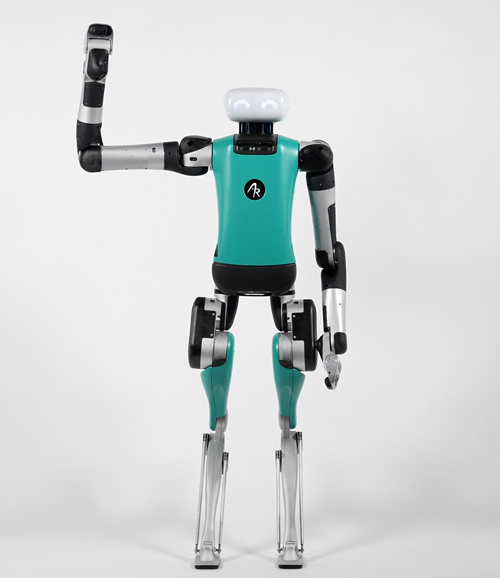
The company's Digit robot is a 175 cm, 60 kg bipedal humanoid designed specifically for warehouse and logistics material handling 7. It moves totes, loads and unloads conveyors and autonomous mobile robots (AMRs), handles bins, and operates in facilities built for human workers — without requiring structural modification to those facilities 13. The Arc cloud platform manages fleet orchestration, integrates with warehouse management and execution systems, and delivers over-the-air software updates 9. The primary commercial model is Robot-as-a-Service: Agility retains hardware ownership and charges a monthly subscription covering hardware, the workcell, Arc, maintenance, and updates 59.
Confirmed deployments as of mid-2026 include Amazon, GXO Logistics, Toyota Motor Manufacturing Canada (TMMC) in Woodstock, Ontario, and Mercado Libre in San Antonio, Texas 10131516. The TMMC engagement is particularly well-documented: a year-long pilot with three Digit units concluded with a commercial agreement signed in February 2026, with seven additional robots planned 1016. At a single unnamed Georgia facility, Agility reports that Digit has moved more than 100,000 totes 13 — a COMPANY CLAIM that has not been independently audited but is consistent with the deployment timeline.
Financially, the company has raised approximately $640 million in total funding across multiple rounds, with a $400 million round reported but not yet confirmed by primary sources 811. The CEO has disclosed a valuation of approximately $2 billion 1214. Manufacturing is concentrated at the 70,000 square-foot RoboFab facility in Salem, Oregon, which the company states can produce up to 10,000 robots per year at peak capacity 112. Approximately 80 percent of parts are US-sourced 13.
The central tension in Agility's story is the gap between its genuine first-mover advantage and the commercial scale required to justify its valuation and funding. Being first to deploy a humanoid in a warehouse is a real achievement. Sustaining that advantage against better-capitalised competitors — Boston Dynamics, Figure AI, 1X Technologies, and the emerging Chinese field — while simultaneously expanding the task repertoire, improving reliability, and driving down unit economics to the $2–3 per hour target the CEO has cited 5 is a categorically harder problem. This report examines the evidence for both sides of that tension.
Latest news
- Automate 2026 — North America's Premier Robotics Trade Show Opens in ChicagoStäubli Robotics·2026-06-22EVENT
- Nvidia leads China assisted-driving chip market; Horizon Robotics rises to secondDigitimes·2026-06-19GENERAL
- ABB RoboticsとPSYONIC、人間が生成したデータを活用してロボットの巧緻性を向上Prtimes.jp·2026-06-19GENERAL
- /C O R R E C T I O N -- Channel Robotics/Associated Press·2026-06-18GENERAL
- robotics-application-manager 5.6.12Pypi.org·2026-06-18GENERAL
- Berkeley researchers convert internet videos into robot training dataCrypto Briefing·2026-06-18GENERAL
- /C O R R E C T I O N -- Channel Robotics/PRNewswire·2026-06-18GENERAL
02The Agility Robotics Story
Origins: Oregon State and the Bipedal Bet
Agility Robotics was founded in 2015 as a spinoff from Oregon State University's Dynamic Robotics Laboratory 2. The three co-founders — Jonathan Hurst, Damion Shelton, and Mikhail Jones — brought with them a specific and at the time unfashionable conviction: that legs, not wheels, were the correct locomotion substrate for robots operating in human environments 228. Hurst, who served as Chief Robot Officer before transitioning roles, had spent years at OSU studying the biomechanics and control theory of legged locomotion. The lab's earlier work on ATRIAS, a spring-mass bipedal platform, provided the intellectual foundation for what would become Cassie and then Digit.
The OSU lineage is not merely biographical colour. It shaped the company's technical priorities in ways that remain visible today. The Dynamic Robotics Laboratory's approach emphasised passive dynamics, energy efficiency, and robust locomotion over manipulation dexterity — a hierarchy that explains both Digit's genuine strengths in walking through cluttered warehouse environments and its relative limitations in fine manipulation tasks. Independent research published on Digit hardware confirms that the locomotion policy work originating from this tradition has translated successfully to real hardware via sim-to-real transfer 2326.
Cassie to Digit: The Product Lineage
Before Digit, there was Cassie — a bipedal lower-body platform without arms or a torso, released in 2017 and sold to research institutions. Cassie was never a commercial product in the logistics sense; it was a research platform that generated academic publications, validated the locomotion approach, and provided cash flow during the pre-Digit years. Numerous university labs acquired Cassie units, and the resulting body of published research on bipedal locomotion control — much of it using reinforcement learning and sim-to-real transfer — constitutes a genuine intellectual asset that Agility has been able to build on 2325.
Digit emerged from Cassie by adding a torso, arms, and a sensor suite capable of supporting manipulation tasks. The transition from research platform to commercial product required not just hardware development but the construction of an entirely different organisational capability: manufacturing at scale, customer support, software integration with enterprise warehouse systems, and the development of a business model that could survive contact with procurement departments at large logistics operators.
Funding History and Investor Composition
The funding trajectory reflects both the genuine commercial progress and the broader surge of investor interest in humanoid robotics that characterised 2022–2025.
| Round | Date | Amount | Notable Investors |
|---|---|---|---|
| Series A | September 2020 | $20M | Undisclosed 18 |
| Series B | March 2022 | $150M | Amazon Industrial Innovation Fund 8 |
| Series C | November 2024 | $105M | Schaeffler Group, NVIDIA NVentures 820 |
| Reported additional round | 2025–2026 | ~$400M | WP Global, SoftBank (reported) 11 |
Total confirmed funding: approximately $375M across Series A–C 818. The $400 million additional round reported by illustrated-ai.com 11 has not been confirmed by primary sources and should be treated as UNKNOWN until corroborated. The cumulative "$640M+" figure cited in the dossier summary incorporates this unconfirmed round.
The investor composition is strategically significant. Amazon's participation in the Series B 8 is not merely financial: Amazon is simultaneously a customer deploying Digit in its facilities 13 and an investor with a stated interest in warehouse automation. This creates an alignment of incentives that is commercially useful but also raises questions about whether Amazon's deployment represents arm's-length commercial validation or a supported pilot by a strategic investor. The distinction matters for interpreting the strength of the commercial evidence. Schaeffler Group's Series C participation 820 is notable because Schaeffler is a precision engineering manufacturer with direct interest in industrial automation — a different kind of strategic validator than a financial investor.
NVIDIA's NVentures investment 20 aligns with NVIDIA's broader push into robotics infrastructure through its Isaac simulation platform and Omniverse tools. The technical partnership between Agility and NVIDIA 4 is consistent with Agility's use of simulation for policy training, though the specific terms of that partnership are not publicly disclosed.
The Rebrand: "Agility Robotics" Becomes "Agility"
On 5 March 2026, the company announced it was dropping "Robotics" from its name, becoming simply "Agility" 17. The stated rationale was expanding reach across emerging use cases beyond the original robotics framing 17. EDITORIAL INFERENCE: the rebrand is a positioning move consistent with a company that has secured enough commercial credibility to stop needing to explain what it does and wants to signal broader ambition — potentially into adjacent automation software, fleet management, or sectors beyond logistics. It is also consistent with the general trend among maturing robotics companies to present themselves as automation solution providers rather than hardware manufacturers. Whether the rebrand reflects genuine product diversification or is primarily a marketing exercise cannot be determined from available evidence.
Leadership and Organisational Structure
Jonathan Hurst co-founded the company and has served in technical leadership roles 2. Damion Shelton and Mikhail Jones are co-founders 2. The current CEO is not named in the research dossier's primary sources, though CEO statements on pricing and valuation are cited through commerce and news sources 512. UNKNOWN: the current full executive team composition is not detailed in the supplied dossier.
The company operates across three locations: primary manufacturing in Salem, Oregon; offices in Pittsburgh, Pennsylvania; and Fremont, California 12. The Pittsburgh presence is consistent with proximity to Carnegie Mellon University's robotics ecosystem. The Fremont location places the company near the Bay Area's software and AI talent pool.
03Product Portfolio: What Agility Robotics Actually Sells
Digit: The Core Product
Digit is the company's sole commercial product. It is a bipedal humanoid robot — two legs, two arms, a sensor-equipped head — designed from the outset for warehouse and logistics material handling rather than general-purpose manipulation 13. This design specificity is both a strength and a constraint: Digit is genuinely optimised for its target environment in ways that general-purpose humanoids are not, but it is also more narrowly applicable than the company's broader marketing language sometimes implies.
Hardware Specifications
| Parameter | Current Generation | Gen 5 (Planned) | Source |
|---|---|---|---|
| Height | 175 cm | Not disclosed | 7 |
| Weight | 60 kg | Not disclosed | 7 |
| Maximum speed | 1.8 m/s | Not disclosed | 7 |
| Lift capacity | 16 kg | 22.7 kg (50 lb deadlift) | 714 |
| Sensor suite | Cameras, LiDAR, multi-modal fusion | Not disclosed | 79 |
| Recharging | Autonomous docking | Not disclosed | 9 |
| Parts count | ~6,000 | Not disclosed | 13 |
| US-sourced parts | ~80% | Not disclosed | 13 |
The 1.8 m/s maximum speed is slower than a brisk human walk (approximately 1.4 m/s average, 2.0 m/s brisk). In a warehouse context, this is adequate for most material-handling workflows but becomes a constraint in high-throughput environments where cycle time is the binding variable. The 16 kg lift capacity covers the majority of standard warehouse tote weights but excludes heavier payloads common in manufacturing and heavy logistics. The planned Gen 5 increase to 22.7 kg 14 addresses this gap partially.
The autonomous docking for recharging 9 is a practically important feature that is often underweighted in competitor comparisons. A robot that requires human intervention to recharge cannot credibly claim autonomous operation across a full shift. Autonomous docking removes this dependency, though the charge time and duty cycle — the ratio of productive work time to charging time — are not publicly disclosed. UNKNOWN: battery capacity, charge time, and operational duty cycle per shift.
Agility Arc: The Software Platform
Arc is Agility's cloud-based fleet orchestration platform 19. Its stated functions include:
- Fleet management and monitoring across multiple Digit units
- Integration with warehouse management systems (WMS) and warehouse execution systems (WES)
- Integration with AMR fleets from third-party providers
- Over-the-air software updates
- Task assignment and workflow coordination
The Arc platform is included in the RaaS subscription 9. EDITORIAL INFERENCE: Arc is strategically important beyond its operational function. If Agility can establish Arc as the integration layer between humanoid robots and existing warehouse software infrastructure, it creates switching costs that extend beyond the hardware. A customer who has integrated Arc with their WMS and WES faces non-trivial re-integration work to switch to a competitor's robot. This is the same logic that has made enterprise software platforms sticky across many industries.
The specific technical architecture of Arc — whether it processes data on-device, in edge compute, or in cloud — is not publicly detailed. The cloud-based description 1 implies significant cloud dependency, which raises questions about latency, connectivity requirements, and operational resilience in facilities with unreliable network infrastructure. UNKNOWN: Arc's latency characteristics, offline operational capability, and data residency arrangements.
Workcell Concept
Agility deploys Digit within a defined "workcell" — a structured operational zone within a larger facility 9. The workcell is included in the RaaS subscription and represents the physical and software infrastructure required to support Digit's operation: charging station, safety perimeter definition, sensor calibration zones, and integration points with conveyor systems or AMR handoff locations.
The workcell concept is a pragmatic acknowledgement that "no facility modification required" 13 is a relative rather than absolute claim. Digit does not require structural changes to the building — no new conveyors, no raised floors, no dedicated corridors. But it does require a defined operational zone with specific setup. EDITORIAL INFERENCE: the workcell framing is honest engineering but creates a deployment friction that pure software products do not face. Each new workcell installation requires physical setup time, calibration, and integration work — costs that are absorbed into the RaaS model but that affect deployment velocity.
Business Model: RaaS and Direct Purchase
Agility offers two commercial routes 59:
Robot-as-a-Service (RaaS) — Primary Model
- Monthly subscription
- Agility retains hardware ownership
- Subscription covers: hardware, workcell, Arc software, maintenance, OTA updates
- Customer pays for productive robot-hours; Agility bears hardware depreciation and maintenance risk
Direct Purchase — Secondary Model
- Available through Ricoh USA partnership 9
- Customer purchases hardware outright
- Ongoing software and service subscriptions apply
- Customer bears hardware depreciation and maintenance risk
The RaaS model is the strategically preferred route for both parties in most scenarios. For customers, it converts capital expenditure to operating expenditure, reduces balance sheet risk, and aligns payment with value delivery. For Agility, it creates recurring revenue, maintains hardware control (enabling data collection and software improvement), and reduces the barrier to initial deployment. The Ricoh USA partnership for direct purchase 9 suggests Agility is willing to accommodate customers with different procurement preferences or accounting structures, but the RaaS model is clearly the primary commercial vehicle.
Pricing
The pricing picture is murky, which is itself informative.
| Source | Figure | Confidence |
|---|---|---|
| CEO-stated benchmark | $30/hour (against fully-loaded human worker cost) | Moderate 5 |
| Analyst estimates (operational cost) | $10–$25/hour currently | Low-moderate 57 |
| Long-term target | $2–$3/hour at scale | COMPANY CLAIM 5 |
| Estimated lease cost | $20,000–$25,000/year or $2,000–$4,000/month | Low 67 |
| Stated ROI target | Under 2 years | COMPANY CLAIM 5 |
The $30/hour CEO benchmark is the most authoritative single figure 5, but it requires careful interpretation. It appears to be a pricing anchor set against the fully-loaded cost of a human warehouse worker — not the internal cost to operate Digit. Analyst estimates of $10–$25/hour for actual operational cost 57 are plausible but unverified. If both figures are approximately correct, Agility's gross margin on RaaS is meaningful but not exceptional. The $2–$3/hour long-term target 5 is a COMPANY CLAIM that implies roughly a 10x reduction in operational cost through scale, manufacturing efficiency, and software improvement — an ambitious but not implausible trajectory for a hardware-plus-software platform at volume.
The under-two-year ROI claim 5 is a COMPANY CLAIM. It is not independently verified and depends heavily on assumptions about utilisation rate, task success rate, maintenance frequency, and the fully-loaded cost of the human labour being displaced. At current pricing and capability levels, the ROI case is plausible for high-throughput, repetitive tote-handling environments but less clear for more variable or complex tasks.
Manufacturing: RoboFab
The RoboFab facility in Salem, Oregon is a VERIFIED FACT 113. Key parameters:
- Floor area: 70,000 square feet 1
- Stated peak capacity: 10,000 robots per year 1214
- US-sourced parts: approximately 80% 13
- Total parts per robot: approximately 6,000 13
The 10,000 units per year figure is a COMPANY CLAIM for peak capacity — not current production volume. Current production volume is not publicly disclosed. EDITORIAL INFERENCE: the gap between stated peak capacity and actual current production is likely substantial. Building a facility capable of producing 10,000 units per year is a capital investment in anticipated demand; it does not mean that demand currently exists at that level. The 80% US-sourced parts figure is commercially and geopolitically significant given the current tariff environment (addressed in Section 10).
Products & versions
04Technology Stack: Strengths and the Work That Remains
Locomotion: The Genuine Strength
Agility's most defensible technical advantage is in bipedal locomotion. This is not a marketing claim — it is supported by a decade of published research from the Oregon State Dynamic Robotics Laboratory lineage and by independent peer-reviewed work demonstrating successful policy transfer to Digit hardware 232526.
The locomotion approach combines classical control theory with modern reinforcement learning. Early Digit work used model-based control with carefully designed feedback policies 23. More recent work has moved toward learning-based approaches, including sim-to-real transfer of locomotion policies trained in physics simulation and deployed on real hardware 26. The ASAP paper (Aligning Simulation and Real-World Physics for Learning Agile Humanoid Whole-Body Skills) 26 demonstrates that the sim-to-real gap — historically a major obstacle to deploying learned policies on physical robots — can be substantially closed through careful physics modelling and domain randomisation. This is independent research, not a vendor claim.
The practical consequence is that Digit can navigate warehouse floors with a robustness that earlier bipedal robots could not achieve. It handles minor floor irregularities, transitions between surface types, and the dynamic environment of an active warehouse — forklifts, human workers, moving conveyors — with sufficient reliability to operate in production settings. The 1.8 m/s maximum speed 7 is not impressive in absolute terms, but stable, reliable locomotion at moderate speed is more commercially valuable than fast locomotion that fails unpredictably.
Manipulation: The Acknowledged Gap
Manipulation — grasping, placing, and handling objects with the arms and hands — is where Digit's current limitations are most apparent. The task repertoire confirmed in production deployments is narrow: tote moving, bin handling, conveyor loading and unloading, AMR loading, tugger loading and unloading 313. These are all relatively structured tasks involving objects of known geometry in defined locations. They do not require the fine dexterity needed for, say, picking individual items from unstructured bins or handling deformable objects.
Community sources note that autonomy and dexterity still need improvement and that Digit is not yet at human-level agility 3537. This is accurate but requires contextualisation: no humanoid robot currently on the market achieves human-level manipulation dexterity in unstructured environments. The relevant question is whether Digit's manipulation capability is sufficient for its target task set, and the deployment evidence suggests it is — for the specific, structured tasks it currently performs.
The MuJoCo-based grasping simulation work visible in community video sources 32 suggests ongoing development of manipulation capabilities through simulation, consistent with the broader industry trend toward learning-based manipulation policies. Whether these simulated capabilities translate to reliable real-world performance at the task success rates required for commercial deployment is not established by available evidence.
Sensor Fusion and Perception
Digit's sensor suite combines cameras and LiDAR with multi-modal sensor fusion 79. The specific sensor models, resolution, field of view, and fusion architecture are not publicly disclosed. UNKNOWN: detailed perception stack architecture, object detection accuracy, and performance in challenging lighting or occlusion conditions.
The perception requirements for Digit's current task set are less demanding than for general-purpose manipulation: the robot needs to navigate to a known location, identify a tote or bin of known geometry, and execute a structured pick-and-place motion. This is a substantially easier perception problem than open-world object recognition. The workcell concept 9 further reduces perception difficulty by constraining the operational environment.
Agility Arc and Software Integration
The Arc platform's integration with WMS and WES systems 19 is a genuine technical and commercial differentiator. Most warehouse automation systems — conveyors, sorters, AMRs — require significant custom integration work to communicate with enterprise software. Agility's claim that Arc handles this integration as part of the RaaS offering 9 reduces the customer's integration burden, though the depth and reliability of these integrations in practice is not independently verified.
The OTA update capability 9 is standard for modern connected devices but important in the robotics context: it means Agility can push capability improvements, bug fixes, and safety updates to deployed robots without requiring on-site service visits. This is operationally efficient and also means that the robots customers deploy today will have different (presumably improved) capabilities over time — a selling point but also a source of operational unpredictability if updates change robot behaviour in ways that affect workflow integration.
Sim-to-Real Transfer: Independent Validation
The most technically significant independent validation in the research dossier is the body of work on sim-to-real transfer for Digit. The ASAP paper 26 and the reinforcement learning locomotion work 23 both demonstrate that policies trained in simulation can be transferred to real Digit hardware with sufficient fidelity to enable useful behaviour. This is not trivial: the sim-to-real gap has historically been a major obstacle to deploying learned policies on physical robots, because small differences between simulated and real physics compound into large behavioural differences.
The "No More Marching" locomotion paper 24 addresses a specific limitation of earlier learned locomotion policies — the tendency to produce unnatural, high-energy gait patterns — and demonstrates more natural short-range locomotion. This is relevant to warehouse deployment because energy efficiency directly affects duty cycle and operating cost.
The multi-contact MPC work 25 demonstrates dynamic loco-manipulation — coordinated locomotion and manipulation — on Digit hardware. This is more advanced than the current production task set and suggests a research pipeline that could expand Digit's capabilities over time, though the timeline from research demonstration to production deployment is typically measured in years.
Safety Architecture
Agility claims to be targeting the first "cooperatively safe" humanoid robot for 2026 413. This is a COMPANY CLAIM that has not been independently verified. The specific safety architecture — collision detection, force limiting, emergency stop protocols, human proximity sensing — is not publicly detailed. UNKNOWN: the specific safety standards (ISO 10218, ISO/TS 15066, or equivalent) to which Digit is designed or certified, and whether any third-party safety certification has been obtained.
The claim of "over a decade of deployment experience" 4 cited in support of the safety roadmap is misleading if taken at face value: Digit has been commercially deployed since 2023–2024 13, and Cassie, the predecessor platform, was a research tool rather than a commercial product. The decade of experience refers to the research lineage, not production deployment history.
05Research, Papers, Authors and Labs
The Oregon State Foundation
Agility Robotics' research identity is inseparable from Oregon State University's Dynamic Robotics Laboratory, where co-founder Jonathan Hurst developed the bipedal locomotion theory that underpins Digit 2. The lab's work on passive dynamics, spring-mass locomotion models, and the ATRIAS platform established the theoretical and experimental foundation for Cassie and Digit. This academic lineage is a genuine asset: it means Agility entered the commercial market with a deeper body of validated locomotion research than most startup competitors.
Key Published Research on Digit Hardware
The research dossier contains four papers directly relevant to Digit's technical capabilities:
[23] Robust Feedback Motion Policy Design Using Reinforcement Learning on a 3D Digit Bipedal Robot (arXiv:2103.15309) This paper demonstrates reinforcement learning-based locomotion policy design on real Digit hardware. It is significant as early independent evidence that learning-based policies can be transferred from simulation to the physical Digit platform. The work addresses the challenge of designing feedback policies that are robust to the model uncertainties inherent in sim-to-real transfer.
[25] Multi-Contact MPC for Dynamic Loco-Manipulation (arXiv:2209.08662) This paper demonstrates model predictive control for coordinated locomotion and manipulation — the robot moves while simultaneously manipulating objects. This is technically more demanding than the current production task set (which involves stationary or slow-moving manipulation) and represents a research capability that has not yet been demonstrated in production deployment.
[26] ASAP: Aligning Simulation and Real-World Physics for Learning Agile Humanoid Whole-Body Skills (arXiv:2502.01143) This is the most recent and technically significant paper in the dossier. ASAP addresses the sim-to-real gap directly, proposing methods to align simulation physics with real-world physics to enable transfer of agile whole-body skills. The paper demonstrates successful transfer on Digit hardware, providing independent validation of the sim-to-real approach that Agility uses for capability development.
[24] No More Marching: Learning Humanoid Locomotion for Short-Range SE(2) Targets (arXiv:2508.14098) This paper addresses the gait quality problem in learned locomotion — the tendency of RL-trained policies to produce unnatural, energy-inefficient gaits. The work is relevant to commercial deployment because energy efficiency affects operating cost and duty cycle, and gait naturalness affects human acceptance in shared workspaces.
Research Gaps and Limitations
The published research on Digit is concentrated in locomotion and whole-body control. There is notably less published work on:
- Manipulation dexterity and grasp success rates in unstructured environments
- Long-horizon task planning and execution
- Multi-robot coordination in shared spaces
- Failure mode analysis and recovery behaviours
- Human-robot interaction safety in production environments
These gaps in the published literature correspond to the known capability limitations of the current system. EDITORIAL INFERENCE: the research pipeline is advancing locomotion and whole-body control faster than manipulation dexterity — a pattern consistent with the company's OSU heritage and with the task set currently deployed in production.
Company-linked papers
- Three Engineers, Hundreds of Robots, One Warehouse2008·215 citations·Agility Digit
- AI buzzwords explained2017·34 citations·Agility Digit
- The Rise of Automation and Robotics in Warehouse Management2020·28 citations·Agility Digit
- Embodied intelligence in RO/RO logistic terminal: autonomous intelligent transportation robot architecture2025·22 citations·Agility Digit
- Robotics and Automation2024·16 citations·Agility Digit
- A Warehousing Robot: From Concept to Reality2023·10 citations·Agility Digit
- Human–Robot Collaboration: The Future of Smart Warehousing2021·6 citations·Agility Digit
- Bringing Robots Home: The Rise of AI Robots in Consumer Electronics2024·5 citations·Agility Digit
Code & simulation
- robosuite_RL Demo (Agility A2)YouTube (demo)
Open-source robosuite_RL demo showing Agility A2 learning robotic grasping in MuJoCo simulation, evidenced by a YouTube video from Agility Robotics.
Datasets & benchmarks
06Media Evidence Library: What the Videos Prove
Applying the Evidence Standard
Video evidence of robotics capability requires careful interpretation. A choreographed demonstration in a controlled environment proves that a specific behaviour was achieved under specific conditions on a specific occasion. It does not prove that the behaviour is reliable, repeatable, autonomous, or representative of production performance. This section applies that standard to the video evidence in the research dossier.
Automate 2025: Beyond the Bot with Agility Robotics [27]
What it shows: Agility's presentation at the Automate 2025 trade show, discussing Digit's capabilities and commercial deployments.
What it proves: The company's public positioning and messaging as of mid-2025. Trade show presentations are marketing events; claims made in this context are COMPANY CLAIMS unless corroborated by independent sources.
What it does not prove: Task success rates, autonomous operation duration, or the reliability of capabilities demonstrated in controlled settings.
The Two-Legged Robots Walking Into the Future [28]
What it shows: Journalistic or documentary coverage of bipedal robotics, likely including Digit footage.
What it proves: Media interest in the category and some visual evidence of Digit's locomotion capabilities.
What it does not prove: Production deployment performance or autonomous task completion in unstructured environments.
Breaking: CEO Sanctuary and Agility Drop 2 New Humanoid Demos [29]
What it shows: New capability demonstrations from Agility (and Sanctuary AI), presented in a live or near-live format.
What it proves: That Agility was actively developing and demonstrating new capabilities as of the recording date. CEO-presented demos are COMPANY CLAIMS in video form.
What it does not prove: That demonstrated capabilities are production-ready, reliably autonomous, or representative of deployed system performance.
Agility A2 Learns Robotic Grasping in MuJoCo [32]
What it shows: A simulation demonstration of robotic grasping using MuJoCo physics simulation, described as an open-source robosuite_RL demo.
What it proves: That simulation-based grasping research is ongoing and that some of this work is being shared publicly. The "A2" designation and open-source framing suggest this may be community or research work rather than official Agility product development.
What it does not prove: Real-hardware grasping capability, production-ready manipulation, or that simulation results transfer to physical Digit hardware.
Contaminated Sources: AGIBOT / Q1 Videos [30][31]
Two video sources in the dossier — "Unitree vs AGIBOT Kung Fu Robots Face Off in 2026" 30 and "Meet Your First Personal Humanoid: Q1" 31 — appear to relate to AGIBOT, a different Chinese robotics company, not Agility Robotics. The research dossier's conflict analysis correctly identifies this as source contamination: the Q1 robot (0.8m height, QDD joints, "Agi-Soul" AI, co-founder Zhihui Jun) is an AGIBOT product, not an Agility Robotics product 3031. These sources are excluded from the evidence base for this report.
The Evidentiary Gap
The most important observation about the video evidence is what is absent: there is no independently filmed, unedited footage of Digit operating autonomously in a production warehouse environment over an extended period. The confirmed deployments at Amazon, GXO, Toyota, and Mercado Libre 10131516 are documented through press releases and news articles, not through continuous operational video evidence. This is normal for industrial deployments — customers do not typically allow cameras on their production floors — but it means the video evidence cannot independently verify the autonomous production claims.
The strongest independent evidence for production deployment comes from written reporting: The Robot Report's coverage of the Toyota deployment 10 and The Logic's independent reporting on the same 16 provide corroborating journalistic accounts that are more evidentially robust than vendor-produced video.
Media library
07Commercial Reality
What Is Actually Confirmed
The commercial evidence for Agility is stronger than for any other humanoid robotics company currently operating, but it requires precise characterisation. The following are VERIFIED FACTS, supported by multiple independent sources:
Amazon: Deployment confirmed by multiple independent news sources 13. Amazon is also a Series B investor through the Amazon Industrial Innovation Fund 8, which complicates the interpretation of this as purely arm's-length commercial validation. The specific facility location, number of units deployed, task success rates, and commercial terms are not publicly disclosed.
GXO Logistics: Deployment confirmed by multiple independent news sources 13. GXO is a major third-party logistics operator, making this a commercially significant independent customer. Specific operational details are not publicly disclosed.
Toyota Motor Manufacturing Canada (Woodstock, Ontario): This is the best-documented deployment in the dossier. The Robot Report 10 and The Logic 16 provide independent corroborating coverage. Key confirmed facts:
- Year-long pilot with three Digit robots completed
- Commercial agreement signed February 2026
- Seven additional robots planned
- Tasks: tote/bin handling and tugger loading
The TMMC deployment is significant precisely because it is a manufacturing environment rather than a pure logistics/warehousing context, suggesting Digit's applicability extends beyond e-commerce fulfilment.
Mercado Libre (San Antonio, Texas): Commercial agreement announced via BusinessWire press release in December 2025 15. BusinessWire is a paid press release distribution service, so this is an official company announcement rather than independent journalism. However, the named customer (Mercado Libre, Latin America's largest e-commerce company) and the specific location (San Antonio, TX) provide sufficient specificity to treat this as a confirmed commercial agreement. Whether robots have been physically deployed and operating as of the report date is not independently confirmed.
100,000+ totes moved at a single Georgia facility: COMPANY CLAIM 13. Not independently audited. Consistent with the deployment timeline if task cycle times are in the range of minutes, but not independently verifiable.
The Customer Quality Question
The four confirmed customers represent a meaningful cross-section of the logistics and manufacturing landscape: a global e-commerce and logistics giant (Amazon), a major 3PL operator (GXO), a tier-one automotive manufacturer (Toyota), and a major Latin American e-commerce platform (Mercado Libre). This is not a list of friendly pilots with small companies — these are organisations with sophisticated procurement processes and genuine operational stakes.
However, the depth of these deployments matters as much as their existence
08Markets and Use Cases
Where Digit Actually Works Today, and Where the Roadmap Points
Agility's commercial deployments cluster tightly around a single operational archetype: a human-scale robot moving standardised containers — totes, bins, cases — between fixed points in a warehouse or light-manufacturing environment. That specificity is not a weakness in the short term; it is the strategic choice that made commercial deployment possible at all. The question for investors and prospective customers is how far that archetype can stretch before it encounters hard physical or economic limits.
The Core Beachhead: Intralogistics Tote Handling
The confirmed deployment tasks are tote and bin moving, conveyor loading and unloading, autonomous mobile robot (AMR) loading, and tugger loading and unloading 13. All of these share a common profile: objects of bounded weight (current 16 kg limit, rising to 22.7 kg in Gen 5), standardised geometry, and predictable pick-and-place locations defined by the workcell setup 714. The 100,000-plus totes moved at a single Georgia facility is the most concrete throughput figure in the public record 13, though Agility has not disclosed cycle time, error rate, or the proportion of that volume achieved without human intervention.
This beachhead market is large. Global warehouse automation spending was estimated at roughly $30 billion annually before the current wave of humanoid interest, and the addressable sub-segment — facilities that are too variable or too legacy-constrained for fixed automation — is routinely cited by analysts as the primary rationale for humanoid form factors. Agility's "no facility modification required" claim 19 is the commercial hook: a robot that can walk through an existing building, use existing shelving, and integrate with existing warehouse management systems via Arc is a fundamentally different procurement conversation from a conveyor overhaul.
The Agility Arc platform, which integrates with warehouse management systems (WMS) and warehouse execution systems (WES) as well as AMR fleets 19, is the software layer that makes multi-robot orchestration tractable. Without it, a single Digit unit is a curiosity; with it, a coordinated fleet becomes a plausible operational unit. The OTA update model means the software capability of deployed units can improve without physical recall, which matters for customers signing multi-year RaaS agreements.
Confirmed Customer Segments
| Customer | Sector | Task Confirmed | Source |
|---|---|---|---|
| Amazon | E-commerce fulfilment | Tote handling (pilot) | 13 |
| GXO Logistics | Third-party logistics | Bin/tote handling | 13 |
| Toyota Motor Manufacturing Canada | Automotive assembly support | Tote/bin handling, tugger loading | 1016 |
| Mercado Libre | E-commerce fulfilment (LatAm) | Tote handling (commercial agreement) | 15 |
The Toyota deployment is the most thoroughly documented. The Logic and The Robot Report both independently confirmed a year-long pilot with three Digit units at the Woodstock, Ontario facility, followed by a commercial agreement signed in February 2026 and a planned expansion to ten robots 1016. The automotive sector is a meaningful signal: Toyota's procurement processes are rigorous, and a signed commercial agreement — not merely a pilot letter of intent — implies the robot cleared internal safety and reliability thresholds. The specific tasks (tote and bin handling, tugger loading) are consistent with the intralogistics archetype rather than anything approaching assembly or precision manipulation.
Mercado Libre's commercial agreement, announced via Business Wire in December 2025, covers deployment at a San Antonio, Texas facility 15. The Latin American e-commerce giant's involvement is notable for two reasons: it extends Agility's customer base beyond North American manufacturing and logistics incumbents, and it suggests the RaaS model is commercially attractive to operators outside the traditional automation-heavy sectors.
Adjacent Markets: Plausible but Unproven
Light manufacturing support. The Toyota deployment hints at a broader automotive-adjacent opportunity: material replenishment to assembly lines, kitting, and sub-assembly transport. These tasks are structurally similar to warehouse tote handling but occur in more constrained, faster-paced environments with tighter tolerance for error. Agility's "no facility modification" claim is more strained here; automotive plants are not designed around humanoid robot traffic patterns, and the safety certification requirements for human-robot co-working in manufacturing are substantially more demanding than in warehouse aisles.
Retail backroom operations. Receiving, sorting, and replenishing stock in retail distribution centres shares the tote-handling profile. Several large US retailers have publicly explored humanoid pilots; none have been confirmed with Agility as of the coverage date.
Cold chain and hazardous environments. Digit's sensor suite and autonomous docking capability make it theoretically suitable for environments where human presence is costly or dangerous — cold storage, pharmaceutical distribution, certain chemical handling contexts. No deployments in these segments have been confirmed.
Post-rebrand expansion signals. The March 2026 rebrand from "Agility Robotics" to "Agility" was explicitly framed as reflecting ambitions beyond the Digit product line and beyond warehouse logistics 17. The company cited "emerging use cases" without specifying them. This is a standard pre-IPO narrative move — broadening the addressable market story — and should be treated as a directional signal rather than a product roadmap commitment.
Market Size and Competitive Timing
The intralogistics humanoid market is real but early. Agility's advantage is that it has actual paying customers and actual production hardware in actual facilities — a lead that is measured in years over most competitors. The risk is that the market window for a first-mover premium may be shorter than the capital cycle required to reach the cost targets ($2–$3 per hour at scale) that would make humanoids genuinely disruptive rather than merely premium 56. At current pricing estimates of $10–$25 per hour operational cost 67, Digit competes on flexibility and avoidance of capital expenditure, not on raw labour cost displacement.
The RaaS model is well-suited to a market where customers are uncertain about long-term humanoid reliability. Monthly subscriptions with Agility retaining hardware ownership 9 transfer technology risk back to the manufacturer, which is the correct commercial structure for a product category where failure modes are not yet well-characterised. The Ricoh USA partnership for direct purchase 9 provides an alternative for customers who prefer asset ownership, though the economics of owning a rapidly-iterating hardware platform are less obviously attractive.
09Competitive Landscape
Agility in a Field That Is Moving Fast
Agility's competitive position is unusual: it is simultaneously the most commercially advanced humanoid robotics company in the Western market and a company whose hardware and software are being challenged on multiple fronts by better-capitalised or more technically aggressive competitors. The field has changed materially since Digit's first commercial deployments in 2023.
Primary Competitors
| Company | Robot | Funding (approx.) | Commercial Status | Key Differentiator vs Agility |
|---|---|---|---|---|
| Figure AI | Figure 02 | ~$675M | Pilot deployments (BMW) | More dexterous hands; OpenAI partnership for language-conditioned control |
| Boston Dynamics | Atlas (electric) | Hyundai-backed | R&D / pilot | Exceptional dynamic mobility; Hyundai manufacturing integration |
| Tesla | Optimus | Internal (Tesla balance sheet) | Internal testing | Massive scale ambition; vertical integration; Tesla manufacturing base |
| 1X Technologies | NEO | ~$125M | Early pilot | Softer, safer design philosophy; Norwegian origin |
| Apptronik | Apollo | ~$350M | Pilot (Mercedes-Benz) | NASA heritage; explicit automotive focus |
| Unitree Robotics | H1/G1 | Undisclosed (Chinese) | Commercial (lower cost) | Dramatically lower price point; open SDK; Chinese manufacturing cost base |
| Sanctuary AI | Phoenix | ~$140M (CAD) | Pilot | Carbon-based AI; Canadian; strong manipulation focus |
Sources: publicly reported funding rounds and deployment announcements as of coverage date; Agility figures from 81112.
Agility's Structural Advantages
First commercial deployment. No other Western humanoid company has confirmed paying customers at the scale and variety Agility has achieved. Amazon, GXO, Toyota, and Mercado Libre are not pilot curiosities; they are named, independently confirmed commercial relationships 101516. This matters because it means Agility has real operational data — failure modes, maintenance intervals, task success rates — that competitors do not yet have. That data advantage compounds over time if Agility uses it effectively.
RoboFab manufacturing infrastructure. A 70,000 square foot dedicated humanoid manufacturing facility with stated peak capacity of 10,000 units per year and approximately 80% US-sourced components 112 is a genuine moat in the near term. No competitor has disclosed equivalent manufacturing infrastructure at scale. The US-sourcing figure is also relevant in the context of potential tariff or export-control pressures on Chinese-manufactured components (see Section 10).
Workcell-plus-software model. The Arc platform and the workcell deployment model mean Agility is selling a system, not just a robot. Competitors selling hardware alone face a harder commercial conversation with logistics operators who need integration, not just iron.
NVIDIA partnership. NVIDIA's NVentures participation in the Series C 20 is not merely financial. It signals access to NVIDIA's Isaac simulation platform and Omniverse tooling, which are increasingly central to the sim-to-real training pipelines that determine how quickly a humanoid company can expand its task library. Independent research has already demonstrated successful sim-to-real policy transfer on Digit hardware 2326, validating the technical approach.
Agility's Structural Vulnerabilities
Hardware performance gap. At 1.8 m/s maximum speed and 16 kg lift capacity (current generation) 7, Digit is not the fastest or strongest humanoid in the field. Boston Dynamics' electric Atlas has demonstrated more dynamic mobility in public videos, though Atlas has no confirmed commercial deployments. Tesla Optimus is targeting higher throughput in Tesla's own factories. Figure 02 has demonstrated more capable hand dexterity in its BMW pilot videos. Agility's Gen 5 improvements (22.7 kg lift) 14 are incremental rather than transformative.
Narrow task envelope. Digit's confirmed commercial tasks are all variations on the same theme: pick up a standardised container, carry it, put it down. This is commercially valuable but strategically limiting. Competitors pursuing broader manipulation capabilities — Figure with OpenAI language models, Sanctuary with its Carbon AI system — are building toward a more general-purpose robot. If the market shifts toward general manipulation before Agility expands its task library, the first-mover advantage in tote handling becomes less defensible.
Capital position relative to Tesla. Tesla's Optimus programme is funded from Tesla's balance sheet, which means it is not capital-constrained in the way a venture-backed company is. If Tesla achieves cost targets through vertical integration and manufacturing scale, it could undercut Agility's pricing before Agility reaches its own scale targets. This is a medium-term risk, not an immediate one, but it is the scenario that should concern Agility's investors most.
Chinese competition on cost. Unitree's G1 and H1 platforms are available at price points that make Agility's current cost structure look expensive. Unitree's open SDK and aggressive pricing are aimed at a different market segment (research, early adopters), but if Chinese humanoid manufacturers achieve the reliability thresholds required for industrial deployment, the cost differential becomes a serious competitive threat. The geopolitical constraints discussed in Section 10 may limit Chinese humanoid penetration in US and allied markets, which would benefit Agility, but this is not a permanent protection.
Competitive Positioning Summary
Agility's position is best described as: commercially ahead, technically mid-field, financially adequate but not dominant. The company has converted its academic origins and early-mover advantage into real customer relationships and real manufacturing infrastructure. It has not yet demonstrated the technical breadth or cost trajectory that would make it the obvious long-term winner in a field where Tesla, Boston Dynamics (Hyundai), and well-funded startups are all accelerating. The next 18 months — Gen 5 hardware, RoboFab scale-up, and whether the $400 million funding round closes at the reported terms — will determine whether Agility consolidates its lead or finds itself in a more contested position.
Competitive comparison
| Robot | Maker | Autonomy | Conf. |
|---|---|---|---|
| iRobot Roomba Combo 10 Max | iRobot | Autonomous | 0.90 |
| Mobile ALOHA (Stanford) | Stanford University | Teleoperated | 0.90 |
| 1X NEO | 1X Technologies | Remote-Assisted | 0.90 |
10Geopolitical Context and Constraints
Supply Chain, Policy, and the US-China Dimension
Agility operates in a sector that has become geopolitically charged with unusual speed. Humanoid robotics sits at the intersection of advanced manufacturing, artificial intelligence, and national security — a combination that has attracted regulatory attention in both Washington and Beijing.
US Manufacturing and Supply Chain
Agility's approximately 80% US-sourced components figure 112 is a deliberate strategic choice, not merely a logistical one. In the current US policy environment — characterised by the CHIPS Act, expanded export controls on advanced semiconductors, and growing political pressure to reshore advanced manufacturing — a company that can credibly claim domestic supply chain depth has a procurement advantage with US government-adjacent customers and is better insulated from tariff shocks.
The RoboFab facility in Salem, Oregon 112 is the physical manifestation of this strategy. Building a dedicated humanoid manufacturing plant in the United States, at a time when most electronics manufacturing has migrated to Asia, is expensive. The capital cost is partially offset by the strategic positioning it enables. If US tariffs on Chinese-manufactured robots increase — a plausible scenario given the trajectory of US-China trade policy — Agility's domestic manufacturing becomes a significant competitive advantage over any competitor relying on Chinese component supply chains.
The approximately 20% of components sourced outside the US represents a residual vulnerability. Agility has not publicly disclosed which components fall into this category. If any are sourced from China — particularly sensors, actuators, or power electronics — they are exposed to tariff escalation and potential export control restrictions. This is an unknown that prospective customers and investors should probe.
NVIDIA Partnership and Export Controls
NVIDIA's investment via NVentures 20 and the associated technical partnership create a dependency on NVIDIA's compute platforms for simulation and training. NVIDIA's advanced GPUs are themselves subject to US export controls that restrict their sale to China. This is not a constraint on Agility's domestic operations, but it is relevant to any future international expansion strategy, particularly if Agility were to pursue deployments in markets where NVIDIA hardware access is restricted.
The China Competitive Threat and Market Access
The research dossier flags unverified claims about Agility deployments with China Post and SF Express [conflict noted in dossier]. These claims appear in a single lower-confidence source and have no independent corroboration. They should not be treated as confirmed. More broadly, Agility has not disclosed any commercial deployments in China, and it is unclear whether the company has any strategic intent to compete in the Chinese market given the domestic humanoid robotics ecosystem (Unitree, AGIBOT, Fourier Intelligence, and others) and the regulatory environment.
The more relevant geopolitical dynamic is the inverse: whether Chinese humanoid manufacturers can penetrate the US and allied markets where Agility operates. US government scrutiny of Chinese technology in critical infrastructure is increasing. Several US states and federal agencies have restricted or are considering restrictions on Chinese-manufactured drones and autonomous systems. If similar restrictions extend to humanoid robots in logistics facilities — particularly those handling goods for US defence contractors or critical supply chains — Chinese competitors would face significant market access barriers, benefiting Agility.
Automotive Sector Geopolitics
The Toyota Motor Manufacturing Canada deployment 1016 is notable in the geopolitical context. Toyota is a Japanese company operating a Canadian facility, deploying an American humanoid robot. This is a supply chain configuration that is broadly aligned with the "friend-shoring" logic of current US and allied trade policy. As automotive manufacturers face pressure to demonstrate supply chain resilience and domestic content, partnerships with US-based robotics companies may carry political as well as operational value.
Labour Relations and Regulatory Environment
Humanoid robots in warehouses and manufacturing facilities are not politically neutral. The deployment of Digit at Amazon facilities — a company with a contentious labour relations history — has attracted scrutiny from labour advocates. No regulatory action has been taken against Agility or its customers as of the coverage date, but the policy environment around automation and worker displacement is evolving. Several US states have introduced or are considering legislation requiring advance notice of automation deployments or imposing automation taxes. These are medium-term risks that could affect the pace of customer adoption, particularly among unionised facilities.
Agility's safety roadmap — the vendor claim of being the first "cooperatively safe" humanoid targeted for 2026 4 — is relevant here. Regulatory approval for human-robot co-working in industrial environments is a genuine bottleneck. The relevant standards bodies (ISO, ANSI, OSHA in the US context) have not yet published comprehensive standards for humanoid robots operating in shared human workspaces. Agility's "over a decade of deployment experience" claim 4 is the basis for its safety credibility, but independent verification of that claim's substance — what specific safety certifications Digit holds, what incident record exists — is not available in the public record.
11The Hype, the Real and the Ugly
Separating Signal from Noise in Agility's Public Narrative
Agility is a company with genuine achievements that has also participated enthusiastically in the humanoid robotics hype cycle. Distinguishing between the two requires applying consistent evidentiary standards to specific claims.
What Is Real
Commercial deployment is real. Four named customers — Amazon, GXO Logistics, Toyota Motor Manufacturing Canada, and Mercado Libre — are confirmed by multiple independent sources 10151613. The Toyota deployment in particular is documented in granular detail by two independent outlets, including the specific number of robots (three in pilot, ten planned), the specific facility (Woodstock, Ontario), and the specific tasks (tote/bin handling, tugger loading). This is not a choreographed demo; it is a commercial agreement with a company that has rigorous procurement standards.
Sim-to-real policy transfer is real. Independent peer-reviewed and preprint research has demonstrated successful transfer of reinforcement-learning locomotion policies to physical Digit hardware 2326. This is not a vendor claim; it is independent scientific validation of a core technical approach. The ASAP paper 26 specifically addresses the sim-to-real gap for humanoid whole-body skills, and the work in 23 demonstrates robust feedback motion policy design on the 3D Digit platform. These results confirm that Agility's technical foundation is sound, even if the gap between research demonstrations and production-grade reliability is substantial.
RoboFab is real. The 70,000 square foot manufacturing facility in Salem, Oregon, with stated capacity for 10,000 units per year, is confirmed by multiple sources including official company materials and independent reporting 112. A facility of this scale represents a genuine capital commitment and a genuine manufacturing capability that most competitors lack.
The funding is substantially real. The Series A ($20 million), Series B ($150 million, including Amazon Industrial Innovation Fund), and Series C ($105 million, including Schaeffler and NVIDIA's NVentures) are confirmed by multiple sources 81820. The additional $400 million round reported by illustrated-ai.com 11 is from a single lower-confidence source and should be treated as unconfirmed until corroborated.
What Is Claimed but Unverified
"First commercially deployed humanoid." Agility uses this framing 14, and it is defensible for the specific definition of "humanoid" (bipedal, human-scale) in industrial settings. However, it depends on definitional choices. Boston Dynamics' Spot (quadruped, not humanoid) has been commercially deployed longer. The claim is marketing language, not a falsifiable technical statement.
"Cooperatively safe" by 2026. The vendor has stated this target 4, but no independent verification of what specific safety certifications or standards this refers to, or whether the target has been met, is available in the public record. Safety certification for human-robot co-working in industrial environments is a multi-year regulatory process; a vendor announcement is not equivalent to certification.
ROI under two years. The vendor-stated target 5 is plausible at the right pricing and utilisation assumptions but has not been independently verified with customer data. No customer has publicly confirmed achieving this ROI. The calculation is sensitive to assumptions about uptime, task success rate, and the fully-loaded cost of the human labour being displaced.
$30/hour pricing benchmark. The CEO-stated figure 5 is the most authoritative single source, but it is a pricing benchmark set against human labour cost, not a disclosed contract price. Actual contract terms are not public. The $10–$25/hour operational cost estimates from analysts 67 may reflect cost-to-operate rather than price-to-customer, and both can be simultaneously true.
300% Q2 2026 delivery volume growth and China Post/SF Express deployments. These claims appear in a single source with no independent corroboration [conflict noted in dossier]. They should not be cited as facts. The confirmed deployment base (Amazon, GXO, Toyota, Mercado Libre) is the appropriate reference point.
What Is Ugly
The autonomy framing is selectively applied. Agility describes Digit as operating "autonomously 24/7 in production environments" 14. The operational reality is more nuanced: Digit requires a workcell setup, Arc cloud connectivity, periodic maintenance, and autonomous docking for recharging 9. None of these requirements disqualify the autonomous classification for the specific tasks Digit performs, but the "24/7" claim implies a reliability and uptime that has not been independently verified. The dossier's autonomy verdict (confidence 0.82) appropriately notes the absence of independent operational audits of task success rates and intervention frequency.
Demo videos are not operational evidence. Several of the video sources in the dossier 272829 show Digit performing tasks in controlled or semi-controlled environments. The editorial standard applied throughout this report treats choreographed demo videos as illustrative of capability, not proof of autonomous production performance. The distinction matters: a robot that can move a tote in a demo environment and a robot that can move totes reliably for eight hours in a noisy, variable warehouse environment are different things. Only the Toyota and GXO deployments provide evidence of the latter, and even there, detailed performance metrics are not public.
The rebrand narrative is premature. The March 2026 rebrand to "Agility" with language about "expanding reach across emerging use cases" 17 is a classic pre-IPO narrative broadening exercise. The company's actual commercial revenue comes from one product (Digit) performing one category of tasks (intralogistics tote handling) for four confirmed customers. The rebrand is a legitimate strategic signal about ambition, but treating it as evidence of a diversified business would be a category error.
Pricing economics at scale are unproven. The target of $2–$3 per hour at scale 56 would require a combination of manufacturing cost reduction, software amortisation across a large fleet, and maintenance cost reduction that has not been demonstrated. The path from current operational cost estimates ($10–$25/hour) to $2–$3/hour involves assumptions about manufacturing yield, component cost curves, and software leverage that are speculative. This is not a criticism unique to Agility — it applies to the entire humanoid robotics sector — but it is a material uncertainty for any investment or procurement decision with a long time horizon.
Claim tracker
Independent research confirms successful sim-to-real policy transfer on Digit hardware, and confirmed deployments at Amazon, GXO, Toyota, and Mercado Libre involve Digit autonomously handling totes/bins — not humans performing those tasks.
The 10,000 robots/year peak capacity figure originates from Agility's own marketing materials for the 70,000 sq ft facility; no independent production audit or third-party verification of this throughput claim has been publicly confirmed.
The $30/hour figure is a CEO-stated pricing benchmark set against fully-loaded human labor cost, not a verified internal operational cost — analyst estimates of actual cost-to-operate range $10–$25/hour, and neither figure has been independently audited.
The under-2-year ROI target is a vendor-stated figure with no independently verified customer case studies, published financial analyses, or third-party ROI audits to substantiate it.
These claims appear in a single lower-confidence source and are not corroborated by any independent reporting, while confirmed deployments are limited to Amazon, GXO, Toyota, and Mercado Libre.
12Future Scenarios
Three Plausible Paths for Agility Through 2028
Scenario analysis for a company at Agility's stage requires distinguishing between variables the company controls (product development, manufacturing scale, pricing strategy) and variables it does not (competitor progress, regulatory environment, macroeconomic conditions, customer adoption pace). The following three scenarios are constructed from the evidence base; they are not forecasts.
Scenario A: Consolidation and Category Leadership (Probability: Moderate)
Conditions required: Gen 5 hardware delivers the 22.7 kg lift capacity and improved reliability on schedule; the reported $400 million funding round closes at or near the $2 billion valuation; RoboFab scales to several hundred units per year by end of 2026 and several thousand by 2028; Arc platform deepens WMS/WES integrations; two or more additional named enterprise customers sign commercial agreements.
Outcome: Agility establishes a durable position as the leading Western humanoid robotics company for intralogistics applications. The customer base expands from four to fifteen or more named accounts. The RaaS model generates recurring revenue sufficient to fund continued R&D without dependence on additional dilutive funding rounds. A credible IPO pathway opens in 2027–2028. The $30/hour pricing benchmark holds, and operational costs decline toward $10/hour as manufacturing scale improves.
Key indicators to watch: Gen 5 commercial availability date; RoboFab production volume disclosures; new customer announcements with named facilities and confirmed tasks; Arc platform integration partnerships.
Scenario B: Technical Plateau and Competitive Squeeze (Probability: Moderate)
Conditions required: Gen 5 hardware improvements are incremental rather than transformative; Figure AI, Apptronik, or another competitor demonstrates materially superior manipulation capability in production environments; Tesla Optimus achieves internal deployment at scale, creating a credible cost benchmark that undercuts Agility's pricing; the $400 million funding round closes at a lower valuation or with more dilutive terms than reported.
Outcome: Agility retains its existing customer base but struggles to expand beyond the tote-handling niche. The competitive narrative shifts from "first mover" to "narrow specialist." Pricing pressure from better-capitalised competitors forces margin compression. The IPO window narrows. The company remains viable but does not achieve category leadership; it becomes an acquisition target for a larger industrial automation or logistics company seeking humanoid capability.
Key indicators to watch: Competitor deployment announcements with performance metrics; Agility's task library expansion (or lack thereof); pricing disclosures from customer contracts; any reports of customer churn or pilot terminations.
Scenario C: Structural Disruption from Below (Probability: Lower but Non-Trivial)
Conditions required: Chinese humanoid manufacturers (Unitree, AGIBOT, or successors) achieve industrial-grade reliability at dramatically lower cost; US regulatory barriers to Chinese humanoid deployment in logistics facilities do not materialise or are circumvented; a major US logistics operator (not currently an Agility customer) deploys Chinese humanoid robots at scale, establishing a cost benchmark that Agility cannot match.
Outcome: Agility's RaaS pricing model becomes untenable. The US-manufacturing premium that RoboFab represents becomes a cost disadvantage rather than a strategic asset. The company is forced into a fundamental restructuring of its cost model or a pivot to higher-value, lower-volume applications (specialised manufacturing, defence-adjacent, hazardous environments) where cost is less decisive than capability and supply chain provenance.
Key indicators to watch: Chinese humanoid reliability data from independent sources; US regulatory developments on Chinese robotics in critical infrastructure; pricing announcements from Chinese competitors targeting US enterprise customers.
Cross-Scenario Variables
Several factors cut across all three scenarios and deserve explicit monitoring:
Labour market conditions. Tight labour markets accelerate humanoid adoption; labour market softening reduces the urgency of automation investment. The US warehouse labour market has been structurally tight since 2020; any significant shift would affect Agility's customer pipeline.
Insurance and liability frameworks. The absence of established liability frameworks for humanoid robots in shared workspaces is a genuine commercial friction. If a Digit unit causes a workplace injury, the legal and reputational consequences for Agility and its customers are unclear. The development of clear liability frameworks — whether through legislation, industry standards, or case law — would accelerate adoption; continued ambiguity would constrain it.
General-purpose AI integration. The integration of large language models and vision-language models into robot control stacks is proceeding rapidly across the industry. If Agility successfully integrates general-purpose AI to expand Digit's task library beyond tote handling, the addressable market expands significantly. If competitors achieve this integration first and more effectively, Agility's narrow task focus becomes a liability.
13What to Watch: A Live Monitoring Checklist
The following indicators are the most diagnostically useful signals for tracking Agility's trajectory. They are organised by time horizon and evidence type.
Immediate (0–6 Months)
Gen 5 hardware commercial availability. Agility has disclosed the 22.7 kg lift capacity target for Gen 5 14 but has not confirmed a commercial availability date. The gap between announced specification and customer-available hardware is a standard industry metric for execution credibility.
$400 million funding round confirmation. The round reported by illustrated-ai.com 11 has not been corroborated by independent sources as of the coverage date. Confirmation — or denial — from a primary source (SEC filing, official press release, named investor confirmation) would materially update the financial picture.
New named customer announcements. Each new named customer with a confirmed facility and confirmed tasks (not merely a "partnership" or "pilot agreement") is evidence of commercial traction. Watch for announcements that include independent corroboration from the customer side, not just Agility press releases.
Safety certification disclosures. The "cooperatively safe" target for 2026 4 should produce specific, verifiable outputs: named safety standards achieved, certification body, scope of certification. Vague vendor announcements without these specifics should be treated sceptically.
Medium Term (6–18 Months)
RoboFab production volume. Agility has stated peak capacity of 10,000 units per year 112 but has not disclosed actual production volumes. Any disclosure of units shipped, units deployed, or fleet size would be a significant data point. Watch for indirect signals: component supplier announcements, logistics filings, customer fleet size disclosures.
Task library expansion. Digit's current confirmed task set is narrow. Any credible demonstration — ideally in a production environment, not a demo video — of tasks beyond tote/bin handling (assembly support, quality inspection, more complex manipulation) would signal meaningful capability expansion.
Arc platform integrations. New WMS/WES integration partnerships, particularly with major logistics software providers (Manhattan Associates, Blue Yonder, SAP Extended Warehouse Management), would indicate that the software platform is scaling alongside the hardware.
Competitor deployment announcements. Figure AI's BMW pilot, Apptronik's Mercedes-Benz engagement, and Boston Dynamics' Atlas commercial programme are the most relevant competitive signals. Watch for any of these moving from pilot to commercial agreement with disclosed performance metrics.
Labour relations and regulatory developments. Monitor US federal and state legislative activity on automation disclosure requirements, automation taxes, and humanoid-specific safety regulations. Monitor OSHA guidance on human-robot co-working standards.
Longer Term (18+ Months)
IPO or acquisition activity. The $2 billion valuation and the pre-IPO narrative of the March 2026 rebrand suggest an IPO is a plausible medium-term outcome. Watch for S-1 filing activity, investment bank mandates, or acquisition approaches from industrial automation majors (Honeywell, Emerson, Rockwell Automation) or logistics companies (DHL, FedEx, UPS).
Operational performance data. The most important long-term signal is data that does not currently exist in the public record: task success rates, mean time between failures, maintenance cost per unit per year, and customer renewal rates on RaaS contracts. Any customer that publicly discloses operational performance data — positive or negative — would be a significant input to the investment and procurement calculus.
Cost trajectory. The path from $10–$25/hour operational cost to the $2–$3/hour target 56 requires manufacturing scale and software amortisation that will take years to achieve. Watch for any disclosed cost-per-unit figures, manufacturing yield data, or component cost reduction announcements that would allow independent assessment of whether the cost trajectory is on track.
Chinese humanoid industrial deployments in Western markets. If any Chinese humanoid manufacturer achieves confirmed, independently verified industrial deployment in the US, EU, or allied markets at a materially lower price point than Agility, the competitive landscape changes fundamentally.
14Sources and Methodology
Source List
1 Industrial Humanoid Automation | Agility — https://agilityrobotics.com
2 Company | Agility — https://agilityrobotics.com/company
3 Humanoid Solutions | Agility — https://agilityrobotics.com/solutions
4 Latest Press | Agility — https://agilityrobotics.com/latest-press
5 How Monetizely's 5-Step Framework Can Help You Price Humanoid Robots — https://www.getmonetizely.com/blogs/are-you-ready-to-buy-humanoid-robots-on-a-subscription-plan
6 Agility Robotics Stock: $2.1B Valuation — Is It a Buy? — https://tsginvest.com/agility-robotics
7 Tesla Optimus vs Digit: Complete Comparison [Mar 2026] | Robozaps — https://blog.robozaps.com/b/tesla-optimus-vs-agility-robotics-digit
8 Sell or Invest in Agility Robotics Stock Pre-IPO — http://www.nasdaqprivatemarket.com/company/agility-robotics
9 FAQs | Agility — https://www.agilityrobotics.com/faq
10 Toyota Motor Manufacturing Canada to deploy Agility Robotics' Digit humanoids — The Robot Report — https://www.therobotreport.com/toyota-motor-manufacturing-canada-deploys-agility-robotics-digit-humanoids/
11 Agility Robotics Raises $400M for Humanoid Warehouse Bots — https://illustrated-ai.com/agility-robotics-400m-raise-for-humanoid-warehouse-robots/
12 Agility Robotics Plans New Funding Round at $2B Valuation, Expands RoboFab to 10,000 Units Annually | Embodied Global — https://embodiedglobal.com/en/article/agility-robotics-2b-valuation-new-funding-robofab-2026
13 Agility Robotics Digit Goes Commercial: Amazon, Toyota & GXO Deploy Humanoid Robots in Real Warehouses | Embodied Global — https://embodiedglobal.com/en/article/agility-robotics-digit