Sphero BOLT
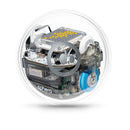
The Sphero BOLT is a programmable robotic ball designed primarily for K–12 STEM education. Manufactured by Sphero, it features a transparent shell housing an 8×8 RGB LED matrix, an infrared sensor, a compass, an accelerometer, and a gyroscope, enabling a wide range of coding and interactive activities. Students can program the BOLT using block-based drag-and-drop coding, a drawing-based interface, JavaScript, or Python through the Sphero Edu app, making it accessible to beginners while offering depth for more advanced learners. The BOLT is positioned as a classroom-ready tool, supporting multi-robot activities through its infrared communication capability, which allows multiple BOLTs to sense and interact with one another. It is rechargeable via an inductive charging cradle and is designed to be durable enough for repeated classroom use. Sphero markets the BOLT to educators, school districts, and coding camps as a versatile, engaging platform for teaching computational thinking and programming fundamentals.
Overview and Use Cases
The Sphero BOLT is a spherical educational robot built around the idea that learning to code should be tactile, visual, and fun. Its transparent polycarbonate shell reveals an internal 8×8 RGB LED matrix that can display animations, scrolling text, and real-time sensor data, giving students immediate visual feedback from their programs. The BOLT is used in a variety of educational contexts, including:
- Classroom coding lessons aligned to computer science standards
- STEM clubs and after-school programs focused on robotics and programming
- Coding camps for elementary through high school students
- Multi-robot collaborative activities using infrared communication between units
The Sphero Edu app provides a library of educator-created activities and lesson plans, lowering the barrier for teachers who may not have a deep coding background.
Key Technical Features
The BOLT's sensor suite and programmable outputs set it apart from simpler robotic toys:
- 8×8 RGB LED matrix: Displays graphics, text, and data visualizations
- Infrared sensor: Enables communication and proximity detection between multiple BOLT units
- Compass (magnetometer): Allows heading-aware navigation programming
- Accelerometer and gyroscope: Detect motion, orientation, tilt, and collision events
- Bluetooth connectivity: Pairs with iOS, Android, macOS, and Chromebook devices via the Sphero Edu app
- Inductive charging: The BOLT charges wirelessly in its cradle; reported runtime is approximately two hours of active use on a full charge, though real-world results vary by activity intensity
- Waterproof shell: The sealed design reportedly makes it water-resistant, adding to classroom durability
Programming options span four modalities — block-based (Scratch-like), draw (trace a path on screen), JavaScript, and Python — allowing the same hardware to serve students across multiple grade levels and skill stages.
Comparison to Similar Robots
Within Sphero's broader ecosystem, the BOLT occupies a mid-to-upper tier among Sphero's educational lineup. It offers more sensors and the LED matrix compared to the entry-level Sphero Mini, while remaining more approachable and lower-cost than Sphero's RVR programmable rover platform.
Compared to competitors in the K–12 educational robotics space:
- mBot2 (Makeblock): A wheeled robot with a more traditional form factor, better suited to physical construction challenges; the BOLT's spherical design emphasizes motion and sensor-based coding over building.
- NAO 6 (SoftBank Robotics / now Aldebaran): A humanoid robot targeting higher education and research; far more complex and expensive than the BOLT, which is aimed at younger or introductory learners.
- Ozobot Evo: Another small programmable robot for classrooms, but with a simpler sensor set and no LED matrix display comparable to the BOLT's.
Market Context and Target Buyers
The Sphero BOLT is priced in the mid-range of the educational robotics market — above basic coding toys but well below professional or research-grade platforms. It is typically sold both individually and in classroom packs (often sets of 15 units bundled with charging cradles). Target buyers include:
- K–12 schools and school districts procuring STEM tools
- Public libraries and maker spaces
- Private coding academies and summer camps
- Individual parents seeking an advanced coding toy for motivated learners
Spherical robots have a niche appeal: their motion is omnidirectional and visually engaging, which can sustain student interest longer than stationary or simple wheeled robots.
Deployments and Notable Adoption
Spheroy has reported broad adoption of the BOLT across school districts in the United States and internationally, though specific district names and deployment scales are not consistently disclosed in public materials. The Sphero Edu platform, which supports the BOLT, reportedly hosts a large community of educators who share lesson plans and activities. The BOLT has been featured in various STEM education initiatives and coding awareness campaigns, though detailed partnership specifics are not always publicly confirmed.
Future Outlook
As coding education continues to expand in K–12 curricula globally, demand for accessible, multi-modal programming platforms like the BOLT is expected to remain steady. Sphero has historically updated its app and curriculum resources more frequently than its hardware, suggesting the BOLT's longevity may depend on continued software support and curriculum alignment. Competition from lower-cost alternatives and the growing availability of free software-based coding tools may pressure the hardware segment, but the BOLT's combination of physical engagement and sensor richness continues to differentiate it in the classroom robotics market.
Related entries
 Robot
RobotG1
The Unitree G1 is a general-purpose humanoid robot developed by Unitree Robotics, a Chinese robotics company headquartered in Hangzhou. Standing approximately 1.32 meters tall and weighing around 35 kilograms, the G1 features 23 degrees of freedom and is capable of walking, running, recovering from falls, and performing dexterous manipulation tasks. It ships with SDK access, making it accessible to researchers and small-business operators seeking an affordable entry point into humanoid robotics. The G1 is widely regarded as one of the most competitively priced serious humanoid platforms available as of public reporting, positioning Unitree as a disruptive force in a market historically dominated by far more expensive systems. Its combination of mobility, recoverability, and open software access has attracted attention from academic institutions, robotics developers, and automation-focused startups worldwide.
44 views
 Robot
RobotUniversal Robots UR5e
The Universal Robots UR5e is a six-axis collaborative robot arm (cobot) belonging to Universal Robots' e-Series product line. Designed for light-to-medium industrial and laboratory tasks, it is widely used in assembly, pick-and-place, machine tending, quality inspection, and lab automation workflows. Universal Robots, a Danish company and a subsidiary of Teradyne, is one of the most recognized names in the collaborative robotics market. The UR5e is programmed using Universal Robots' PolyScope graphical interface on a teach pendant, making it accessible to operators without deep robotics expertise. Its built-in force/torque sensing, tool-center-point control, and a broad ecosystem of certified end-effectors and accessories (the UR+ platform) have made it a popular mid-range cobot choice across manufacturing, electronics, food handling, and research sectors.
43 views
 Robot
RobotQuicktron M100
The Quicktron M100 is a heavy-duty autonomous mobile robot (AMR) belonging to Quicktron Robotics' M-Series product line. It is designed for demanding material handling tasks in warehouses, distribution centers, and manufacturing environments, using an integrated lift mechanism to transport shelves and pallets autonomously across facility floors. Quicktron Robotics, a company with roots in China and a global commercial presence, positions the M100 as a high-capacity solution for operations that require moving heavier loads than lighter AMR models can accommodate. The M100 targets logistics operators and manufacturers seeking to automate goods-to-person or pallet-movement workflows at scale.
36 views
 Robot
RobotNVIDIA Jetson Orin NX
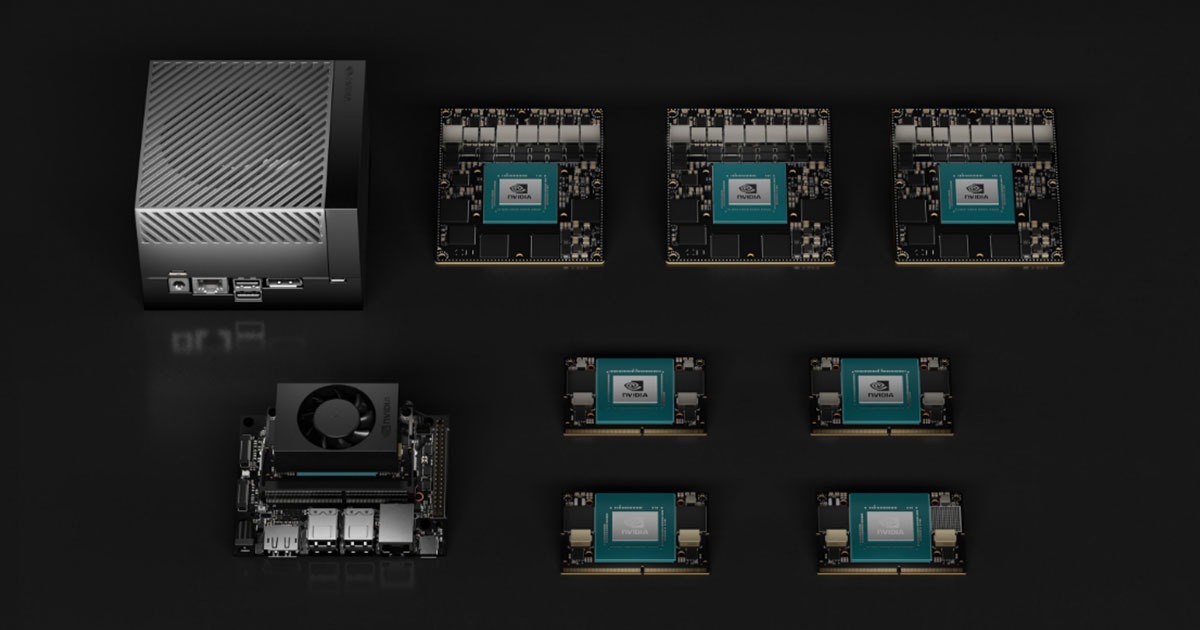
The NVIDIA Jetson Orin NX is a compact, SO-DIMM form-factor edge AI compute module designed for robotics, autonomous machines, and embedded vision applications. Manufactured by NVIDIA, it is available in 8 GB and 16 GB memory configurations and pairs an Ampere-architecture GPU with an 8-core Arm Cortex-A78AE CPU to deliver high-throughput on-device inference without relying on cloud connectivity. Positioned within NVIDIA's broader Jetson Orin family, the Orin NX targets developers and system integrators who need a balance of performance and power efficiency in a small footprint. It is commonly used in applications such as industrial inspection, autonomous mobile robots (AMRs), drone navigation, and smart edge devices where real-time AI inference is critical.
35 views