LuckiBot Pro
The LuckiBot Pro is a next-generation AI-powered delivery robot developed by OrionStar Robotics, designed for deployment in hospitality environments such as restaurants and hotels. It is built to autonomously transport food, beverages, and other items to guests, reducing the workload on human staff while maintaining a consistent service experience. The robot features a 240° LiDAR sensor combined with dual RGB-D 3D cameras for obstacle avoidance, a 14.1-inch HD touchscreen display for guest interaction, and an industry-notable dish recognition camera that allows it to identify and manage food items. These capabilities position the LuckiBot Pro as one of the more sensor-rich hospitality delivery robots in its category.

Overview and Use Cases
The LuckiBot Pro is a hospitality-focused autonomous delivery robot produced by OrionStar Robotics, a company known for developing AI-driven service robots for commercial environments. The robot is primarily intended for use in restaurants, hotels, and similar venues where repetitive delivery tasks — such as bringing dishes from a kitchen to a table, or delivering amenities to hotel rooms — can be automated.
By handling routine delivery runs, the LuckiBot Pro allows human staff to focus on higher-value guest interactions. Its onboard 14.1-inch HD display can be used to show promotional content, greet guests, or provide status updates, adding a secondary communication function beyond simple transport.
Key Technical Features
The LuckiBot Pro's sensor suite is a notable aspect of its design:
- 240° LiDAR: Provides wide-angle horizontal scanning for real-time mapping and navigation in dynamic environments.
- Dual RGB-D 3D cameras: Offer depth-sensing obstacle avoidance, reportedly enabling the robot to detect objects at varying heights, including low obstacles and overhanging hazards.
- Dish recognition camera: Described by OrionStar as an industry-exclusive feature, this camera can reportedly identify food items placed on the robot's trays, potentially enabling smarter delivery confirmation or inventory tracking.
- 14.1-inch HD touchscreen: Supports guest-facing interaction and content display.
Specific figures for payload capacity, battery runtime, and maximum speed have not been independently verified in public documentation and should be confirmed directly with OrionStar Robotics.
Comparison to Similar Robots
Within OrionStar Robotics' broader portfolio, the LuckiBot Pro is the company's dedicated hospitality delivery platform. The sibling models listed under OrionStar's umbrella — including educational robots and companion devices — serve fundamentally different market segments and share little functional overlap with the LuckiBot Pro.
In the wider hospitality robot market, the LuckiBot Pro competes with products such as the Keenon T8 and T9 series, the BellaBot by Pudu Robotics, and the Matradee series by Richtech Robotics. The dish recognition camera is a differentiating feature that few direct competitors have publicly claimed, though the practical deployment impact of this feature in real-world restaurant settings has not been extensively documented in independent reviews.
Market Context and Target Buyers
The LuckiBot Pro is positioned in the mid-to-premium tier of the hospitality robot market. Its target buyers are typically:
- Restaurant chains and franchises seeking to reduce labor costs and improve delivery consistency.
- Hotels and resorts looking to automate in-room dining delivery or lobby-level service.
- Venue operators in high-traffic environments where robot navigation reliability is critical.
As of public reporting, OrionStar Robotics markets the LuckiBot Pro primarily in Asian markets, with reported interest from operators in China and Southeast Asia, though the company has pursued international expansion more broadly.
Deployments and Notable Customers
OrionStar Robotics has reported deployments of its hospitality robots across restaurant and hotel chains, particularly in China. Specific named customers or large-scale deployment figures for the LuckiBot Pro model specifically have not been widely disclosed in public sources. The robot has reportedly been demonstrated at industry trade events focused on smart hospitality and foodservice automation.
Future Outlook
The hospitality delivery robot segment is growing as labor costs rise and venues seek automation solutions. OrionStar Robotics continues to iterate on its LuckiBot line, and the Pro variant's emphasis on advanced sensing — particularly the dish recognition camera — suggests the company is positioning itself toward smarter, more context-aware delivery rather than purely mechanical transport. Future developments may include deeper integration with restaurant management systems, enhanced AI-driven guest interaction via the display, and expanded multi-floor navigation capabilities. As competition in this space intensifies, differentiating features like the dish recognition camera will be important factors in the LuckiBot Pro's market positioning.
Related entries
 Robot
RobotG1
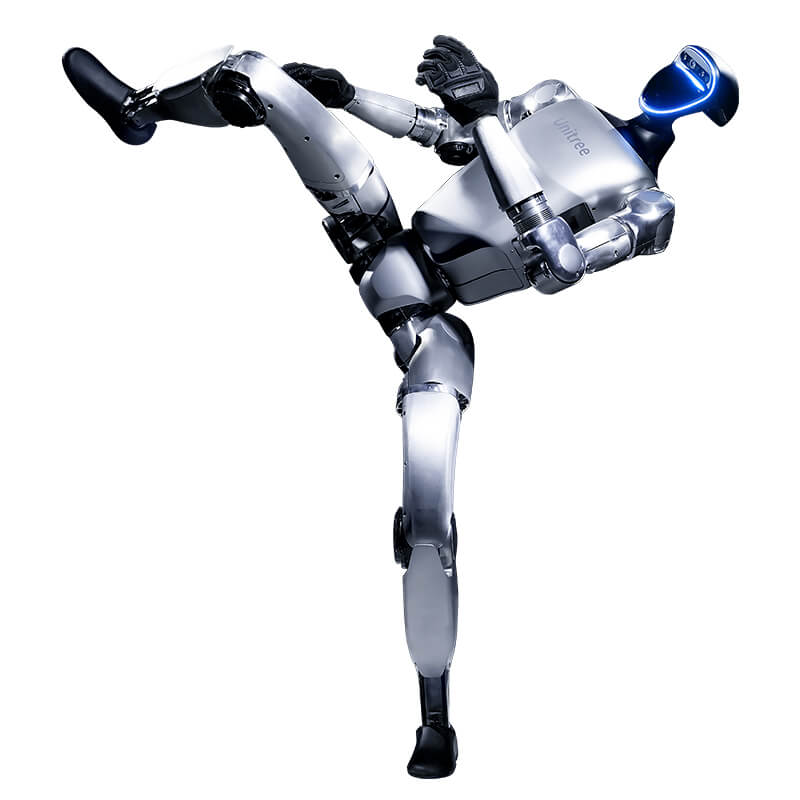
The Unitree G1 is a general-purpose humanoid robot developed by Unitree Robotics, a Chinese robotics company headquartered in Hangzhou. Standing approximately 1.32 meters tall and weighing around 35 kilograms, the G1 features 23 degrees of freedom and is capable of walking, running, recovering from falls, and performing dexterous manipulation tasks. It ships with SDK access, making it accessible to researchers and small-business operators seeking an affordable entry point into humanoid robotics. The G1 is widely regarded as one of the most competitively priced serious humanoid platforms available as of public reporting, positioning Unitree as a disruptive force in a market historically dominated by far more expensive systems. Its combination of mobility, recoverability, and open software access has attracted attention from academic institutions, robotics developers, and automation-focused startups worldwide.
44 views
 Robot
RobotUniversal Robots UR5e
The Universal Robots UR5e is a six-axis collaborative robot arm (cobot) belonging to Universal Robots' e-Series product line. Designed for light-to-medium industrial and laboratory tasks, it is widely used in assembly, pick-and-place, machine tending, quality inspection, and lab automation workflows. Universal Robots, a Danish company and a subsidiary of Teradyne, is one of the most recognized names in the collaborative robotics market. The UR5e is programmed using Universal Robots' PolyScope graphical interface on a teach pendant, making it accessible to operators without deep robotics expertise. Its built-in force/torque sensing, tool-center-point control, and a broad ecosystem of certified end-effectors and accessories (the UR+ platform) have made it a popular mid-range cobot choice across manufacturing, electronics, food handling, and research sectors.
43 views
 Robot
RobotQuicktron M100
The Quicktron M100 is a heavy-duty autonomous mobile robot (AMR) belonging to Quicktron Robotics' M-Series product line. It is designed for demanding material handling tasks in warehouses, distribution centers, and manufacturing environments, using an integrated lift mechanism to transport shelves and pallets autonomously across facility floors. Quicktron Robotics, a company with roots in China and a global commercial presence, positions the M100 as a high-capacity solution for operations that require moving heavier loads than lighter AMR models can accommodate. The M100 targets logistics operators and manufacturers seeking to automate goods-to-person or pallet-movement workflows at scale.
36 views
 Robot
RobotNVIDIA Jetson Orin NX
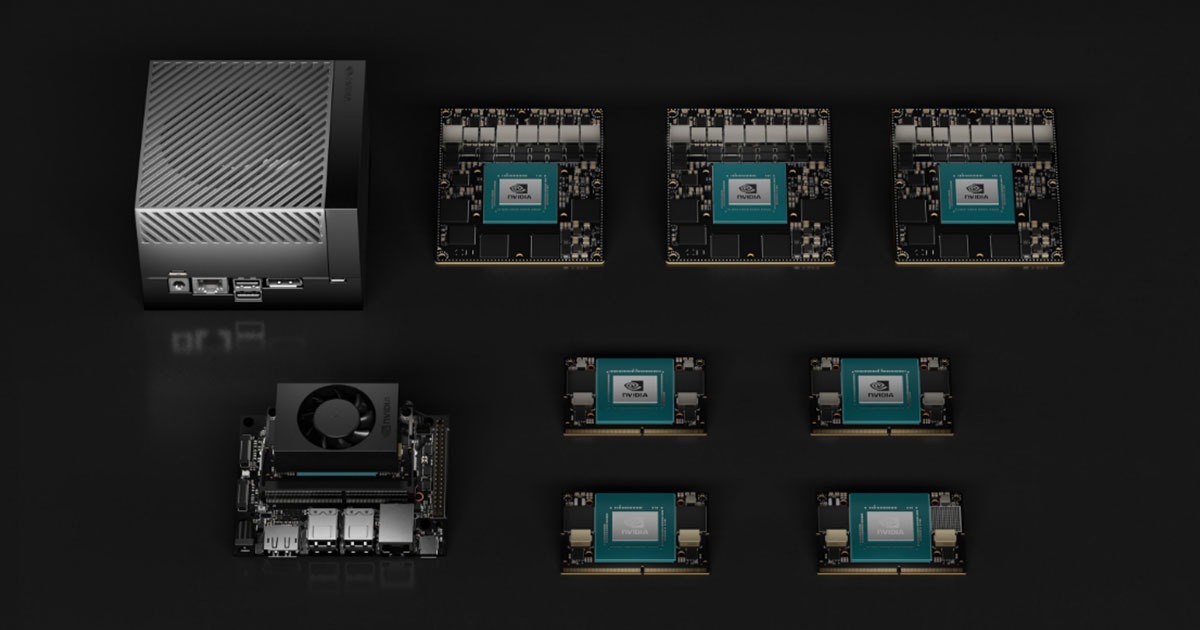
The NVIDIA Jetson Orin NX is a compact, SO-DIMM form-factor edge AI compute module designed for robotics, autonomous machines, and embedded vision applications. Manufactured by NVIDIA, it is available in 8 GB and 16 GB memory configurations and pairs an Ampere-architecture GPU with an 8-core Arm Cortex-A78AE CPU to deliver high-throughput on-device inference without relying on cloud connectivity. Positioned within NVIDIA's broader Jetson Orin family, the Orin NX targets developers and system integrators who need a balance of performance and power efficiency in a small footprint. It is commonly used in applications such as industrial inspection, autonomous mobile robots (AMRs), drone navigation, and smart edge devices where real-time AI inference is critical.
35 views