Bear Robotics Servi Q
The Servi Q is a compact autonomous service robot developed by Bear Robotics, a California-based robotics company known for its hospitality-focused robot lineup. Designed specifically for delivery and service tasks in space-constrained environments, Servi Q is engineered to navigate narrow corridors, tight corners, and densely furnished spaces where larger service robots typically struggle to operate. Targeted at restaurants, hotels, hospitals, and retail venues, Servi Q extends Bear Robotics' mission of automating repetitive service tasks to facilities that were previously underserved by standard-sized service robots. It features autonomous navigation and obstacle avoidance capabilities, making it a practical tool for operators seeking to improve service efficiency without requiring significant layout modifications.
Overview and Use Cases
Servi Q is Bear Robotics' answer to a common operational challenge in the hospitality and service industries: many venues — from boutique restaurants to hospital wards — feature layouts too tight for conventional service robots. Servi Q's compact form factor is purpose-built to address this gap, enabling autonomous food and item delivery in environments with narrow aisles, closely spaced tables, and confined service corridors.
Primary deployment environments reportedly include:
- Restaurants and cafes with limited floor space or densely arranged seating
- Hotels requiring in-corridor delivery to guest rooms
- Healthcare facilities such as hospitals and clinics where hallway clearance is restricted
- Retail environments needing restocking or item transport assistance
Key Technical Features
While Bear Robotics has not publicly disclosed a comprehensive technical specification sheet for Servi Q as of available reporting, the robot is described as incorporating:
- Autonomous navigation using sensor fusion for real-time mapping and path planning
- Obstacle avoidance to safely operate around staff, guests, and moving objects
- Compact chassis design that reportedly allows access to spaces inaccessible to larger robots in the Servi lineup
- Multi-tier tray or shelf configuration for carrying food, beverages, or other items
Specific figures for payload capacity, battery runtime, and maximum speed have not been independently confirmed and should be verified with Bear Robotics directly.
Comparison to Bear Robotics' Other Models
Bear Robotics' broader product portfolio includes the original Servi and Servi Plus robots, which are designed for standard restaurant and hospitality environments with more generous floor plans. Servi Q appears to occupy a distinct niche within this family — prioritizing spatial agility over maximum carrying capacity. The company also reportedly offers a security-oriented outdoor patrol robot for security service companies, illustrating Bear Robotics' expansion beyond purely hospitality applications. Servi Q, by contrast, remains firmly focused on indoor service delivery.
Market Context and Target Buyers
Servi Q competes in the growing autonomous service robot segment alongside products from companies such as Keenon Robotics, Pudu Robotics, and LG CLOi ServeBot. Its differentiating proposition is compact size rather than raw throughput, making it particularly relevant for small-to-medium hospitality operators who have previously been unable to adopt robot-assisted service due to spatial constraints.
Pricing has not been publicly disclosed; Bear Robotics has historically offered its robots through subscription or leasing models as well as outright purchase, though the specific commercial terms for Servi Q have not been confirmed in public reporting.
Deployments and Customers
As of available public reporting, Bear Robotics has not announced specific named customers or large-scale deployment figures exclusively for Servi Q. The broader Servi platform has been deployed across thousands of restaurant locations in the United States and internationally, and Servi Q is positioned to extend that reach to venues previously excluded by size limitations.
Future Outlook
The introduction of Servi Q reflects a broader industry trend toward right-sizing service robots for diverse real-world environments rather than optimizing solely for high-capacity, open-plan venues. As hospitality operators continue to face labor cost pressures, demand for compact, easy-to-deploy autonomous robots is expected to grow. Bear Robotics' continued investment in the Servi product family suggests ongoing development, though specific roadmap details have not been publicly announced.
Community buzz (Reddit)
Fully autonomous valet robot that parks on its own
r/nextfuckinglevel · ▲ 99,791
This model's robotic costume
r/nextfuckinglevel · ▲ 81,600
Man Mimics Robot with INSANE Body Control
r/nextfuckinglevel · ▲ 78,020
Olaf robot at Paris Disneyland
r/Damnthatsinteresting · ▲ 74,198
Japanese researchers at the University of Tsukuba created CirculaFloor, robotic tiles that let you walk infinitely in VR without ever leaving your spot.
r/Damnthatsinteresting · ▲ 72,691
Related entries
 Robot
RobotG1
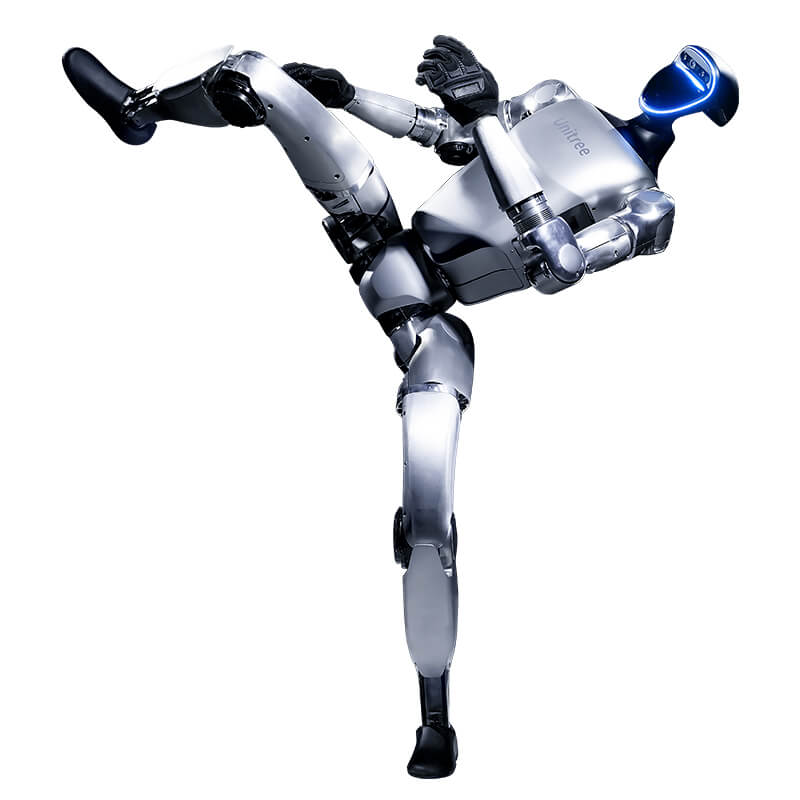
The Unitree G1 is a general-purpose humanoid robot developed by Unitree Robotics, a Chinese robotics company headquartered in Hangzhou. Standing approximately 1.32 meters tall and weighing around 35 kilograms, the G1 features 23 degrees of freedom and is capable of walking, running, recovering from falls, and performing dexterous manipulation tasks. It ships with SDK access, making it accessible to researchers and small-business operators seeking an affordable entry point into humanoid robotics. The G1 is widely regarded as one of the most competitively priced serious humanoid platforms available as of public reporting, positioning Unitree as a disruptive force in a market historically dominated by far more expensive systems. Its combination of mobility, recoverability, and open software access has attracted attention from academic institutions, robotics developers, and automation-focused startups worldwide.
27 views
 Robot
RobotUniversal Robots UR5e
The Universal Robots UR5e is a six-axis collaborative robot arm (cobot) belonging to Universal Robots' e-Series product line. Designed for light-to-medium industrial and laboratory tasks, it is widely used in assembly, pick-and-place, machine tending, quality inspection, and lab automation workflows. Universal Robots, a Danish company and a subsidiary of Teradyne, is one of the most recognized names in the collaborative robotics market. The UR5e is programmed using Universal Robots' PolyScope graphical interface on a teach pendant, making it accessible to operators without deep robotics expertise. Its built-in force/torque sensing, tool-center-point control, and a broad ecosystem of certified end-effectors and accessories (the UR+ platform) have made it a popular mid-range cobot choice across manufacturing, electronics, food handling, and research sectors.
26 views
 Robot
RobotQuicktron M100
The Quicktron M100 is a heavy-duty autonomous mobile robot (AMR) belonging to Quicktron Robotics' M-Series product line. It is designed for demanding material handling tasks in warehouses, distribution centers, and manufacturing environments, using an integrated lift mechanism to transport shelves and pallets autonomously across facility floors. Quicktron Robotics, a company with roots in China and a global commercial presence, positions the M100 as a high-capacity solution for operations that require moving heavier loads than lighter AMR models can accommodate. The M100 targets logistics operators and manufacturers seeking to automate goods-to-person or pallet-movement workflows at scale.
26 views
 Robot
RobotNVIDIA Jetson Orin NX
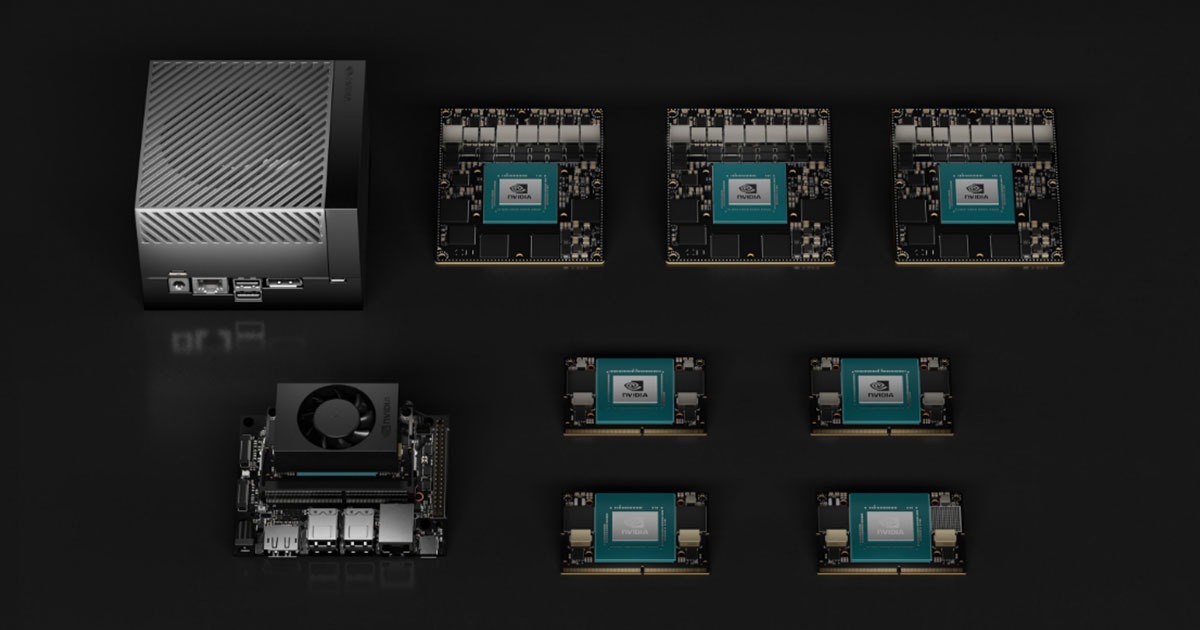
The NVIDIA Jetson Orin NX is a compact, SO-DIMM form-factor edge AI compute module designed for robotics, autonomous machines, and embedded vision applications. Manufactured by NVIDIA, it is available in 8 GB and 16 GB memory configurations and pairs an Ampere-architecture GPU with an 8-core Arm Cortex-A78AE CPU to deliver high-throughput on-device inference without relying on cloud connectivity. Positioned within NVIDIA's broader Jetson Orin family, the Orin NX targets developers and system integrators who need a balance of performance and power efficiency in a small footprint. It is commonly used in applications such as industrial inspection, autonomous mobile robots (AMRs), drone navigation, and smart edge devices where real-time AI inference is critical.
25 views