Let's compare
Locus Origin - ESD
Locus Robotics
Not yet assessed
- Height
- —
- Payload
- —
- Verified autonomy
- not assessed
- Real deployment
- not assessed
- Status
- —
- Price
- —
Locus Origin - ESD
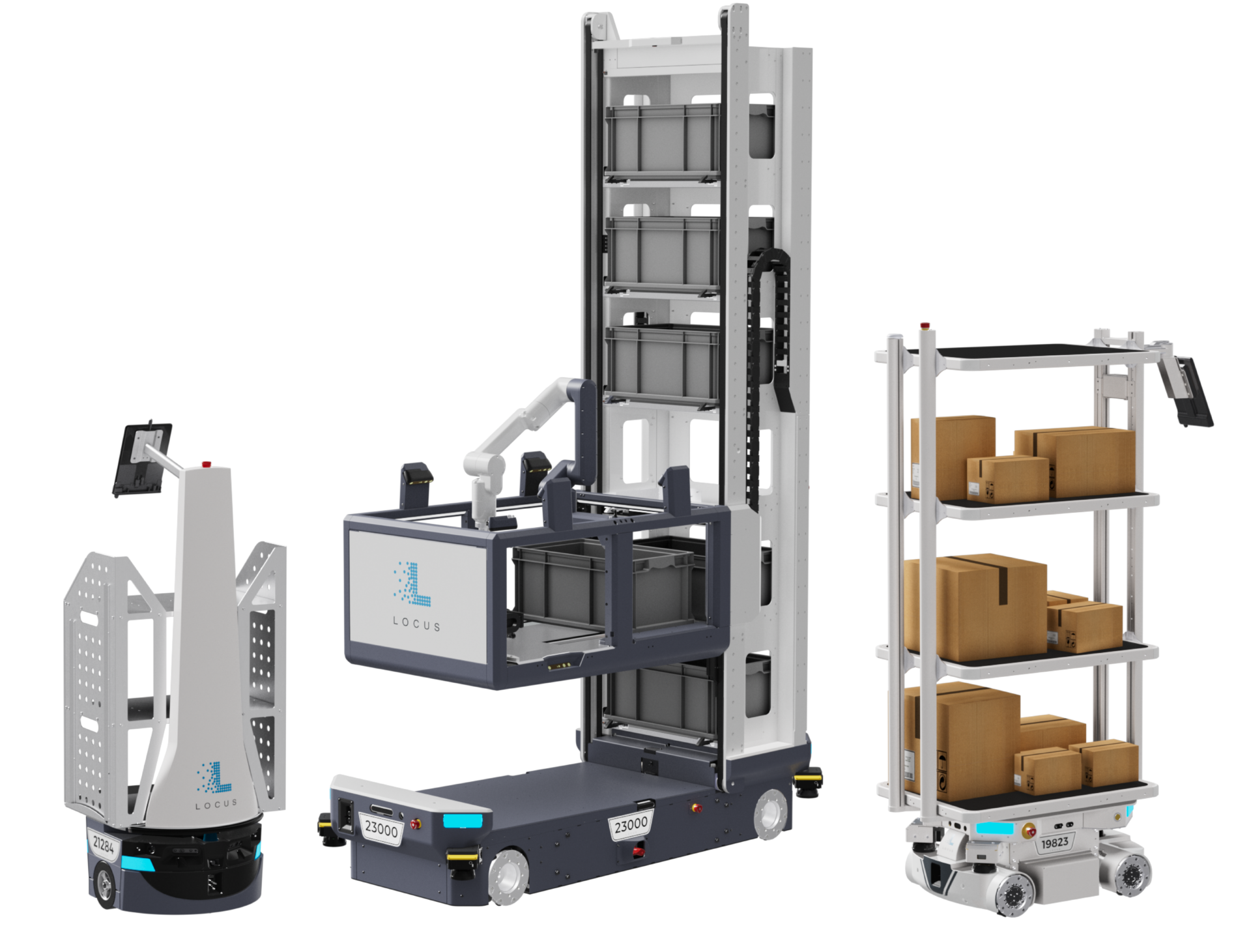
Locus RoboticsThe Locus Origin is an AMR (Autonomous Mobile Robot) developed by Locus Robotics (Wilmington, MA) designed for collaborative warehouse fulfillment. It operates as a worker-assist platform: the robot autonomously navigates to pick locations and carries goods (up to 80 lbs), while human workers physically pick items and place them in the robot's bin — making it a human-robot collaborative system rather than a fully autonomous picker. The Origin is part of a broader fleet (alongside Locus Vector and the newer Locus Array) managed by the LocusONE platform. Pricing is subscription-based (RaaS) at approximately $950/month per bot plus a one-time deployment fee, with deployment timelines of 4 weeks to 3 months. The newer Locus Array product claims fully autonomous picking, but the Origin itself relies on human workers to perform the actual pick task.
Availability
Specification
- dimensions
- 22" diameter x 57.8" H
- weight_payload_capacity
- 36 kg / 80 lbs (CE Certified)
- battery_operating_time
- 14 hours per charge
- battery_charge_time
- 50 minutes to full charge
Price
No public price — contact the supplier for a quote.
Good · Bad · Ugly
Evidence-graded claims from the Locus Robotics deep report
Autonomous picking speed of the best AI model benchmarked on a real warehouse task is ~64 picks/hour, versus ~1,300 picks/hour for a human
An independently conducted community benchmark [18] tested four robot AI models on a real industrial picking task and found the best model achieved ~64 picks/hour; the ~1,300 picks/hour human baseline was also measured in the same study — though the benchmark does not specifically test the Locus Array hardware, leaving a gap in direct product-level validation.
from Locus Robotics deep report →GEODIS deployed 1,000 LocusBots across 14 global warehouse sites (U.S. and Europe) over 24 months
A GEODIS press release [11] — an independent customer announcement — directly confirms the expanded agreement to deploy 1,000 LocusBots across 14 sites in the U.S. and Europe; this is a customer-issued statement, though actual operational outcomes (throughput, labor savings) at those sites are not independently audited.
from Locus Robotics deep report →The legacy Origin/Vector AMR model requires human associates to perform the physical pick; robots navigate and carry totes but do not manipulate items
The MWPVL independent consultant review [9] and the Forrester TEI report [5] both explicitly describe the operational model as robots guiding human associates to pick locations while workers perform the physical pick, with a bot-to-picker ratio of ~3.5:1; this is further corroborated by the official picking page [4].
from Locus Robotics deep report →Locus Robotics has raised over $330M in venture funding at a ~$2B valuation (as of Series F, November 2022)
The Series F press release [10] and Nasdaq Private Market listing [8] independently confirm the $117M Series F round bringing total funding over $330M at a ~$2B valuation; however, this reflects a 2022 snapshot and no subsequent funding round or updated valuation has been reported in the dossier.
from Locus Robotics deep report →
Locus Array hardware features an omnidirectional base, vision system, robot arm with NeuraGrasp AI-powered gripper, vertical reach up to 10 feet, and centimeter-level precision near double-deep shelving
Robot Report [14] (independent trade press) and the official site [1] corroborate the hardware description including the NeuraGrasp gripper from the Nexera Robotics acquisition, but no independent third-party test has verified the claimed 10-foot reach, centimeter-level precision, or gripper adaptability across shape/surface/material in a production environment.
from Locus Robotics deep report →Locus Robotics robots are safe for human-shared environments and require no human-exclusive safety zones, including deployment on mezzanines
The MWPVL independent consultant review [9] corroborates the vendor's claim that no human-exclusive zone is required, but this assessment appears to be based on vendor-provided information rather than independent safety certification or regulatory audit, and no third-party safety standard compliance documentation is cited in the dossier.
from Locus Robotics deep report →
About the company
Editorial directory of real robot products from leading global manufacturers. Each entry links to the manufacturer's official page.