Let's compare
Locus Origin - Heavy Duty
Locus Robotics
Not yet assessed
- Height
- —
- Payload
- —
- Verified autonomy
- not assessed
- Real deployment
- not assessed
- Status
- —
- Price
- —
Locus Origin - Heavy Duty
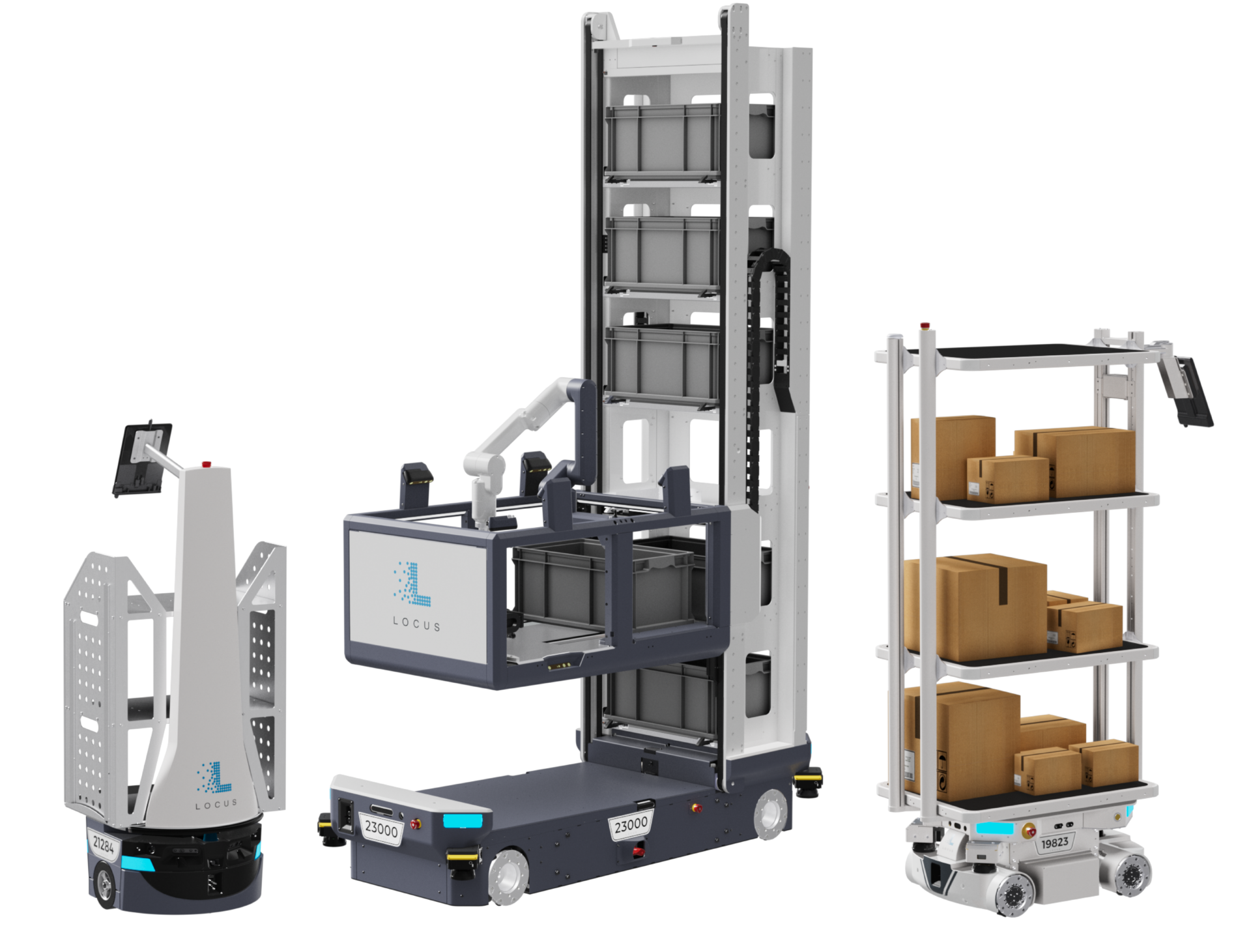
Locus RoboticsThe Locus Origin is a Heavy Duty Autonomous Mobile Robot (AMR) designed for warehouse fulfillment, operating on a Robotics-as-a-Service model. It assists human warehouse associates in picking, putaway, replenishment, and related tasks by navigating autonomously to item locations while workers perform the actual pick — a collaborative human-robot model rather than fully unattended manipulation. The Locus Array (a separate, newer product) adds autonomous manipulation capability, but the Origin itself relies on human associates to physically pick items. Hardware specs include an 80 lb payload capacity, 8-hour operating time, and 50-minute charge time. Large-scale deployments (e.g., 1,000 units across GEODIS global sites) validate enterprise-scale adoption, though pricing data from 2019 may be outdated.
Availability
Specification
- hardware_dimensions
- 22.2" x 20" x 58" (563mm x 511mm x 1473mm)
- hardware_payload
- Up to 80 lbs / 36 kg
- hardware_battery_charge_time
- 50 minutes to full charge
Price
No public price — contact the supplier for a quote.
Good · Bad · Ugly
Evidence-graded claims from the Locus Robotics deep report
Autonomous picking speed of the best AI model benchmarked on a real warehouse task is ~64 picks/hour, versus ~1,300 picks/hour for a human
An independently conducted community benchmark [18] tested four robot AI models on a real industrial picking task and found the best model achieved ~64 picks/hour; the ~1,300 picks/hour human baseline was also measured in the same study — though the benchmark does not specifically test the Locus Array hardware, leaving a gap in direct product-level validation.
from Locus Robotics deep report →GEODIS deployed 1,000 LocusBots across 14 global warehouse sites (U.S. and Europe) over 24 months
A GEODIS press release [11] — an independent customer announcement — directly confirms the expanded agreement to deploy 1,000 LocusBots across 14 sites in the U.S. and Europe; this is a customer-issued statement, though actual operational outcomes (throughput, labor savings) at those sites are not independently audited.
from Locus Robotics deep report →The legacy Origin/Vector AMR model requires human associates to perform the physical pick; robots navigate and carry totes but do not manipulate items
The MWPVL independent consultant review [9] and the Forrester TEI report [5] both explicitly describe the operational model as robots guiding human associates to pick locations while workers perform the physical pick, with a bot-to-picker ratio of ~3.5:1; this is further corroborated by the official picking page [4].
from Locus Robotics deep report →Locus Robotics has raised over $330M in venture funding at a ~$2B valuation (as of Series F, November 2022)
The Series F press release [10] and Nasdaq Private Market listing [8] independently confirm the $117M Series F round bringing total funding over $330M at a ~$2B valuation; however, this reflects a 2022 snapshot and no subsequent funding round or updated valuation has been reported in the dossier.
from Locus Robotics deep report →
Locus Array hardware features an omnidirectional base, vision system, robot arm with NeuraGrasp AI-powered gripper, vertical reach up to 10 feet, and centimeter-level precision near double-deep shelving
Robot Report [14] (independent trade press) and the official site [1] corroborate the hardware description including the NeuraGrasp gripper from the Nexera Robotics acquisition, but no independent third-party test has verified the claimed 10-foot reach, centimeter-level precision, or gripper adaptability across shape/surface/material in a production environment.
from Locus Robotics deep report →Locus Robotics robots are safe for human-shared environments and require no human-exclusive safety zones, including deployment on mezzanines
The MWPVL independent consultant review [9] corroborates the vendor's claim that no human-exclusive zone is required, but this assessment appears to be based on vendor-provided information rather than independent safety certification or regulatory audit, and no third-party safety standard compliance documentation is cited in the dossier.
from Locus Robotics deep report →
About the company
Editorial directory of real robot products from leading global manufacturers. Each entry links to the manufacturer's official page.