Let's compare
NAO V5
Aldebaran Robotics
Not yet assessed
- Height
- —
- Payload
- —
- Verified autonomy
- not assessed
- Real deployment
- not assessed
- Status
- —
- Price
- —
NAO V5
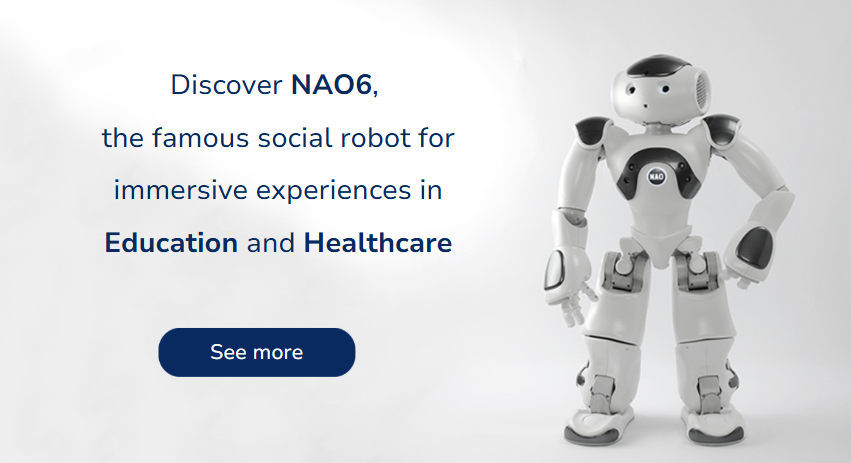
Aldebaran RoboticsNAO V5 is a 25-DOF autonomous programmable humanoid robot originally developed by Aldebaran (later SoftBank Robotics Europe), now under Maxtronics Robotics SAS, with over 20,000 units deployed across 70+ countries primarily for education, research, and therapy. The V5 Evolution (open-box) is available from resellers like RobotLAB starting at $6,500, while newer V6 units list at ~$7,970–$16,990 depending on channel. Critically, Aldebaran entered judicial liquidation in 2025, though a successor entity (NAO Robotics SA) is being formed and RobotLAB has pledged service continuity. NAO performs its programmed tasks autonomously — executing behaviors, interacting socially, and navigating — without a human performing or driving those tasks, though it requires programming/setup and is not suited for heavy-duty physical work.
Availability
Specification
- degrees_of_freedom
- 25 DOF
Price
No public price — contact the supplier for a quote.
Good · Bad · Ugly
Evidence-graded claims from the Aldebaran Robotics deep report
NAO has been used in 3,600+ independent research studies, making it the dominant platform in HRI and educational robotics research.
Multiple independent academic and news sources [21][31][32][33][34] corroborate the 3,600+ research studies figure and NAO's widespread use in HRI labs and universities globally; peer-reviewed arxiv papers [20][21][22][23] themselves constitute independent evidence of active research deployment, though the exact count of 3,600+ is a company-originated figure repeated by independents rather than an independently audited number.
from Aldebaran Robotics deep report →
Approximately 20,000 NAO and 17,000 Pepper units were sold across 70+ countries, totalling ~37,000 robots (vs. the company's own claim of 40,000+).
The ~37,000 figure (20,000 NAO + 17,000 Pepper) is cited consistently across multiple independent news and community sources [2][3][7][34], lending it credibility, but the underlying data originates from company-reported figures repeated by press — no independent audit or third-party sales verification is present in the dossier; the company's own higher claim of 40,000+ [1] is likely a rounded-up marketing figure that may include Plato units.
from Aldebaran Robotics deep report →Aldebaran's liquidation and Maxvision acquisition will result in continuity of NAO robot development, with NAO V7 in development and a new entity NAO Robotics SA planned with 59 engineers.
Multiple news sources [7][9][11][13] confirm the Maxvision acquisition of core IP (~July 19, 2025) and report plans for NAO Robotics SA and NAO V7, but these are forward-looking announcements from the acquirer with no independent verification of actual engineering progress, funding adequacy, or timeline — RobotLAB's pledge of service continuity [11] is a partner statement, not independent confirmation of product development.
from Aldebaran Robotics deep report →Aldebaran's financial collapse was caused primarily by URG's underinvestment and unrealistic 2-year profitability targets, not fundamental product failure.
Independent news and community sources [6][10][34] cite employee accounts attributing the collapse to URG's unrealistic targets and withdrawal of RAG-Stiftung funding in August 2024, but the dossier also shows net deficits of €156M accumulated under SoftBank ownership (2019–2022) [12], suggesting structural product/market problems predating URG — the causal attribution to URG alone is not independently verified and is contested by the broader financial record.
from Aldebaran Robotics deep report →NAO supports ROS2-based autonomous HRI capabilities independently of manufacturer APIs, including GPT-based conversation and advanced sensor fusion.
An independent peer-reviewed arxiv paper [21] specifically documents the Open Access NAO (OAN) ROS2 framework enabling HRI applications independent of manufacturer APIs, and [23] demonstrates text-driven motion generation via reinforcement learning on NAO — these are credible independent research demonstrations, but they represent experimental lab capabilities, not validated production-level autonomous performance; cloud/network dependency for GPT functions is an additional reliability caveat noted in the dossier.
from Aldebaran Robotics deep report →
Pepper was a commercially viable service robot for retail and banking, with broad customer adoption (e.g., HSBC banks, SoftBank stores Japan).
Independent sources directly contradict commercial viability: only 15% of Pepper customers planned contract renewal as early as 2015 [34], production was halted in 2020–2021 [3][7][18], and the company accumulated net deficits exceeding €156M between 2019–2022 [12][13] — deployment at named retailers is confirmed but sustained commercial success is not, and the robot's limited robustness for commercial use is a consistent independent criticism [30][31][34].
from Aldebaran Robotics deep report →NAO's hardware is robust enough for repeated use — its 5 kg weight and low-power motors mean falls cause no damage.
An independent Hacker News community source [30] explicitly states NAO can fall without damage due to its 5 kg mass, but this is directly contradicted by multiple independent sources [31][34] citing frequent hardware failures including ribbon harness tears as a well-known chronic problem, and the dossier notes NAO is described as hard to repair — indicating the robot is not reliably robust in practice.
from Aldebaran Robotics deep report →
About the company
Editorial directory of real robot products from leading global manufacturers. Each entry links to the manufacturer's official page.