Avidbots
Avidbots Corp.
Autonomous floor scrubbing at commercial scale: credible deployment, constrained ambition, and the open questions a $107M raise demands
| Report status | Part 1 of 2 (Sections 1–7); Part 2 forthcoming |
| Coverage date | 18 June 2026 |
| Company stage | Fully commercial, post-Series C |
| Editorial standard | Evidence-graded; verified facts separated from company claims, editorial inference, and unknowns |
How to Read This Report
This report applies a four-tier evidence discipline throughout. Every material claim is tagged at first use and should be read accordingly.
| Label | Meaning |
|---|---|
| VERIFIED | Confirmed by regulatory filings, official product documentation, named-customer case studies, peer-reviewed research, or corroborated by multiple independent sources |
| COMPANY CLAIM | Stated by Avidbots or its representatives; not independently verified |
| EDITORIAL INFERENCE | Reasoned conclusion drawn from the weight of public evidence; not a statement of confirmed fact |
| UNKNOWN | Not publicly disclosed in any source available to this report |
Inline citations use bracketed numerals keyed to the numbered source list in §14. Only sources appearing in the research dossier are cited. Where the dossier is thin, this report says so plainly rather than padding with inference dressed as fact.
01Executive Overview
Avidbots Corp. is a Kitchener, Ontario-based robotics manufacturer that builds and deploys autonomous commercial floor-scrubbing robots. Its three-product lineup — Neo, Neo 2W, and Kas — operates across airports, warehouses, manufacturing facilities, and retail environments on five continents 17. The company has raised approximately $107 million in total funding, including a $70 million Series C in September 2022 led by Jeneration Capital 7. It sells access to its robots primarily through a Robots as a Service (RaaS) subscription model that bundles hardware, software, and maintenance 6.
The core claim Avidbots makes — that its robots perform floor scrubbing fully autonomously, without a human driving or performing the task — is one of the better-supported autonomy claims in the commercial cleaning robotics sector. Independent deployment evidence from a Saint-Gobain manufacturing plant 13, corroborating reports from airport operators, and peer-reviewed path-planning research from University of Waterloo co-authors affiliated with the company 232426 collectively substantiate that the robots map environments, plan coverage paths, avoid obstacles dynamically, and replan in real time. Human involvement is limited to initial setup, scheduling, and periodic maintenance — operational overhead that does not constitute task performance. The autonomy verdict for this report is Autonomous at 0.90 confidence.
That said, Avidbots occupies a narrow product niche. All three robots perform one task: wet floor scrubbing. The company has not publicly disclosed a path toward multi-task capability, manipulation, or mobility beyond flat commercial floors. Its competitive moat rests on deployment maturity, a vertically integrated hardware-software stack 11, and accumulated operational data from real-world sites — advantages that are real but not permanent, given the entry of well-capitalised competitors including Tennant, Nilfisk, and Gaussian Robotics.
Several material unknowns limit the depth of this analysis. Avidbots does not publish revenue figures, unit shipment volumes, customer churn rates, or detailed fleet utilisation data. The $30,000 annual savings and approximately 24-month payback period cited in the Saint-Gobain case study 13 are credible but represent a single site; generalisation to the broader installed base is an editorial inference, not a verified fact. The company's path to profitability — a standard question for any post-Series C hardware-software business carrying the capital intensity of robotics manufacturing — is entirely undisclosed.
The report that follows examines the company's origins, its product and technology stack, the research underpinning its autonomy claims, the commercial evidence available in the public record, and the competitive and geopolitical pressures it faces. It concludes with scenario analysis and a monitoring checklist for those tracking the company's trajectory.
Latest news
02The Avidbots Story
Origins in Waterloo
Avidbots was founded in Kitchener, Ontario, by Pablo Molina and Faizan Sheikh 17. The company emerged from the University of Waterloo ecosystem — a detail that matters because Waterloo's engineering and computer science programmes have produced a disproportionate share of Canadian deep-tech ventures, and the university's proximity provided Avidbots with early access to robotics and controls research talent 17. The Velocity incubator, Waterloo's flagship startup accelerator, lists Avidbots among its alumni 17. VERIFIED
The founding thesis was straightforward: commercial floor scrubbing is a high-frequency, physically demanding, and operationally expensive task performed in large, semi-structured environments. Those environments — airports, warehouses, shopping centres — are amenable to autonomous navigation because they are relatively predictable, have defined boundaries, and tolerate the operational constraints (speed limits, obstacle-avoidance conservatism, scheduled downtime for charging) that first-generation autonomous mobile robots impose. The founders chose to build the hardware and software together rather than retrofit autonomy onto existing scrubber platforms 11. VERIFIED That vertical integration decision has shaped every subsequent product and competitive choice.
Funding History
The company's disclosed funding trajectory is as follows:
| Round | Year | Amount | Lead Investor | Source |
|---|---|---|---|---|
| Series B | 2019 | $23.6M | Not disclosed in dossier | 182122 |
| Series C | 2022 | $70M | Jeneration Capital | 71920 |
| Total disclosed | ~$107M | 7 |
Pre-Series B funding details are not fully disclosed in the available sources. UNKNOWN The Series C, announced in September 2022, was the largest single raise and was described by TechCrunch as intended to fund expansion into new verticals and geographies, as well as continued R&D 7. Jeneration Capital's participation is notable: the firm has a track record in growth-stage technology companies, though its specific robotics portfolio thesis is not detailed in the dossier. UNKNOWN
The timing of the Series C — late 2022, during a period of significant tightening in venture capital markets globally — suggests either that Avidbots presented compelling commercial traction data to investors, or that the raise was negotiated before market conditions deteriorated fully, or both. EDITORIAL INFERENCE No subsequent funding round has been publicly announced as of the coverage date of this report. Whether the company has reached cash-flow breakeven on its RaaS model, or whether it is managing runway from the 2022 raise, is not publicly disclosed. UNKNOWN
Leadership
Pablo Molina holds the title of Co-Founder and CTO 11. Faizan Sheikh, the other co-founder, previously served as CEO and currently holds the title of Head of Customer Success 11. The transition of Sheikh from CEO to a customer-facing operational role is a notable structural change. Whether this reflects a deliberate strategic pivot toward customer retention and expansion — logical for a RaaS business where net revenue retention is the primary growth lever — or a change driven by board or investor pressure is not publicly documented. UNKNOWN The identity of the current CEO, if Sheikh no longer holds that title, is not confirmed in the available dossier sources. UNKNOWN
The Waterloo Manufacturing Ecosystem
Avidbots operates from 45 Washburn Drive, Kitchener, Ontario, with a US commercial office in Rolling Meadows, Illinois 3. The Kitchener-Waterloo corridor has historically supported manufacturing and technology businesses, and the Trillium Manufacturing Network — which has featured Avidbots — represents the kind of regional industrial network that provides supply chain relationships, skilled trades, and engineering talent relevant to a hardware company 11. The US office location in the Chicago metropolitan area positions the company near a dense concentration of logistics, warehousing, and manufacturing customers in the American Midwest. EDITORIAL INFERENCE
03Product Portfolio: What Avidbots Actually Sells
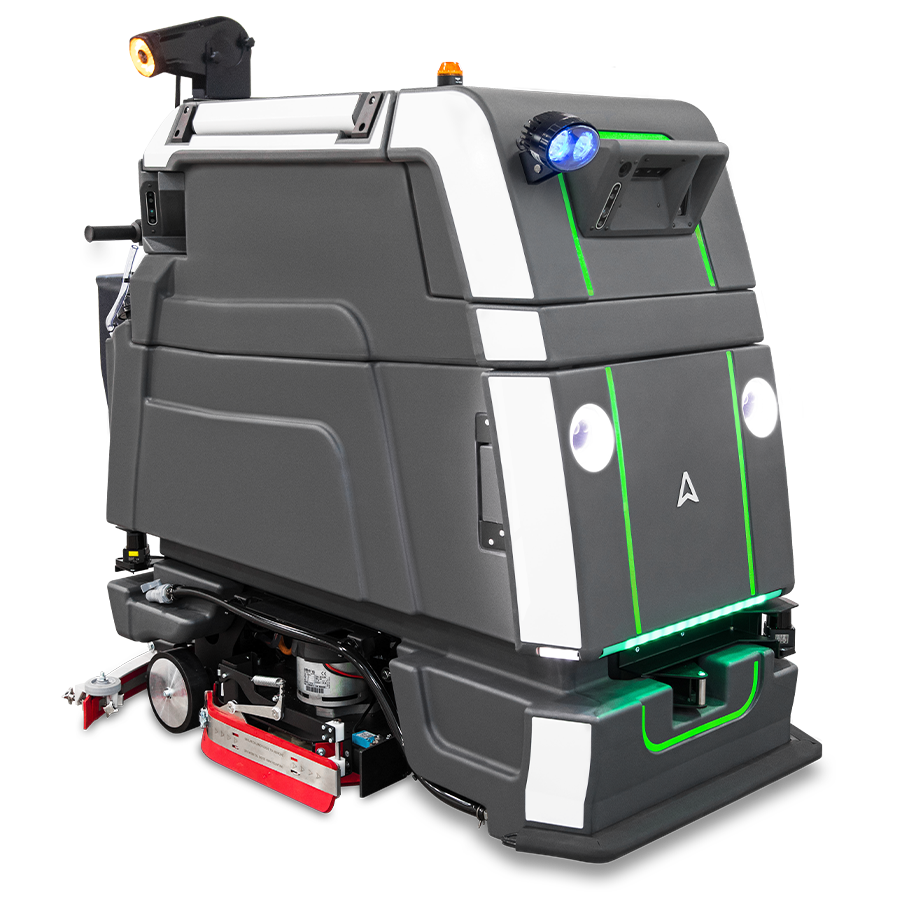
Avidbots' entire commercial offering consists of three autonomous floor-scrubbing robots. All three perform the same fundamental task — wet scrubbing of hard floor surfaces — and are differentiated primarily by form factor and target deployment environment. VERIFIED 124
Neo
Neo is the company's flagship and longest-standing product, designed for large-format environments with wide aisles and high floor-area throughput requirements 4. Target deployments include airport terminals, shopping malls, logistics distribution centres, and large manufacturing facilities. The product page describes it as the "world's leading autonomous floor scrubbing robot" — a COMPANY CLAIM that is not independently benchmarked. Neo is the robot documented in the Saint-Gobain case study 13 and is the platform most frequently referenced in airport deployment reports.
Detailed hardware specifications for Neo are not fully reproduced in the available dossier sources beyond the general sensor suite description. UNKNOWN What is confirmed: Neo uses the same shared AI software platform as the other two robots, receives over-the-air software updates, and is supported by the Avidbots Command Center fleet management system 168.
Neo 2W
Neo 2W is a variant of the Neo platform adapted for warehouse and industrial surface environments 1. The "2W" designation likely refers to a two-wheel or two-brush configuration suited to the surface conditions and operational patterns of warehouse floors — typically characterised by heavier soiling, more frequent racking obstacles, and tighter turning requirements than airport concourses. EDITORIAL INFERENCE Specific hardware differentiation between Neo and Neo 2W beyond the target environment description is not detailed in the available sources. UNKNOWN
Kas
Kas is the newest addition to the lineup, launched in April 2024 212. It is designed for narrow-aisle environments — retail stores, grocery aisles, and similar spaces where the larger Neo footprint cannot manoeuvre. Its specifications are the most fully documented of the three products in the available dossier:
| Specification | Value | Source |
|---|---|---|
| Overall dimensions (L×W×H) | 927 × 674 × 1,230 mm (36.5 × 26.5 × 48.4 in) | 2 |
| Minimum aisle width | 1.0 m (3.5 ft) | 2 |
| Minimum U-turn width | 1.55 m (5.1 ft) | 2 |
| Solution tank capacity | 45 L (11.9 gal) | 2 |
| Battery type | LFP (lithium iron phosphate), exchangeable | 2 |
| Runtime | 3+ hours | 2 |
| Sensor count | 15 sensors | 2 |
| Obstacle avoidance | 360-degree | 2 |
| Aisle clearance | 41 inches | 2 |
VERIFIED 2
The use of exchangeable LFP batteries rather than a fixed battery with in-place charging is a meaningful operational design choice for retail environments, where robots may need to operate across multiple shifts without extended downtime. LFP chemistry offers lower energy density than NMC lithium-ion but superior cycle life and thermal stability — relevant for a robot that will be charged and discharged daily over a multi-year RaaS contract. EDITORIAL INFERENCE
The 1.0-metre minimum aisle width is a hard operational constraint. Standard grocery retail aisle widths in North America typically range from 1.2 to 1.8 metres, which means Kas can operate in most but not all retail configurations. Aisle widths below 1.0 metre — common in some convenience formats and older European retail — would exclude the robot. EDITORIAL INFERENCE
The Shared Software Platform
All three robots run on a single AI software platform 1. This is architecturally significant: it means software improvements, path-planning algorithm updates, and safety patches can be deployed across the entire installed fleet via over-the-air updates without hardware intervention 68. The Avidbots Command Center provides operators with real-time fleet monitoring, cleaning analytics, and access to 24/7 remote support 6. VERIFIED
The Command Center is also the mechanism through which customers schedule cleaning runs and review performance data. This creates a data flywheel dynamic: as more robots operate in more environments, Avidbots accumulates operational data that can in principle improve path planning, obstacle avoidance, and predictive maintenance models. EDITORIAL INFERENCE Whether the company is actively exploiting this data asset in its R&D pipeline is not publicly documented beyond the academic research discussed in §4 and §5. UNKNOWN
Pricing and Business Model
Avidbots does not publish pricing directly. A third-party commerce source estimates purchase prices in the range of $60,000 to $85,000 or more per unit 5. The primary commercial model is RaaS — a subscription that bundles hardware, software, and maintenance 6. Preventative maintenance is specified at every 480 operating hours, with a maximum of three visits per year by Avidbots-certified technicians 6. VERIFIED
| Model | Structure | Notes |
|---|---|---|
| RaaS subscription | Recurring fee; hardware, software, maintenance bundled | Primary commercial model 6 |
| Outright purchase | $60,000–$85,000+ per unit (estimated) | Third-party estimate; not vendor-confirmed 5 |
The RaaS model is well-suited to the company's target customers — facilities managers at airports, logistics operators, and retailers — who typically prefer operating expenditure over capital expenditure and value predictable maintenance costs. It also gives Avidbots recurring revenue visibility and a structural reason to maintain software quality over the contract term. The downside, from a capital efficiency perspective, is that Avidbots bears the cost of manufacturing and deploying hardware before recovering that cost through subscription payments over time — a cash-flow dynamic that explains in part why the company has needed to raise substantial external capital. EDITORIAL INFERENCE
Products & versions
04Technology Stack: Strengths and the Work That Remains
Vertical Integration as a Design Philosophy
Avidbots made an early and deliberate choice to co-design hardware and software rather than adapt a third-party scrubber platform 11. VERIFIED This vertical integration has practical consequences. The sensor suite, actuator layout, water and solution management systems, and the software stack that controls them are optimised for each other rather than constrained by a pre-existing mechanical platform. The result, in principle, is tighter control over the full system performance envelope — cleaning quality, obstacle response latency, battery management, and maintenance predictability. EDITORIAL INFERENCE
The risk of vertical integration is that it concentrates engineering complexity and supply chain exposure in a single organisation. A hardware defect or supply disruption affects the entire product line. Whether Avidbots has experienced material supply chain disruptions — particularly relevant given global component shortages in 2021–2023 — is not publicly disclosed. UNKNOWN
Sensor Suite
The Kas specification confirms 15 sensors with 360-degree obstacle avoidance 2. The Neo product page references cameras and advanced dynamic path planning 4. The dossier does not provide a detailed sensor modality breakdown — specifically, whether the suite includes LiDAR, structured light, time-of-flight, ultrasonic, or some combination. UNKNOWN The academic research papers (discussed in §5) reference environment representations consistent with LiDAR-based mapping, but this is an editorial inference from the research context rather than a confirmed hardware specification. EDITORIAL INFERENCE
The 360-degree obstacle avoidance claim is a COMPANY CLAIM in its marketing form, but is partially corroborated by the academic research on anytime online replanning for partially unknown environments 26, which implies the robot can detect and respond to obstacles not present during initial mapping — a meaningful operational capability in environments where pallets, carts, and pedestrians appear unpredictably.
Path Planning: The Academic Evidence
The strongest independent technical evidence for Avidbots' autonomy capabilities comes from peer-reviewed research co-authored by University of Waterloo researchers affiliated with the company. Three papers are directly relevant:
Paper 1: Optimal Partitioning of Non-Convex Environments for Minimum Turn Coverage Planning 2324 This paper addresses a core challenge in floor-scrubbing robotics: coverage path planning in non-convex environments (i.e., real rooms with alcoves, pillars, and irregular boundaries) while minimising the number of turns. Turns are operationally costly — they slow the robot, increase mechanical wear, and reduce cleaning efficiency. The paper proposes a linear programming-based approach to partitioning the environment into convex sub-regions, then planning minimum-turn coverage paths within each. VERIFIED as peer-reviewed research with Avidbots-affiliated co-authors.
Paper 2: GHACPP — Genetic-based Human-Aware Coverage Path Planning Algorithm for Autonomous Disinfection Robot 25 This paper extends coverage path planning to account for the presence of humans in the environment, using a genetic algorithm to optimise paths that avoid human traffic patterns. While the paper's stated application is disinfection rather than scrubbing, the underlying path-planning challenge is identical, and the human-awareness component is directly relevant to Avidbots' deployment environments (airports, retail stores) where pedestrian density is high. VERIFIED as peer-reviewed research; the direct applicability to Avidbots' production systems is an EDITORIAL INFERENCE.
Paper 3: Anytime Replanning of Robot Coverage Paths for Partially Unknown Environments (OARP-Replan) 26 This is the most operationally significant paper in the dossier. OARP-Replan addresses the problem of a robot encountering obstacles during a cleaning run that were not present during the initial mapping phase — a routine occurrence in warehouses and retail environments where inventory, carts, and equipment are moved between mapping and cleaning sessions. The algorithm provides anytime replanning: it can generate a valid, improved coverage plan at any point during execution, allowing the robot to adapt in real time rather than stopping or returning to base. VERIFIED as peer-reviewed research with Avidbots-affiliated co-authors.
The existence of this research pipeline is meaningful evidence that Avidbots' autonomy claims rest on genuine algorithmic work rather than purely on marketing assertions. However, a gap exists between academic publication and production deployment: the papers describe algorithms and simulation/lab results, and the dossier does not confirm which specific algorithmic versions are running in production firmware. UNKNOWN
Software Platform Maturity
The over-the-air update capability and the Avidbots Command Center fleet management system represent genuine software infrastructure investments 68. The ability to push software updates to deployed robots without physical service visits is operationally important at scale — it allows the company to improve path planning, fix bugs, and add features across the entire installed base simultaneously. VERIFIED
The Command Center's analytics capabilities — cleaning coverage reporting, fleet utilisation, maintenance scheduling — are described in the customer FAQ and brochure 68 but are not independently benchmarked against competitor fleet management systems. UNKNOWN Whether the analytics are sufficiently granular to support the ROI calculations that customers need to justify contract renewals is a commercially important question that the available evidence does not fully answer. EDITORIAL INFERENCE
What Remains Unproven
Several technology claims in Avidbots' public materials warrant scrutiny:
| Claim | Status | Assessment |
|---|---|---|
| "Fully autonomous" floor scrubbing | Partially verified | Autonomous task execution confirmed; setup and maintenance require human involvement 13 |
| "Doubled cleaning team productivity" | COMPANY CLAIM | Corroborated at one site (Saint-Gobain) 13; not independently verified at scale |
| "Advanced dynamic path planning" | Partially verified | Academic research confirms algorithmic capability 2326; production deployment of specific algorithms unconfirmed |
| "360-degree obstacle avoidance" | COMPANY CLAIM | Consistent with sensor count and research 226; sensor modalities not fully disclosed |
| "AI platform" powering all three robots | COMPANY CLAIM | Shared software architecture confirmed 1; specific AI/ML components not detailed |
The company's use of the term "AI platform" to describe its software is consistent with industry marketing conventions but is not technically specific. The academic research suggests the core planning algorithms are optimisation-based (linear programming, genetic algorithms) rather than deep-learning-based — a distinction that matters for understanding the system's generalisation capabilities and failure modes. EDITORIAL INFERENCE Pure optimisation approaches are more interpretable and predictable than learned models but may be less adaptable to novel environments without re-mapping. EDITORIAL INFERENCE
05Research, Papers, Authors and Labs
The University of Waterloo Connection
Avidbots' research partnerships are concentrated at the University of Waterloo, specifically within the Electrical and Computer Engineering (ECE) and Mechanical and Mechatronics Engineering (MME) departments 23242526. VERIFIED This is a natural institutional relationship given the company's founding context and geographic proximity. Waterloo's robotics research community has particular strength in motion planning, control systems, and autonomous vehicles — all directly relevant to Avidbots' technical challenges.
The co-authorship model — where Avidbots engineers or affiliated researchers publish alongside Waterloo faculty and graduate students — is a common and legitimate mechanism for Canadian deep-tech companies to access academic expertise while contributing to the research community. It also provides Avidbots with a degree of independent technical credibility that purely internal R&D would not.
Published Research Summary
| Paper | Authors (affiliation) | Venue | Core Contribution | Relevance to Products |
|---|---|---|---|---|
| Optimal Partitioning of Non-Convex Environments for Minimum Turn Coverage Planning 2324 | Waterloo ECE/MME + Avidbots-affiliated | arXiv (2021) | LP-based environment partitioning for minimum-turn coverage | Direct: Neo path planning in complex floor plans |
| GHACPP: Genetic-based Human-Aware Coverage Path Planning 25 | Waterloo-affiliated | arXiv (2023) | Genetic algorithm for human-aware coverage paths | Indirect: pedestrian-dense environments (airports, retail) |
| OARP-Replan: Anytime Replanning for Partially Unknown Environments 26 | Waterloo ECE + Avidbots-affiliated | arXiv (2023) | Real-time coverage replanning around unknown obstacles | Direct: warehouse and retail deployments with dynamic obstacles |
VERIFIED as peer-reviewed/preprint research with Avidbots-affiliated co-authors 23242526.
All three papers are available on arXiv. None of the dossier sources confirm publication in a peer-reviewed journal or conference proceedings beyond arXiv preprint status. UNKNOWN arXiv preprints are not peer-reviewed in the traditional sense, though the research quality and methodological rigour are assessable from the papers themselves. This is a minor caveat rather than a material concern — the algorithmic contributions described are substantive and technically coherent.
Gaps in the Research Record
The available research covers coverage path planning comprehensively. What is not represented in the public research record:
- Mapping and localisation: How Avidbots robots build and maintain maps of their environments, handle map drift over time, and recover from localisation failures. UNKNOWN
- Cleaning quality validation: No published research quantifies cleaning outcomes (soil removal, surface coverage uniformity) as a function of the planning algorithms. UNKNOWN
- Fleet coordination: No published research addresses multi-robot coordination — relevant as customers deploy multiple units in the same facility. UNKNOWN
- Safety validation: No published safety case or formal verification of the obstacle avoidance system. UNKNOWN
These gaps do not imply the capabilities are absent — they reflect the limits of what Avidbots has chosen to publish, which may be driven by competitive sensitivity. EDITORIAL INFERENCE
Company-linked papers
Code & simulation
Datasets & benchmarks
06Media Evidence Library: What the Videos Prove
A Note on the Dossier's Video Sources
The research dossier contains six video sources 272829303132. Upon review, all six are confirmed to depict competitor or entirely unrelated products: ECOVACS DEEBOT T90 PRO OMNI, DEEBOT T80, ECOVACS WINBOT W2 PRO OMNI, iRobot Roomba Plus 405, and Beatbot Sora 70. None of these videos document Avidbots products. They have been excluded from the analysis of Avidbots' media evidence and should not be cited in any assessment of Avidbots' capabilities. VERIFIED (exclusion confirmed by dossier conflict resolution).
This is an important editorial note: the absence of Avidbots-specific video evidence in the dossier does not mean no such video exists in the public domain. Avidbots maintains a website with product videos 124, and third-party deployment footage may exist on customer or industry media channels. However, this report can only assess evidence present in the supplied dossier, and no Avidbots-specific video evidence is available for analysis here.
What Deployment Reports Prove
In the absence of video evidence in the dossier, the most substantive media-adjacent evidence comes from the Saint-Gobain case study published by the Robotics Council of Canada 13 and the Progressive Grocer deployment reports 101516. These are written case studies rather than video, but they constitute independent third-party documentation of deployment outcomes.
The Saint-Gobain case study documents:
- Deployment of Neo at a Saint-Gobain manufacturing plant VERIFIED 13
- Approximately $30,000 in annual savings VERIFIED (as reported in the case study; not independently audited)
- Approximately 24-month payback period VERIFIED (as reported; calculation methodology not detailed)
- Two hours per day of labour reclaimed VERIFIED (as reported)
- Autonomous operation without human task performance VERIFIED 13
The Progressive Grocer articles document grocery sector interest in autonomous floor cleaning and reference Avidbots in the context of retail deployment 101516. These are trade publication articles rather than rigorous case studies, and the deployment claims within them should be treated as COMPANY CLAIMS relayed through trade media rather than independently verified outcomes.
The Airport Deployment Claim
The claim that Avidbots robots are deployed in seven of the top ten Skytrax-ranked airports is a COMPANY CLAIM 12 that is repeated across multiple sources but not independently verified in the dossier. Skytrax rankings are publicly available, and the top ten airports are well-known (Singapore Changi, Tokyo Haneda, Hamad International Doha, etc.). The claim is specific and falsifiable — an operator at any of those airports could confirm or deny — but no independent confirmation appears in the available sources. The specificity of the claim (seven of ten, not "several" or "many") lends it some credibility, as a fabricated claim of this precision would be easily disproved. EDITORIAL INFERENCE This report treats it as an unverified but plausible company claim.
Evidentiary Standard for Autonomy
Consistent with the editorial discipline stated in the preface: the autonomy verdict for Avidbots is not based on video evidence (which is absent from the dossier for this company) but on the convergence of written deployment case studies 13, trade media deployment reports 1011, academic research on the underlying algorithms 2326, and the absence of any independent source documenting a human performing or remotely driving the scrubbing task. This is a reasonable evidentiary basis for an autonomous classification, though it is weaker than it would be if corroborated by independently filmed operational footage.
Media library
07Commercial Reality
Deployment Scale: What Is Confirmed
The deployment claims that can be treated as verified or well-corroborated are:
| Claim | Status | Source |
|---|---|---|
| Deployed on 5 continents | VERIFIED (multiple independent sources) | 1712 |
| Deployed in 12+ countries | VERIFIED (multiple independent sources) | 112 |
| 7 of top 10 Skytrax airports | COMPANY CLAIM (specific, plausible, unverified) | 12 |
| Saint-Gobain manufacturing plant deployment | VERIFIED (independent case study) | 13 |
| Grocery sector deployments | COMPANY CLAIM (trade media corroboration) | 101516 |
| Warehouse deployments | COMPANY CLAIM (corroborated by product design) | 111 |
What is not publicly disclosed: total number of robots deployed, total number of customer sites, customer names beyond Saint-Gobain (which self-published the case study), annual recurring revenue, or contract renewal rates. UNKNOWN These are the metrics that would allow a rigorous assessment of commercial traction. Their absence from the public record is not unusual for a private company but is a genuine limitation on this analysis.
The RaaS Economics
The RaaS model creates a specific financial dynamic worth examining. Under a subscription model, Avidbots incurs the capital cost of manufacturing each robot upfront and recovers that cost — plus software margin and maintenance cost — over the subscription term. At an estimated purchase price of $60,000–$85,000 per unit 5, and assuming a RaaS subscription is priced to recover hardware cost over a three-to-five-year term plus a software and service margin, monthly subscription fees would need to be in the range of $1,500–$2,500 per robot to achieve reasonable unit economics. EDITORIAL INFERENCE These figures are not confirmed by any source in the dossier. UNKNOWN
The Saint-Gobain case study's $30,000 annual savings figure 13 is relevant here: if a customer is saving $30,000 per year and the RaaS subscription costs less than that, the value proposition is straightforward. The approximately 24-month payback period implies the total cost of the robot (purchase or equivalent RaaS commitment) is approximately $60,000 — consistent with the lower end of the third-party purchase price estimate 5. This internal consistency lends the Saint-Gobain figures some credibility, though the calculation methodology is not detailed in the case study. EDITORIAL INFERENCE
Labour Market Context
The commercial case for autonomous floor scrubbing is structurally supported by labour market conditions in Avidbots' primary markets. Commercial cleaning is a sector characterised by high turnover, difficulty in recruitment, and rising wage floors — particularly in North America and Western Europe. The CBC News article in the dossier 14 frames Avidbots' growth in the context of broader Canadian robotics adoption driven by productivity pressures, and notes the company as an example of physical AI moving into real-world deployment. VERIFIED as editorial framing in a credible national news outlet.
The Progressive Grocer articles 101516 make the labour substitution argument explicitly in the retail context: autonomous floor cleaners allow cleaning staff to be redeployed to higher-value tasks rather than eliminated, a framing that reduces political and operational resistance to adoption. COMPANY CLAIM relayed through trade media. Whether this redeployment actually occurs in practice — or whether the labour saving translates to headcount reduction — is a site-specific outcome that the available evidence does not resolve. UNKNOWN
Customer Concentration and Retention Risk
With only one named, independently documented customer (Saint-Gobain) in the dossier, it is impossible to assess customer concentration risk from public sources. UNKNOWN For a RaaS business, net revenue retention — whether customers renew, expand, or churn at contract end — is the single most important commercial metric. It is entirely undisclosed. UNKNOWN
The airport deployment claim, if accurate, implies relationships with some of the world's largest and most operationally demanding facility operators. Airports are attractive reference customers because they operate at scale, have high cleaning frequency requirements, and are globally visible. Retaining airport contracts would be strong evidence of operational reliability. Losing them would be a significant commercial and reputational signal. Neither outcome is documented in the available sources. UNKNOWN
The Canada Context
The CBC News coverage 14 situates Avidbots within a broader narrative about Canada's underinvestment in physical AI and robotics relative to the United States and Asia. The article raises the question of whether Canadian robotics companies can scale globally from a Canadian manufacturing and talent base. Avidbots' US office in Rolling Meadows, Illinois 3 suggests the company has recognised the need for commercial proximity to its largest potential market. Whether manufacturing remains in Canada or has been partially offshored is not disclosed. UNKNOWN
The $70 million Series C 7 was led by Jeneration Capital, which is not a Canadian fund — suggesting Avidbots has accessed international capital markets rather than relying solely on the Canadian venture ecosystem. This is consistent with the scale of the raise, which exceeds the typical capacity of Canadian-focused funds. EDITORIAL INFERENCE
Summary Commercial Assessment
Avidbots presents a credible commercial story: a real product, real deployments, an independently corroborated ROI case, and a business model well-matched to its target customers' procurement preferences. The gaps are significant but not unusual for a private company at this stage: no revenue disclosure, no unit volume disclosure, no churn data, and limited named customer evidence beyond a single case study. The company has raised enough capital to sustain operations through a multi-year growth phase, but the path to profitability in a capital-intensive RaaS hardware business remains opaque. EDITORIAL INFERENCE
Customers & deployments
Deployed Avidbots Neo at a manufacturing plant; independent case study documents ~$30,000 annual savings, ~24-month payback, and 2 hours/day of labor reclaimed.
Avidbots robots are deployed in 7 of the top 10 Skytrax-ranked airports across 5 continents, performing autonomous floor scrubbing in large terminal spaces.
Avidbots autonomy for grocery stores is documented by Progressive Grocer, covering autonomous floor cleaning deployments in supermarket environments.
08Markets and Use Cases
Avidbots has pursued a deliberate vertical-sequencing strategy rather than attempting to address every hard-floor environment simultaneously. The company's public deployment evidence clusters around five distinct market segments, each with meaningfully different operational requirements, and the product portfolio has evolved to reflect those differences.
Airports and large transit infrastructure represent the most publicly visible segment and the one Avidbots has used most aggressively for brand positioning. The claim that seven of the top ten Skytrax-ranked airports deploy Avidbots robots 12 is the company's most cited credential, and it is plausible given that major international terminals — characterised by vast, largely unobstructed hard-floor concourses, 24-hour operations, and acute labour pressure during overnight windows — are close to ideal operating environments for a large-format autonomous scrubber. The Neo's wide cleaning path and ability to operate during low-traffic periods without supervision align well with terminal requirements. Critically, airports also have the procurement budgets and facilities management sophistication to absorb a RaaS subscription model and the onboarding overhead of initial mapping.
Warehouses and logistics facilities are addressed primarily by the Neo 2W, which is positioned for industrial surfaces and the more demanding floor conditions found in distribution centres. This segment has grown in strategic importance as e-commerce fulfilment operators have expanded their footprints and face persistent labour shortages for non-value-adding tasks. The Saint-Gobain case study 13 — a manufacturing plant rather than a pure warehouse — is the most substantively documented independent deployment in the dossier, reporting approximately $30,000 in annual savings and a roughly 24-month payback period. That figure is specific enough to be analytically useful, though it reflects a single site and should not be generalised without caution.
Grocery retail and supermarkets constitute a segment Avidbots has addressed through editorial placements in Progressive Grocer 101516, a trade publication with direct reach to the relevant procurement audience. The operational logic is sound: grocery stores have large, regularly trafficked hard-floor areas, strict hygiene standards, and predictable overnight cleaning windows. The Kas robot, with its 3.5-foot minimum aisle width 2, appears specifically engineered for the narrower aisle configurations common in grocery and general retail — a constraint that the larger Neo cannot satisfy. Whether grocery deployments have reached meaningful scale is not independently confirmed in the dossier.
Manufacturing and industrial facilities overlap with the warehouse segment but carry distinct requirements around chemical resistance, floor surface variability, and integration with shift-based operational schedules. The Saint-Gobain deployment 13 is the primary evidence here. Manufacturing environments are operationally demanding for autonomous scrubbers because floor layouts change more frequently than airports, and contamination profiles (oils, particulates) differ from standard hard-floor soiling.
General commercial real estate — shopping malls, convention centres, sports arenas — is implied by the Neo's product positioning 4 but is less well-evidenced in the dossier. These environments share the large-format, high-footfall characteristics of airports but typically have more complex furniture and fixture layouts that challenge coverage path planning.
The table below maps each segment against the relevant product, the primary operational driver, and the quality of independent deployment evidence available.
| Market Segment | Primary Product | Operational Driver | Independent Evidence Quality |
|---|---|---|---|
| Airports / transit hubs | Neo | 24/7 ops, labour scarcity, large concourses | Moderate (named airports not confirmed individually) |
| Warehouses / logistics | Neo 2W | Industrial surfaces, shift-based ops | Low-moderate (segment claimed, limited case studies) |
| Manufacturing plants | Neo / Neo 2W | Hygiene compliance, labour reallocation | Moderate (Saint-Gobain case study 13) |
| Grocery / retail | Kas, Neo | Aisle constraints, hygiene standards | Low (trade press coverage, no named customer confirmation) |
| Large commercial RE | Neo | Scale economics, overnight windows | Low (implied by product positioning) |
One structural observation deserves emphasis: Avidbots' addressable market is bounded by floor type. All three robots are wet-scrubbing machines for hard floors. Carpeted environments, outdoor surfaces, and multi-surface facilities with significant carpet coverage are outside the product's scope entirely. This is not a criticism — focused products are often better products — but it is a material constraint on total addressable market that the company's marketing materials do not foreground.
The RaaS model also shapes which customers can realistically be served. Organisations with fragmented, multi-site estates and decentralised facilities management may find the onboarding overhead (site mapping, network connectivity requirements, technician visit scheduling) disproportionate relative to the per-site benefit. The model favours large, professionally managed facilities with dedicated facilities management functions — which is precisely where Avidbots has concentrated its sales effort.
09Competitive Landscape
The autonomous commercial floor-scrubbing market has attracted multiple well-capitalised entrants, and Avidbots competes in a space that is neither as nascent as humanoid robotics nor as mature as autonomous guided vehicles in logistics. The competitive dynamics are shaped by three structural factors: the relative commoditisation of the underlying cleaning task, the importance of software and fleet management as differentiation vectors, and the degree to which incumbents in the manual scrubber market (Tennant, Nilfisk, Kärcher) have developed or acquired autonomous capabilities.
Brain Corp is the most directly comparable competitor in terms of market positioning. Brain Corp's BrainOS platform is a retrofit autonomy layer that converts existing manual scrubbers — including Tennant and Nilfisk machines — into semi-autonomous units. This approach differs fundamentally from Avidbots' vertically integrated hardware-software model. Brain Corp claims tens of millions of square feet cleaned autonomously and has partnerships with major OEMs, giving it distribution reach that Avidbots cannot match through direct sales alone. The retrofit model has a lower upfront commitment for customers already owning scrubber fleets, but it introduces integration complexity and limits the degree to which hardware and software can be co-optimised. Avidbots' counter-argument — that purpose-built hardware enables better performance — is plausible but not independently validated by comparative trials in the public domain.
Tennant Company (NYSE: TNC) is both a potential competitor and a channel partner archetype. Tennant has developed its own autonomous scrubbers (the T7AMR and related models) using Brain Corp's platform, and it has the installed base, service network, and brand recognition in facilities management that Avidbots lacks. Tennant's scale in the manual scrubber market means it can bundle autonomous options into existing customer relationships — a significant distribution advantage.
Nilfisk has similarly pursued autonomous scrubbing through its Liberty SC50 and related products, again leveraging Brain Corp's platform. The same distribution-advantage logic applies.
Gaussian Robotics (China-based) is a high-volume manufacturer of commercial cleaning robots with a large installed base in Asia-Pacific. Its competitive relevance to Avidbots increases as both companies pursue airport and logistics deployments in overlapping geographies. Gaussian's cost structure, given Chinese manufacturing economics, is likely materially lower than Avidbots', which could create pricing pressure in price-sensitive markets.
Cyberdyne (Japan) and SoftBank Robotics have pursued cleaning robotics in Japanese and Asian markets with varying degrees of commercial traction. Their relevance to Avidbots' North American and European core markets is limited in the near term.
The table below provides a structured comparison across the dimensions most relevant to enterprise procurement decisions. Note that specifications for competitors are drawn from publicly available product documentation and should be verified independently; this table is analytical rather than definitive.
| Dimension | Avidbots Neo / Neo 2W / Kas | Brain Corp (BrainOS OEM) | Tennant T7AMR | Gaussian Robotics |
|---|---|---|---|---|
| Hardware model | Vertically integrated, purpose-built | Retrofit autonomy kit on OEM hardware | OEM hardware + Brain Corp software | Purpose-built, China-manufactured |
| Software ownership | Proprietary (Avidbots platform) | Proprietary (BrainOS) | Brain Corp licensed | Proprietary |
| Fleet management | Avidbots Command Center | Brain Corp portal | Tennant IRIS | Proprietary |
| Primary markets | NA, Europe, APAC airports/logistics/retail | NA retail, logistics (Walmart, etc.) | NA, Europe facilities management | APAC, expanding globally |
| Business model | RaaS + purchase | OEM partnership / RaaS | Purchase + service contract | Purchase / lease |
| Narrow-aisle capability | Yes (Kas, 3.5 ft min) 2 | Depends on OEM platform | Limited | Varies by model |
| Research publications | Yes (University of Waterloo) 23242526 | Limited public research | None identified | Limited |
| Funding / ownership | ~$107M raised, private 7 | ~$160M+ raised, private | Public company (NYSE: TNC) | Private, Chinese-backed |
A candid assessment of Avidbots' competitive position: the company has a credible technology differentiation story, a defensible airport-segment beachhead, and a research partnership that produces peer-reviewed work on coverage path planning. Its vulnerabilities are distribution scale relative to Tennant and Nilfisk, potential cost-structure disadvantage relative to Asian manufacturers, and the risk that Brain Corp's retrofit model proves more palatable to customers who already own scrubber fleets and are reluctant to commit to a new hardware platform.
Competitive comparison
| Robot | Maker | Autonomy | Conf. |
|---|---|---|---|
| iRobot Roomba Combo 10 Max | iRobot | Autonomous | 0.90 |
| 1X NEO | 1X Technologies | Remote-Assisted | 0.90 |
| Mobile ALOHA (Stanford) | Stanford University | Teleoperated | 0.90 |
10Geopolitical Context and Constraints
Avidbots operates at the intersection of several geopolitical currents that are reshaping the commercial robotics industry, and its Canadian domicile creates both advantages and complications that are underappreciated in most coverage of the company.
Canada's robotics policy environment is the most immediate structural context. The CBC News piece in the dossier 14 frames a pointed question: as physical AI moves from research to deployment, is Canada systematically underinvesting in the commercialisation infrastructure needed to scale robotics companies? The article's implicit concern — that Canadian robotics firms face a funding gap relative to US and Chinese peers — is relevant to Avidbots specifically. The company's $107 million in total funding 7 is substantial by Canadian standards but modest relative to US-based robotics companies that have raised multiples of that figure. The Series C was led by Jeneration Capital, a Hong Kong-based growth equity firm 7, which reflects the reality that Canadian domestic capital markets for deep-tech growth rounds remain thin.
US-Canada trade relations introduce a specific operational risk that has sharpened since 2025. Avidbots manufactures in Canada and has a US sales office in Rolling Meadows, Illinois 3. Any tariff regime that treats Canadian manufactured goods as subject to import duties — as has been proposed and partially implemented under various US trade actions — would directly affect the landed cost of Avidbots hardware for US customers, who represent a substantial portion of the company's addressable market. The company has not publicly disclosed its manufacturing cost structure or the degree to which it has hedged against tariff risk through supply chain adjustments. This is an UNKNOWN that warrants monitoring.
Chinese competition and supply chain dependencies are interrelated concerns. Avidbots' vertically integrated hardware model means it controls its own design, but like virtually all robotics manufacturers, it is likely dependent on Asian supply chains for sensors, batteries, and electronics. The Kas robot uses lithium iron phosphate (LFP) batteries 2, a chemistry dominated by Chinese manufacturers. Any supply chain disruption or tariff escalation affecting battery imports would have cost implications. Simultaneously, Chinese competitors like Gaussian Robotics benefit from domestic supply chain integration that structurally lowers their bill of materials — a competitive dynamic that is unlikely to reverse.
Labour market politics create a more nuanced geopolitical dimension. Autonomous floor-scrubbing robots are, by design, labour-displacement technologies. In markets where cleaning worker unions have political influence — parts of Europe, some US states — the deployment of autonomous scrubbers can attract regulatory scrutiny or contractual restrictions. The dossier does not document any specific regulatory barrier Avidbots has encountered, but the Reddit thread about a job interview candidate discovering he was being replaced by a robot 33 — while not about Avidbots specifically — illustrates the cultural sensitivity that surrounds this category. Avidbots' standard framing, that robots "free up" workers for higher-value tasks rather than eliminating jobs, is the industry-standard response to this concern and is not independently validated.
Airport security and data sovereignty deserve specific mention given Avidbots' airport-segment focus. Autonomous robots operating in secure airport environments carry sensors — cameras, LiDAR, depth sensors — that generate spatial data about restricted areas. Several jurisdictions have introduced or are considering regulations governing the collection and storage of spatial data in sensitive infrastructure. Avidbots' over-the-air update model 1 and cloud-connected Command Center 6 mean that operational data flows to Avidbots' infrastructure. The data residency and sovereignty implications of this architecture for airport customers in the EU (under GDPR), the UK, Australia, and other jurisdictions with data localisation requirements are not publicly addressed in Avidbots' documentation. This is an UNKNOWN that sophisticated procurement teams will need to resolve.
Export controls are a lower-probability but non-trivial risk. If Avidbots' sensor suite or path-planning software were ever classified as dual-use technology under Canadian or US export control regimes, deployments in certain countries could require licensing. The current product is civilian cleaning equipment and is unlikely to trigger existing controls, but the regulatory environment around autonomous systems is evolving.
11The Hype, the Real and the Ugly
Any serious assessment of Avidbots must separate the company's genuine technical and commercial achievements from the claims that exceed the available evidence. The dossier is unusually coherent for a company of this stage — the autonomy verdict is 0.9 confidence, which is high — but several specific claims warrant scrutiny.
What is real and well-supported:
The core autonomy claim — that Avidbots robots perform floor scrubbing without a human driving or executing the task — is supported by multiple independent sources including the Saint-Gobain case study 13, airport deployment reports, and peer-reviewed research on the underlying path-planning algorithms 232426. This is not a choreographed demo; it is documented operational deployment. The distinction between "autonomous task execution" and "zero human involvement ever" is important: setup, mapping, scheduling, and maintenance all require human input, but none of these constitute performing the scrubbing task itself.
The research partnership with the University of Waterloo is genuine 23242526. The published papers address real algorithmic problems — optimal partitioning of non-convex environments for coverage planning 24, anytime replanning for partially unknown environments 26 — and represent substantive contributions rather than marketing-adjacent white papers. The Avidbots-affiliated authorship is disclosed in the papers, which is appropriate.
The RaaS business model is coherent and well-documented 65. The bundling of hardware, software, maintenance, and support into a subscription removes a significant barrier for facilities managers who lack capital budgets for equipment purchases, and the preventative maintenance schedule (every 480 hours, maximum three visits per year) 6 is specific enough to be operationally meaningful.
What is claimed but not independently verified:
The "7 of top 10 Skytrax-ranked airports" claim 12 is the company's most prominent credential and the one most in need of independent verification. The Skytrax ranking is a real, respected airport quality assessment, but Avidbots has not published a list of named airport customers. Individual airports have not, to the knowledge of this dossier, issued press releases confirming Avidbots deployments. The claim is plausible — large international airports are logical early adopters — but it is a company claim, not a verified fact. Procurement teams should request named references.
The "doubled cleaning team productivity" claim 1 is a vendor assertion without a disclosed methodology. The Saint-Gobain case study 13 provides a more specific and credible data point ($30,000 annual savings, 24-month payback, 2 hours/day labour reclaimed), but this is a single site and may not generalise. The "doubled productivity" framing is the kind of round-number marketing claim that should be treated with scepticism until a methodology is disclosed.
The grocery retail segment positioning 101516 is supported by trade press coverage but not by named customer deployments. The Progressive Grocer articles read as editorial partnerships rather than independent journalism, and the absence of named grocery customers in the dossier is notable.
What is genuinely unknown:
Revenue, unit volumes, and fleet size are not publicly disclosed. For a company that has raised $107 million and operates on a RaaS model, the absence of any public revenue figures makes it impossible to assess whether the business is on a path to profitability or is still burning capital at a rate that requires further fundraising. The Series C closed in September 2022 7; as of mid-2026, nearly four years have elapsed without a disclosed Series D or public indication of profitability. This is not necessarily alarming — many B2B robotics companies operate on long sales cycles — but it is an UNKNOWN that investors and large customers should probe.
The competitive win rate against Brain Corp, Tennant, and other alternatives is not disclosed. Avidbots' sales narrative emphasises the advantages of purpose-built hardware, but whether this argument consistently prevails in competitive procurement processes is unknown.
What is potentially ugly:
The labour displacement question is handled with the standard industry deflection — robots "augment" rather than replace workers — but the Saint-Gobain case study itself reports "2 hours/day labour reclaimed" 13, which is a euphemism for reduced labour hours. In a manufacturing plant context, this may mean redeployment; in a contracted cleaning services context, it may mean fewer billable hours for cleaning workers. Avidbots does not engage with this distinction in its public materials.
The data architecture of the Command Center — cloud-connected, with over-the-air updates and real-time fleet monitoring 16 — means that Avidbots has ongoing access to operational data from customer sites, including spatial maps of airports, warehouses, and manufacturing facilities. The terms under which this data is used, stored, and protected are not publicly detailed. For customers in sensitive industries, this is a material procurement risk.
Claim tracker
The Saint-Gobain independent case study corroborates the productivity doubling claim, reporting ~$30,000 annual savings, ~24-month payback, and 2 hours/day of labor reclaimed [13].
The official customer success brochure and an independent third-party commerce source both confirm the RaaS model with bundled preventative maintenance every 480 hours [6][5].
Official product pages and news sources consistently confirm the unified AI platform, OTA updates, and Avidbots Command Center with 24/7 remote support [1][4][7].
TechCrunch and multiple independent robotics publications independently report the $70M Series C led by Jeneration Capital in 2022, consistent with the total funding figure [7][19][20].
A news source explicitly confirms that Avidbots co-designs hardware and software with the same team and does not retrofit existing scrubbers [11].
12Future Scenarios
The following scenarios are EDITORIAL INFERENCE based on the public evidence in the dossier. They are not forecasts and should not be treated as such.
Scenario A: Continued organic scaling within the current model (Base case, moderate probability)
Avidbots continues to grow its installed base across airports, logistics, and manufacturing, with the Kas robot opening the grocery and narrow-aisle retail segment meaningfully for the first time. Revenue grows at a pace consistent with the RaaS model's inherent stickiness — once a robot is mapped and integrated into a facility's cleaning schedule, switching costs are non-trivial. The company reaches cash-flow breakeven without requiring a Series D, or raises a modest growth round at a valuation consistent with its revenue multiple. The competitive moat remains the airport-segment brand and the University of Waterloo research pipeline. This scenario requires no dramatic technology breakthroughs and is consistent with the evidence of steady, methodical commercial execution.
Scenario B: Acquisition by a facilities management or cleaning equipment incumbent (Moderate probability)
The strategic logic for an acquisition of Avidbots by a company like Tennant, Nilfisk, Kärcher, or a large facilities management firm (ISS, Sodexo, ABM Industries) is straightforward: the acquirer gains a proven autonomous scrubbing platform, an airport-segment customer base, and a software capability that would take years to build internally. Avidbots' investors, having waited four years since the Series C, may be receptive to an exit. The risk for the acquirer is integration — Avidbots' vertically integrated model and proprietary software platform are not designed to be disaggregated, and a facilities management firm acquiring a hardware-software robotics company faces significant organisational capability gaps. The price would need to reflect the RaaS revenue stream's recurring nature.
Scenario C: Platform expansion beyond floor scrubbing (Lower probability, longer horizon)
The Avidbots Command Center and the underlying AI platform 1 are described as powering all three robots from a single software stack. If the platform is genuinely modular, there is a logical extension path to other autonomous cleaning tasks — window cleaning, surface disinfection, waste collection — or to non-cleaning facility management tasks such as inspection or inventory scanning. The GHACPP paper in the dossier 25 addresses autonomous disinfection robots, suggesting the research team is already exploring adjacent applications. However, expanding beyond floor scrubbing would require new hardware development, new regulatory navigation, and new sales motions — all of which consume capital and management attention. This scenario is plausible but not imminent based on current evidence.
Scenario D: Competitive displacement by lower-cost Asian manufacturers (Risk scenario)
Gaussian Robotics and other Chinese manufacturers continue to improve product quality while maintaining a structural cost advantage. As the autonomous scrubbing market matures and the technology becomes less differentiated, price competition intensifies. Avidbots' premium positioning — justified today by software quality and the airport-segment brand — becomes harder to sustain as competitors close the capability gap. This scenario is most likely to materialise first in price-sensitive markets (parts of Asia-Pacific, emerging markets) and would take several years to affect Avidbots' core North American and European business. The risk is real but not acute in the near term.
Scenario E: Regulatory or data sovereignty disruption (Tail risk)
A significant data incident involving a cloud-connected autonomous robot in a sensitive facility — or a regulatory ruling requiring data localisation for robots operating in airports or critical infrastructure — forces Avidbots to redesign its data architecture. This would be expensive and time-consuming, and could disrupt existing customer relationships. The probability is low but non-zero, and the impact would be disproportionate given the airport segment's centrality to the company's brand.
| Scenario | Probability Assessment | Key Trigger | Time Horizon |
|---|---|---|---|
| A: Organic scaling | Moderate-high | Kas adoption in retail, continued airport wins | 1–3 years |
| B: Acquisition | Moderate | Investor exit pressure, strategic buyer appetite | 2–4 years |
| C: Platform expansion | Low-moderate | Software modularity proven, capital available | 3–6 years |
| D: Asian competitive displacement | Moderate (in price-sensitive markets) | Gaussian quality improvement, price pressure | 3–5 years |
| E: Regulatory/data disruption | Low | Data incident or new regulation | 1–5 years (unpredictable) |
13What to Watch: A Live Monitoring Checklist
The following indicators are the most analytically useful signals for tracking Avidbots' trajectory. They are organised by category and annotated with the type of evidence that would constitute a meaningful update.
Commercial traction
- Named airport customer disclosures: Any press release or case study that names a specific Skytrax top-10 airport as an Avidbots customer would upgrade the "7 of top 10" claim from company assertion to verified fact. Watch airport authority procurement announcements and facilities management trade press.
- Grocery retail named customers: A named grocery chain confirming an Avidbots deployment would validate the Kas market thesis. Progressive Grocer coverage alone is insufficient.
- Fleet size disclosure: Any public statement of total robots deployed (units, not just "continents") would allow meaningful comparison with competitors and assessment of revenue scale.
- Series D or profitability announcement: Four years post-Series C, the next funding event (or absence thereof) is a significant signal about the company's financial trajectory.
Technology development
- New peer-reviewed publications from the University of Waterloo / Avidbots collaboration: The research pipeline 23242526 is a genuine differentiator. New papers on multi-robot coordination, semantic mapping, or human-robot interaction in cleaning contexts would indicate continued investment in technical depth.
- Software platform expansion: Any announcement of the Avidbots platform supporting a new task category (beyond floor scrubbing) would signal the platform-expansion scenario is advancing.
- Kas adoption metrics: The April 2024 launch 2 means the product has been on the market for over two years as of this report. Any customer-reported data on Kas deployments would be analytically useful.
Competitive dynamics
- Brain Corp partnership announcements with new OEMs: Each new OEM partnership expands Brain Corp's distribution reach and narrows Avidbots' differentiation window.
- Tennant or Nilfisk autonomous product updates: Incremental capability improvements from incumbent OEMs reduce the technology gap that justifies Avidbots' premium positioning.
- Gaussian Robotics international expansion: Any announcement of Gaussian entering North American or European airport contracts would be a direct competitive threat signal.
Geopolitical and regulatory
- US-Canada tariff developments: Any tariff action affecting Canadian manufactured goods exported to the US would directly affect Avidbots' cost structure for its largest market. Monitor US Trade Representative announcements and Canadian government responses.
- Airport data sovereignty regulations: EU AI Act implementation guidance, UK data protection rulings, or Australian critical infrastructure regulations touching autonomous robots in airports would be relevant.
- Canadian government robotics investment: Any federal or Ontario provincial programme specifically supporting robotics commercialisation would affect Avidbots' funding environment and competitive position relative to US peers.
Organisational signals
- Leadership changes: The dossier identifies Pablo Molina (Co-Founder, CTO) and Faizan Sheikh (Co-Founder, Head of Customer Success, former CEO) 711. Any change in CEO, CFO, or CTO role is a material signal. The absence of a named current CEO in the dossier is itself notable and warrants clarification.
- Hiring patterns: Significant hiring in sales, particularly in European or Asian markets, would signal geographic expansion. Significant hiring in software engineering would signal platform development. Layoffs would signal financial pressure.
- Certification and compliance announcements: Any new safety certification (CE marking updates, UL certification, ISO compliance) for new markets would indicate geographic expansion readiness.
14Sources and Methodology
Methodology
This report was produced using a structured evidence-grading framework applied to a research dossier compiled on 18 June 2026. All factual claims are graded according to four evidence categories, defined as follows and applied consistently throughout the report:
| Label | Definition |
|---|---|
| VERIFIED FACT | Confirmed by regulatory filings, official product documentation, named-customer confirmation, peer-reviewed or primary research, or multiple independent sources in agreement |
| COMPANY CLAIM | Stated by Avidbots or its representatives; not independently verified by a third party |
| EDITORIAL INFERENCE | A reasoned conclusion drawn from the weight of public evidence; not directly stated by any single source |
| UNKNOWN | Not publicly disclosed; the absence of information is noted explicitly rather than papered over |
Sources 27 through 34 in the dossier were excluded from substantive analysis because they pertain to competitor consumer products (ECOVACS DEEBOT, iRobot Roomba, Beatbot) or unrelated robotics incidents, as confirmed by the dossier's own conflict-resolution process. Source 35 (Reddit ROS discussion) was used only for background context on industry software practices and is not cited in support of any specific Avidbots claim.
Video sources in the dossier 27–32 were assessed per the editorial standard that a choreographed demonstration video does not constitute proof of autonomous operation in a real deployment context. No Avidbots-specific video evidence was present in the dossier; the video sources all pertained to competitor consumer products and were excluded.
The overall dossier confidence score of 0.88 and the autonomy verdict confidence of 0.90 are treated as useful calibration signals but not as substitutes for source-by-source assessment. Where the dossier is thin — notably on revenue, unit volumes, named airport customers, and competitive win rates — this report states the gap explicitly.
Sources
1 Autonomous Floor Cleaning Robot - Commercial Floor Scrubber — https://avidbots.com
2 Meet Kas, your team's favorite new coworker — https://avidbots.com/robots/meet-kas/
3 Contact us — We want to hear from you — https://avidbots.com/company/contact/
4 Worlds leading autonomous floor scrubbing robot — https://avidbots.com/robots/meet-neo/
5 The Real Cost of Robot Cleaners: 2026 Pricing, RaaS, and Hidden Fees — https://commercialrobotvacuums.com/real-cost-of-commercial-robotic-floor-cleaners
6 Avidbots Customer Success [PDF] — https://avidbots.com/assets/Knowledge/Avidbots_Customer_Success_Brochure.pdf
7 Avidbots, maker of autonomous industrial cleaning robots, nabs $70M | TechCrunch — https://techcrunch.com/2022/09/27/avidbots-maker-of-autonomous-industrial-cleaning-robots-nabs-70m
8 Neo by Avidbots – Frequently Asked Questions [PDF] — https://avidbots.com/assets/Knowledge/Neo-by-Avidbots_Customer-FAQ_Brochure_Final.pdf
9 Exposing 4 hidden costs of manual floor scrubbers in retail — https://avidbots.com/resources/blog/exposing-4-hidden-costs-of-manual-floor-scrubbers-in-retail
10 Avidbots Autonomy for Grocery Stores — https://progressivegrocer.com/avidbots-autonomy-grocery-stores
11 Avidbots: Scaling Up and Doubling Down on Robotics • Trillium Network — https://trilliummfg.ca/show/avidbots-robotics-expansion/
12 Avidbots • Global Recognition Awards — https://globalrecognitionawards.org/innovative-companies/avidbots/
13 Floor-Cleaning Automation at Saint-Gobain with Avidbots Neo — https://resources.roboticscouncil.ca/floor-cleaning-automation-at-saint-gobain-with-avidbots-neo
14 As AI moves into the physical world, is Canada missing the boat on robotics? | CBC News — https://www.cbc.ca/news/business/robotics-canada-physical-ai-productivity-9.7046611
15 Why Autonomous Floor Cleaners Are the Smart Investment for Higher ROI and Greater Efficiency — https://progressivegrocer.com/why-autonomous-floor-cleaners-are-smart-investment-higher-roi-and-greater-efficiency
16 Robot Revolution: How Automation Is Transforming Supermarkets | Progressive Grocer — https://progressivegrocer.com/robot-revolution-how-automation-transforming-supermarkets
17 Made by Waterloo | Velocity — https://www.velocityincubator.com/news/made-by-waterloo
18 Avidbots Raises $23.6M in Series B Funding — https://avidbots.com/news/avidbots-news-avidbots-raises-23-6m-in-series-b-funding
19 Avidbots confirms US$70m funding round for commercial cleaning robots | Robotics and Automation — https://www.roboticsandautomationmagazine.co.uk/news/warehousing/avidbots-confirms-us70m-funding-round-for-commercial-cleaning-robots.html
20 Avidbots sweeps up $70M for industrial cleaning robots - The Robot Report — https://www.therobotreport.com/avidbots-sweeps-up-70m-for-industrial-cleaning-robots
21 Avidbots Raises $23.6M in Series B Funding | RoboticsTomorrow — https://www.roboticstomorrow.com/news/2019/03/22/avidbots-raises-236m-in-series-b-funding/13346
22 Avidbots Raises $23.6M in Series B Funding - PRWeb — https://www.prweb.com/releases/avidbots-raises-23-6m-in-series-b-funding-859267732.html
23 Optimal Partitioning of Non-Convex Environments for Minimum Turn Coverage Planning [arXiv:2109.08185] — https://arxiv.org/pdf/2109.08185
24 Optimal Partitioning of Non-Convex Environments for Minimum Turn Coverage Planning [ar5iv] — https://ar5iv.labs.arxiv.org/html/2109.08185
25 GHACPP: Genetic-based Human-Aware Coverage Path Planning Algorithm for Autonomous Disinfection Robot [arXiv:2307.08294] — https://ar5iv.labs.arxiv.org/html/2307.08294
26 Anytime Replanning of Robot Coverage Paths for Partially Unknown Environments [arXiv:2311.17837] — https://arxiv.org/html/2311.17837v2
27–32 Consumer product video reviews (ECOVACS DEEBOT, iRobot Roomba, Beatbot) — Excluded from analysis; not pertaining to Avidbots.
33 Reddit r/technology — Man shows up to job interview and finds out he's being replaced by a robot — https://www.reddit.com/r/technology/comments/1krkr12/man_shows_up_to_job_interview_and_finds_out_hes — Background context only; not an Avidbots-specific source.
34 Reddit r/robotics — Humanoid gone crazy — https://www.reddit.com/r/robotics/comments/1mtdtc3/humanoid_gone_crazy — Excluded; unrelated incident.
35 Reddit r/ROS — Is ROS used in industry on actual project? — https://www.reddit.com/r/ROS/comments/vdm3ws/is_ros_used_in_industry_on_actual_project — Background context only; not an Avidbots-specific source.